Cooperative Ligand Binding
 Call Kai
 Learn
Learn Practice Test
 Spaced Repetition
 Match
Match Flashcards
 Knowt Play
1/24

There's no tags or description
Looks like no tags are added yet.
Name | Mastery | Learn | Test | Matching | Spaced | Call with Kai | Chat |
|---|
No analytics yet
Send a link to your students to track their progress
25 Terms
Cooperative Ligand Binding (Definition)
cooperatively refers to a situation where the presence of one affects others
in the context of ligand binding, cooperatively refers to a scenario when ligand binding at one binding site affects binding of a ligand at another binding site.
Cooperative ligand binding depends on the presence of more than one binding site in a molecule or complex of molecules.
Cooperatively is very commonly observed in proteins that form complexes containing multiple protein chains, which each have a ligand binding site.
cooperative ligand binding refers to
cooperatively refers to a situation where the presence of one affects others
in the context of ligand binding, cooperatively refers to a scenario when ligand binding at one binding site affects binding of a ligand at another binding site.
Cooperative Ligand Binding depends on
Cooperative ligand binding depends on the presence of more than one binding site in a molecule or complex of molecules.
Cooperative Ligand Binding commonly observed in
Cooperatively is very commonly observed in proteins that form complexes containing multiple protein chains, which each have a ligand binding site.
Positive Cooperative Ligand Binding
Positive cooperativity in ligand binding occurs when the affinity of a ligand binding at a second binding site is higher than the affinity of a ligand binding at the first binding site.
This means that the Kd or dissociation constant of ligand binding at the second binding site Kd2 is lower than the Kd1 (ligand binding at first binding site).
Kd2<Kd1
Positive Cooperative Ligand Binding graph
shape of graph
affinity for T vs R
low, medium, high ligand concentration
observed binding for ligand binding to a ligand with positive cooperatively is sigmoidal or S- shaped
observed binding modeled by a low affinity T state and high affinity R state
In this model at a low ligand concentration
most molecules in population in T state
observed binding curve and apparent ligand affinity would most closely resemble the binding of the low affinity T state.
At high ligand concentrations
Most molecules in population would be in the R state
observed binding curve and apparent ligand affinity would most closely resemble the binding of the high affinity R state.
At intermediate ligand concentrations
there would be a mix of molecules in the R state and molecules in the T state,
observed binding curve and apparent ligand affinity would be in between the low affinity T state and the high affinity R state
At intermediate ligand concentrations the binding is highly sensitive to ligand concentration. Small changes in lag in concentration can result in relatively large changes in fractional saturation.

Positive Cooperative Ligand Binding graph shape
observed binding for ligand binding to a ligand with positive cooperatively is sigmoidal or S- shaped
observed binding modeled by a low affinity T state and high affinity R state
Positive Cooperative Ligand Binding low
In this model at a low ligand concentration
most molecules in population in T state
observed binding curve and apparent ligand affinity would most closely resemble the binding of the low affinity T state.
Positive Cooperative Ligand Binding intermediate
At intermediate ligand concentrations
there would be a mix of molecules in the R state and molecules in the T state,
observed binding curve and apparent ligand affinity would be in between the low affinity T state and the high affinity R state
Positive Cooperative Ligand Binding high
At high ligand concentrations
Most molecules in population would be in the R state
observed binding curve and apparent ligand affinity would most closely resemble the binding of the high affinity R state.
At intermediate ligand concentrations
the binding is highly sensitive to ligand concentration. Small changes in lag in concentration can result in relatively large changes in fractional saturation.
Positive Cooperative Ligand Binding graph axis
X: [Ligand]
Y: fractional saturation
Protein Dimer Example
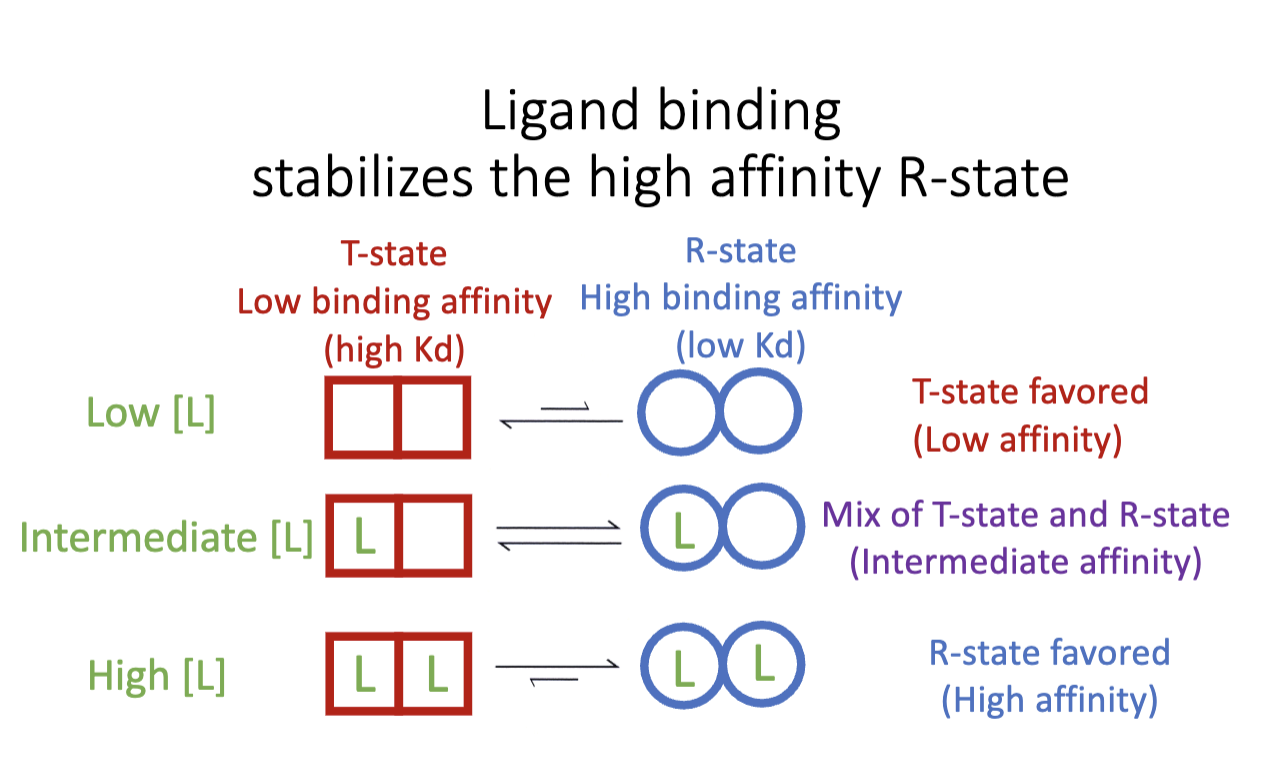
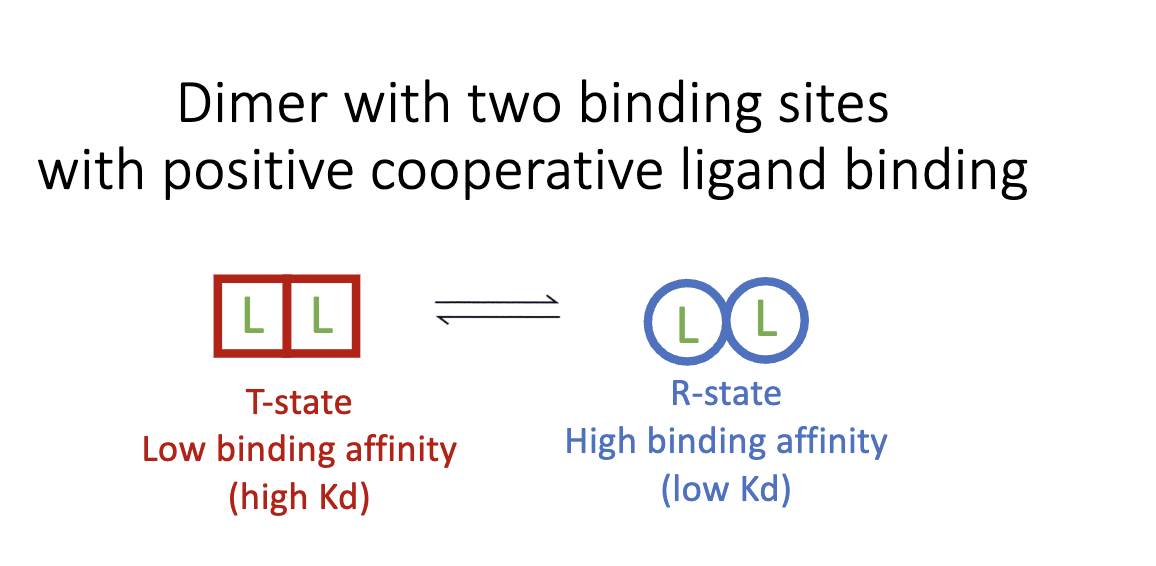
As an example, let's consider a protein dimer consisting of two subunits. The dimer can exist in a low affinity T state represented by the red squares or a high affinity R state represented by blue circles.
A dimer can have subunits both in the R state or both in the T state. A dimer can switch between the T state and R states, and there is an equilibrium between the two states. Each subunit has one binding site for the ligand L.

Stabilization of the R State by Ligand Binding
The key to understanding positive cooperative binding is that binding of the ligand lowers the free energy of the higher affinity R state, which leads to stabilization of the R state.
This means that the R state becomes more populated at equilibrium, at increased concentrations of ligand
in the absence of ligand or in the presence of low concentrations of lag in the low affinity T state will be favored. Favourability of the T state over the R state can be indicated by an arrow pointing towards the T state that is longer than the arrow pointing towards the R state. The fractional saturation of the ligand binding sites will be relatively low.
At high ligand concentrations the high affinity R state will be favored. Favourability of the R state over T state can be indicated by an arrow pointing towards the R state that is longer than the arrow pointing towards the T state. The fractional saturation of the ligand binding sites will be relatively high
at intermediate lag in concentrations there will be a mix of molecules in the T state and R state. The observed binding affinity and fractional saturation of a population of molecules at an intermediate concentration of ligand will be intermediate between the low affinity T state and the high affinity R state.
Stabilization of the R State by Ligand Binding 1
The key to understanding positive cooperative binding is that binding of the ligand lowers the free energy of the higher affinity R state, which leads to stabilization of the R state.
This means that the R state becomes more populated at equilibrium, at increased concentrations of ligand
Stabilization of the R State by Ligand Binding low
in the absence of ligand or in the presence of low concentrations of lag in the low affinity T state will be favored.
Favourability of the T state over the R state can be indicated by an arrow pointing towards the T state that is longer than the arrow pointing towards the R state.
The fractional saturation of the ligand binding sites will be relatively low.
Stabilization of the R State by Ligand Binding intermediate
at intermediate lag in concentrations there will be a mix of molecules in the T state and R state.
The observed binding affinity and fractional saturation of a population of molecules at an intermediate
concentration of ligand will be intermediate between the low affinity T state and the high affinity R state.
Stabilization of the R State by Ligand Binding high
At high ligand concentrations the high affinity R state will be favored.
Favourability of the R state over T state can be indicated by an arrow pointing towards the R state that is longer than the arrow pointing towards the T state.
The fractional saturation of the ligand binding sites will be relatively high
Visualizing Cooperative Binding with Panels
Panels are useful to visualize the ligand binding and conformational state of molecules in a population at different ligand concentrations
at low levels of ligand most of the molecules are in the T state. Most of the ligand binding sites do not have ligand bound, as shown in panel one
at intermediate levels of ligand concentration there is a mix of molecules in the R state and T state. In panel two half of the molecules are in the R state and half are in the T state, and exactly half of the potential ligand binding sites are bound by ligand.
At high levels of ligand most of the molecules are in R state and most of the ligand binding sites have a ligand bound, as shown in panel three.

Summary of Cooperative Ligand Binding
• Cooperative ligand binding involves two ligand binding sites
• Ligand binding with positive cooperativity is when affinity at the second binding site is higher than at the first site (Kd2<Kd1)
• Ligand binding stabilizes the high affinity R-state
• At low ligand concentrations, the low affinity T-state is more populated
• At high ligand concentrations, the high affinity R-state is more populated
• At intermediate ligand concentrations, there is a mix of molecules in the R-state and T-state and an intermediate affinity
Cooperative Ligand Binding
• The ligand binding at one binding site affects binding of a ligand at another binding site
• Depends on more than one binding site in a molecule or molecular complex
• Common when multiple protein chains each with binding sites for a ligand associated to form complexes
Ligand binding with positive cooperativity
affinity at the second binding site is higher than at the first site (Kd2<Kd1)
Cooperative ligand binding can be modeled as two states

Dimer with two binding sites with positive cooperative ligand binding
Ligand binding stabilizes the high affinity R-state