Plant Path Quiz #4
 Call Kai
 Learn
Learn Practice Test
 Spaced Repetition
 Match
Match Flashcards
 Knowt Play
1/44

There's no tags or description
Looks like no tags are added yet.
Name | Mastery | Learn | Test | Matching | Spaced | Call with Kai | Chat |
|---|
No analytics yet
Send a link to your students to track their progress
45 Terms
Ascomycota
Asci sac-like sporangia with 8 sexual spores inside
sexual spores are called ascospores
can also make asexual spores
most have septate hyphae
ascus singular term
may have two different scientific names
Basidiomycota
basidia club-shaped sporangia holding four sexual spores
sexual spores are called basidiospores
they also contain structures on the hyphae called clamp connections
basidium singular term
Ascomycetes produce…
a sack-like ascus (pl. asci) that contains eight ascospores
Ascospores are produced by meiosis and are each 1n
Ascomycete lifecycle
Ascomycete lifecycle includes both sexual and asexual cycles and the haploid (n) stage dominates.

Ascocarps
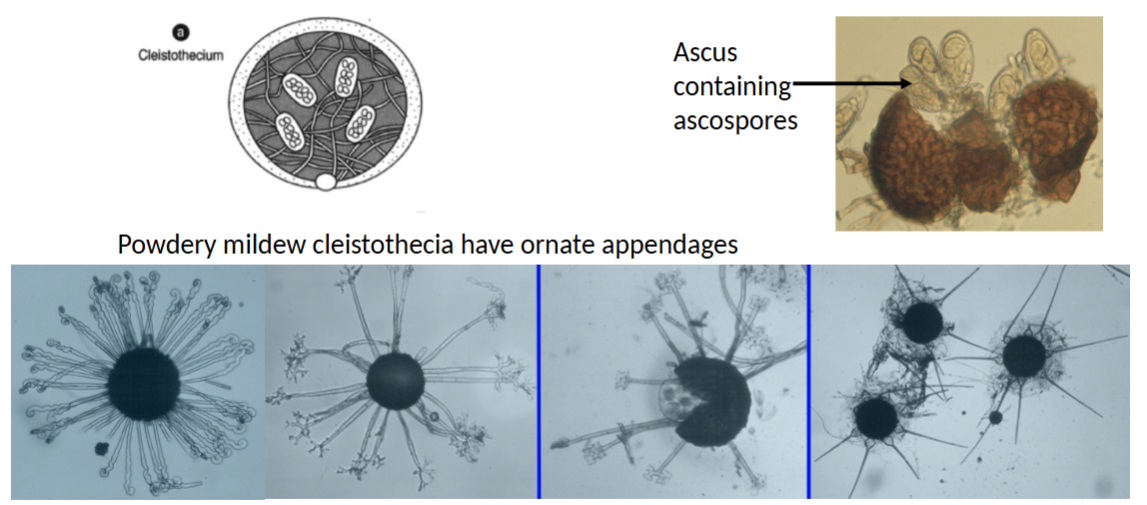
sexual reproductive structures of ascomycetes, including cleistothecia (chasmothecia), perithecia, and apothecia

Cleistothecia (chasmothecia)
A closed, globose fruiting structures containing asci inside.
Perithecia
Pear-shaped fruiting bodies with asci inside

Apothecia
Small cup-shaped fruiting bodies made up of tightly woven hyphae and asci.

Conidiophores
Conidiophores are aerial hyphae that produce conidia, the asexual spores of ascomycetes.
Conidia: 1n haploid spores produced by mitotic cell division
Basidiomycota lifecycle has a dominant…
dikaryotic stage and does not include an asexual cycle.

Basidiomycete clamp connections
needed for each cell to be bi-nucleate as the hyphae elongate.

All vegetative hyphae and visible structures are…
dikaryotic (n+n) and sexual recombination occurs in the gills
Hyphal fusion forms…
dikaryotic hyphae, followed by nuclear fusion and meiosis to form haploid basidiospores.
Anamorph
The asexual reproductive form in the life cycle of any fungus, whereas the teleomorph is the sexual reproductive form in the life cycle
Because some fungi have two forms that were discovered at
different times, they have an ________ name
anamorphic and teleomorphic
Fusarium graminearum is the ________ and Gibberella zeae
is the ________
Fusarium graminearum is the anamorph and Gibberella zeae
is the teleomorph
Ascomycota are predominantly ________ and can undergo ________, whereas Basidiomycota have a long ________
Ascomycota are predominantly haploid and can undergo asexual
reproduction, whereas Basidiomycota have a long dikaryotic phase
Fusarium
Ascomycota
Fusarium is a large genus of filamentous fungi, widely distributed in soil and associated with plants
Many Fusarium species produce ________
mycotoxins, which are any toxic substance produce by a fungus
These chemicals may operate in nature to disable plant defense mechanisms or to defend the fungus against other microorganisms
Mycotoxins
Only produced by certain fungi and under specific conditions (temperature and moisture).
Cryptic species
Cryptic species are species that are difficult to distinguish based on morphology but can be identified by their DNA sequences and sometimes hosts
often make up a species complex: a group of closely related organisms
that are so similar in appearance and other features that it’s hard to distinguish them apart.
The term “Forma specialis” denotes…
taxonomic groups with a specialized host (range) within a fungal species
A race is defined as…
a population (within a species) of which all individuals carry the same combination of virulence gene
Fusarium head blight (FHB)
Caused by Fusarium graminearum is an important disease globally, and produces a mycotoxin
FHB occurs in small grains (wheat, barley, and oats) and corn
F. graminearum (anamorph) only produces macroconidia
Gibberella Zeae (telemorph) produces ascospores
Hemi-biotroph
Deoxynivalenol (DON)
Has stringent allowable concentrations in food for humans and animals
DON
Disrupts normal cell function by inhibiting protein synthesis and will cause symptoms of nausea, fever, headaches, and vomiting
FHB
FHB inoculum includes macroconidia (clustered together to form
sporodochia) and ascospores produced in perithecia

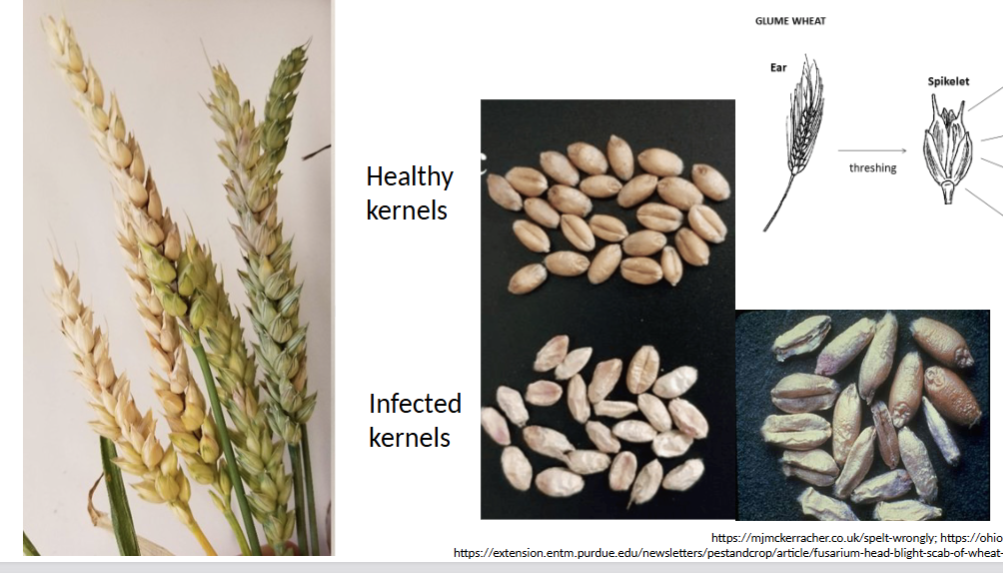
Symptoms of FHB
premature bleaching of the cereal head (ear) and shriveled and discolored kernels
Fungi that are heterothallic require
A compatible partner for sexual reproduction, but homothallic fungi are self-fertile and can
sexually reproduce without a partner

Most of the isolates of F. graminearum are…
Homothallic, meaning they are self-fertile and can sexually reproduce without a partner
FHB Management practices
preventative fungicide application, using partially resistant cereal varieties, biological
controls, cultural practices like crop rotation, and RNAi
FHB is well suited for disease forecasting because…
Its narrow time periods of pathogen sporulation, spore dispersal, and host infection that contribute to epidemic development
Rice blast
Caused by Magnaporthe oryzae is a devastating disease of rice
Annual 30% global loss,equivalent to 60 million people.
M. oryzae has a broad host range in Poaceae, but individual isolates are host-
limited.Hemi-biotroph

Rice blast disease cycle

Rice blast steps to infection
Steps to infection: Adhesion of conidium to plant cell using mucilage
The conidium germinates and starts to form an appressorium
based on chemotaxes of cutin extractsThe appressorium has a melanin layer that enables it to build
up immense turgor pressor, leading to the penetration peg,
which punctures through the plant cell wallThe fungus secretes molecules that
inhibit plant detection and defense in
the biotrophic stage, and then toxins
during the necrotrophic stage

Rice blast management
Rice blast management includes destroying infested crop
residue before and during the growth cycle, planting resistant
or tolerant varieties, and applying a preventative fungicide
Verticillium wilt (Verticillium dahliae)
Colonizes the xylem of many plant hosts
Causes disease on over 300 plant species
Nightshade family (solanaceous plants), cucurbits, mint, and strawberry
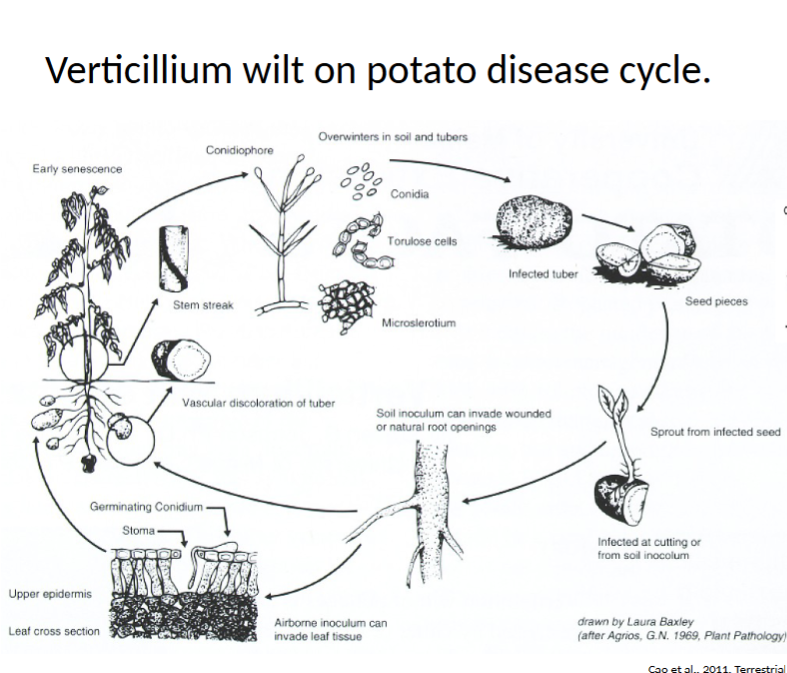
Initial symptom is yellowing of bottom leaves, v-shaped lesions, wilting,
and discoloration of the vascular tissue and tubers (potatoes)Hemi-biotroph

Verticillium disease cycle
Management practices for verticillium wilt
Management practices for verticillium wilt include sanitation, managing weeds that could be alternative hosts, managing the soil (e.g., solarization), and crop rotation with grasses
Sclerotinia sclerotiorum
a ubiquitous necrotroph globally
Causes disease on over 400 plant species except for grasses
Bleaching and lodging (falling over) of plants
White fluffy mycelium and black rock-like sclerotia
Sclerotia are the primary sources of inoculum and can either germinate into ascocarps which produce ascospores or hyphae

Stemphylium leaf blight
(Stemphylium vesicarium) is a re-emergent disease of onions

Taphrina spp.
biotrophic and have naked asci
Disease cycle of peach leaf curl (T. deformans) and plum pocket (T. communis)

Monilinia vaccinii-corymbosi
is a biotroph that attracts insect vectors via floral mimicry
Pollinators are tricked into landing on infected leaves by their
change in color and composition of volatile organic compounds
Pseudoflowers
Form in yellow-eyed grass infected with Fusarium xyrophilum