CHEM 51C Chap 20-21
 Call Kai
 Learn
 Practice Test
 Spaced Repetition
 Match
 Flashcards
 Knowt Play
1/31

There's no tags or description
Looks like no tags are added yet.
32 Terms
Electrophilic Addition Reaction: Acyl Substitution
Type 2 Carbonyl + 1) CH3MgBr 2) H2O
-Makes a single bonded alcohol

Acid Chloride Synthesis:
Carboxylic + SOCL2
-makes acid chloride + SO2 + HCL


Anhydride Synthesis:
Acid Chloride + Carboxylate ion
-Makes Anhydride + Cl-
-Addition reaction

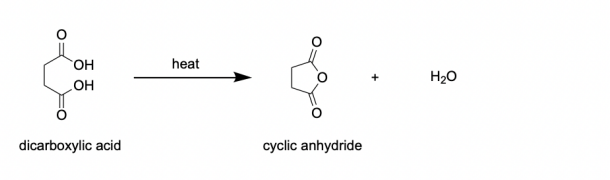
Anhydride Synthesis:
Dicarboxylic Acid + Heat
-makes cyclic anhydride +H2O
Carboxylic Acid Synthesis:
Acid Chloride + H2O + pyridine
-makes carboxylic acid + pyridine with H bond + Cl-


Carboxylic Acid:
Anhydride + H2O
-makes carboxylic acids


Carboxylic Acid Synthesis:
Acid-Catalyzed Hydrolysis of Ester
Ester + H2O + H3O+ (catalytic)
-Makes Carboxylic Acid + HOCH3


Carboxylic Acid Synthesis:
Base-Catalyzed Hydrolysis of Ester
Ester + H2O + OH- (catalytic) then add H3O+
-2 steps
-makes carboxylate first then if wanting to make carboxylic acid, add H3O+

Carboxylate Synthesis:
Ester + H2O + OH-
-carboxylate + HOCH3
Carboxylic Acid Synthesis:
Amide + H3O+
-makes carboxylic acid and ammonium ion
Amide + H2O +OH-
-Makes carboxylate + amine


Ester Production:
Acid Chloride + HOCH3 + Pyridine
-makes an ester + Pyridine-H+ + Cl-

Ester Production:
Anhydride + Alcohol
-Makes an ester + carboxylic acid

Fisher Esterification:
Carboxylic Acid + HOCH3, H2SO4
-ester + H2O

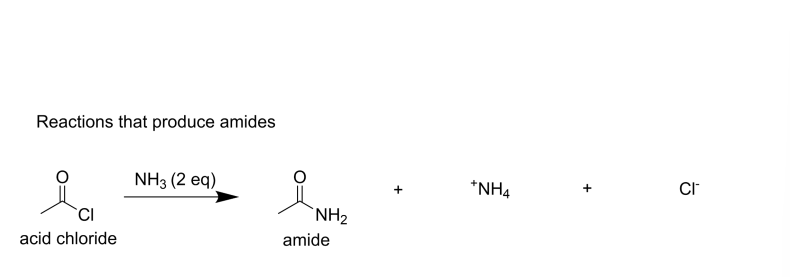
Amide Production:
Acid Chloride + NH3 (2 eq)
-Makes an Amide + NH4+ + Cl-
Amide Production:
Anhydride + NH3 (2 eq)
-Makes amide + carboxylate + NH4+

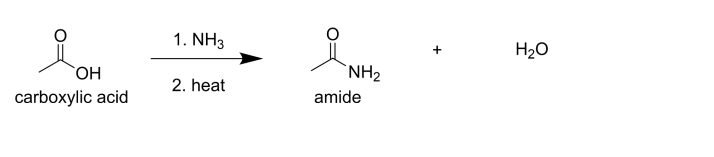
Amide Production:
Carboxylic Acid + 1)NH3 2) Heat
-Makes an amide + H2O
Amide Production:
Ester + NH3
-makes an amide + HOCH3

Acyl Substitution Reaction:
Rate of Reaction Depends on Two Factors
1) The stability of the carbonyl carbon derivative
2) The leaving group ability of leaving
-makes a tetrahedral intermediate with an O-

Stability of the Carboxylic Acid Derivative
AFFECTS RATE OF ADDITION (Step 1)
-The least stable will be the most reactive
-The stability is dependent on the concentration of positive charge on the carbonyl carbon
-ex: acid chloride has a strong inductive which destabilizes and weak resonance (least stable and most reactive)

The leaving group ability of the Leaving group
AFFECTS RATE OF ELIMINATION (Step 2)
-best leaving groups are weak bases

Energy levels
-less stable means more energy

Acid Chloride + CH3NH2 (2 equivalence)
-makes an amide
-Why is extra equivalent of amine is needed:
CH3NH2 will be protonated in this reaction. CH3NH3+ is not nucleophile
Reaction will stop at 50% conversion if only one equivalent of amine is used

Anhydride + NH3 (2 equivalents)
-makes an amide and carboxylate

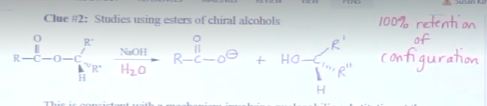
Ester + NaOH
-makes a carboxylate
-100% retention of configuration

Transesterification (Esters to Esters):
Ester + CH3CH2OH + TsOH + heat
-Transforms ester to ester
-Lowers the steric hindrance of the ester

Aminolysis (Esters to Amides):
Ester + CH3CH2CH2NH2 (excess)
-makes an amide

Carboxylate Synthesis:
Carboxylic Acid + NH3
-makes a carboxylate + NH4

Acid Catalyzed Esterification:
Carboxylic Acid + CH3OH (alcohol) + H3O+
-makes an ester and H3O+

Conversion of Carboxylic Acids into Acid Chlorides:
Carboxylic Acid + SOCL2
-2 Steps
1) Convert OH to a good leaving group
2) Adds Cl

Conversion of Carboxylic Acids into Acid Bromides:
Carboxylic Acid + PBr3
Example from Previous Exam:
Carboxylic Acid + 1)SOCl2 2) NH2CH3 (2 equivs) OR NH2CH3 and pyridine
-Converts carboxylic acid to amide