7.1 Taphonomic Processes
 Call Kai
 Learn
 Practice Test
 Spaced Repetition
 Match
 Flashcards
 Knowt Play
1/13

There's no tags or description
Looks like no tags are added yet.
14 Terms
What is taphonomy
the study of process of preservation (in fossils) by ways in which material moves through the biosphere into the lithosphere and how they affect information in fossil record
it is critical to recostruct anatomy and ecology of fossil record
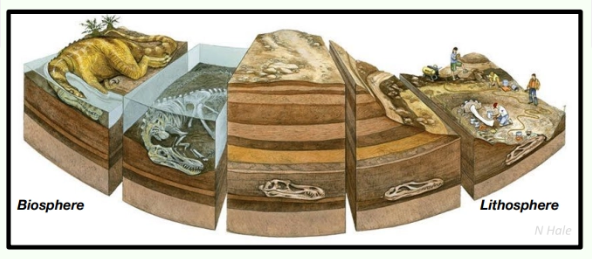
Describe the taphonomical processes from a living organism to the fossil record
necrotic processes (immediate burial)
OR
biostratinomy (delayed burial and biological reworking)
THEN
diagenesis

What are nectrotic processes
the death and decay of soft tissues
What is biostratinomy
the physical, chemical and biological changes occurring before burial, e.g.:
breakage, transport, disarticulation
What is diagenesis
organisms being changed by post burial changes, e.g.:
flattening, dissolution
List the taphonomic processes
disarticulation
seperation
fragmentation
breakage
abrasion
from movement
bioerosion
boring and burrowing
corrosion and dissolution
tissue loss from acid
flattening
comapction
chemical diagenesis
post-depositional chemical alteration
Describe how taphonomical process change over time
processes do not happen in isolation and often overlap over time scales ranging from minutes to millions of years
necrotic processes → biostratinomy → diagenesis → metamorphism

What are assemblages and assemblage fidelity
assemblage = concentation of fossils
fidelity = how well it represent life, how much information has been lost due to taphonomy processes

What are autochthonous assemblages
fossils preserved as they were in life from a particular moment, accurate picture of how other organisms lived together as it is a snapshot in obrution deposites
Ediacaran fossils = autochthonous

What are allohthonous assemblages
where fossils have been transported, sorted and reworked
shows time averaging so can show organisms which may not have coexisted in same place at the same time
Rhaetic Bone Bed = allochthonous


What can this orientation tell use about current type and direction
unimodal and imbricated = unidirectional flow like a river
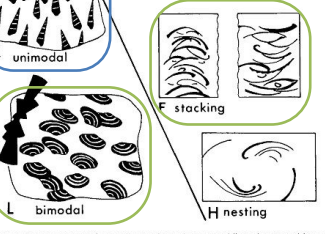
What can this orientation tell use about current type and direction
biomodal and stacked = oscillatory flow like wave action
How can we determine transport in assemblages
assemblage → less bivalve = more transport
fragmentation → more fragmentation = longe transport
packing/ sorting → all together ould suggest transported by water for dense packing
What is concetration and conservation Konzentrat-Lagerstätten deposits
concentration = exceptional concentrations of fossils e.g. bones and shells
Jurassic ammonites
Miocene Rhinos
conservation = exception preservation e.g. soft tissue
Cambrian Burgess Shale
Miocene amber