Muscle and Meat Structure
 Call Kai
 Learn
Learn Practice Test
 Spaced Repetition
 Match
Match Flashcards
 Knowt Play
1/68

Earn XP
Description and Tags
Dr. Hope stated that this was the hardest part of the entire class... ;)
Name | Mastery | Learn | Test | Matching | Spaced | Call with Kai | Chat |
|---|
No analytics yet
Send a link to your students to track their progress
69 Terms
What is “fresh” meat?
Meat that contains no added ingredients and is not frozen
Some consumers additionally want good color and short display times
This meat is quite perishable and has a very short shelf life even with refrigeration
What are red meat species?
Beef, swine, sheep, goat, and horse
What are white meat species?
Any meat from lighter-colored avian species
Locomotive muscle is (light/dark)
Light
White muscle — short periods of activity
Structural muscle is (light/dark)
Dark
Red muscle — long periods of sustained activity
(T/F) Poultry has only white meat
False
Although it contains both red and white, poultry overall is simply considered “white” meat
In nutritional studies, what do “red meat” and “white meat” often serve as surrogate descriptors for?
Fat composition
Red meat → more associated with saturated fat
White meat → more associated with unsaturated fat
What two components is an animal converted to during slaughter?
Carcass and non-carcass components
Non-carcass components can be divided into two portions:
Edible and inedible portions—offal
What is offal?
Inedible portions of non-carcass meat
Organs, skin, hides, blood, horns, head, etc
What are variety meats?
Edible offal
Liver, hearts, kidneys… organs or tissues that are deemed wholesome and sold as food for human consumption
What are byproducts?
Inedible offal
Feathers, poultry, blood, lungs… not sold at food for human consumption
Products derived from the carcass component and edible offal are referred to as ___
Meat
How is meat defined?
Consumable tissues from animals, Primarily:
Skeletal muscle + associated tissues
Edible offal (organs and non-skeletal tissues).
What are the 3 types of muscle?
Skeletal
Smooth
Cardiac

Where is the epimysium located?
A
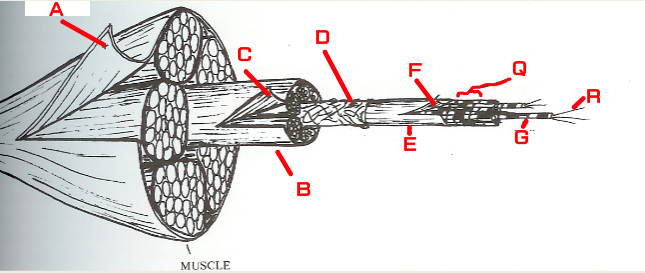
Where is the perimysium located?
C
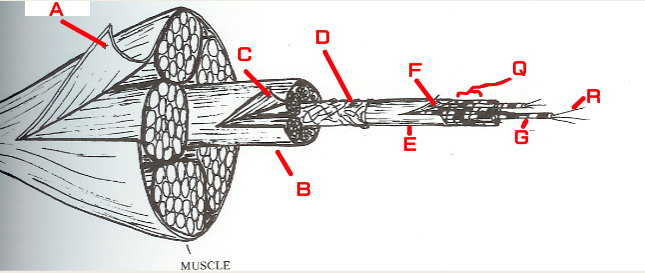
Where is the endomysium located?
D

Where is the sarcolemma located?
F

Where is the muscle bundle located?
B

Where is the muscle fiber located?
E
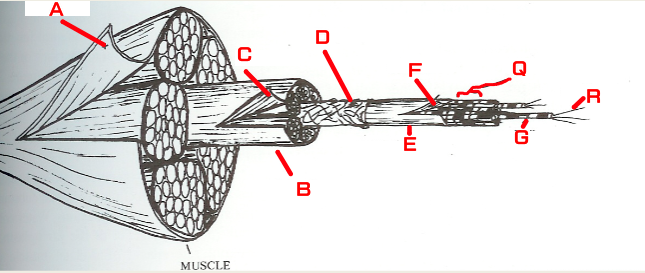
Where is the myofibril located?
G
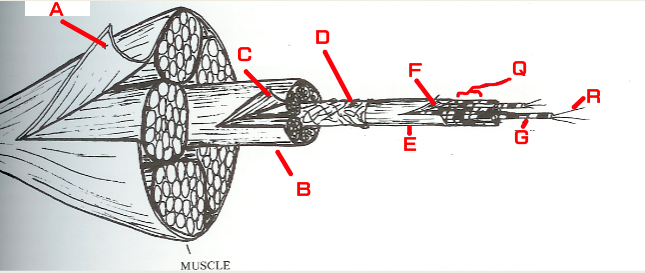
Where is the sacromere located?
Q
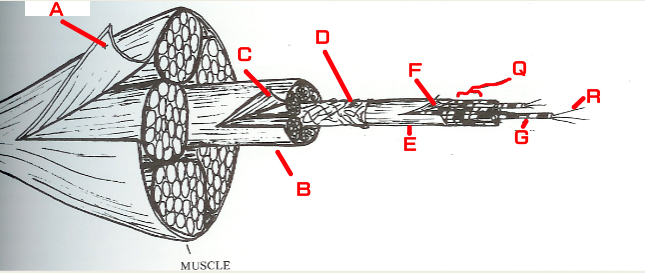
Where is myofilament located?
R
What are the characteristics of skeletal muscle?
Voluntary muscle, therefore under conscious control
Skeletal muscle cells are defined by a cell membrane (sarcolemma)
Multinucleated
Contains a group of arranged contractile proteins
What color are I-bands? What else is the I-band known as?
Light in color, also called the “light band”
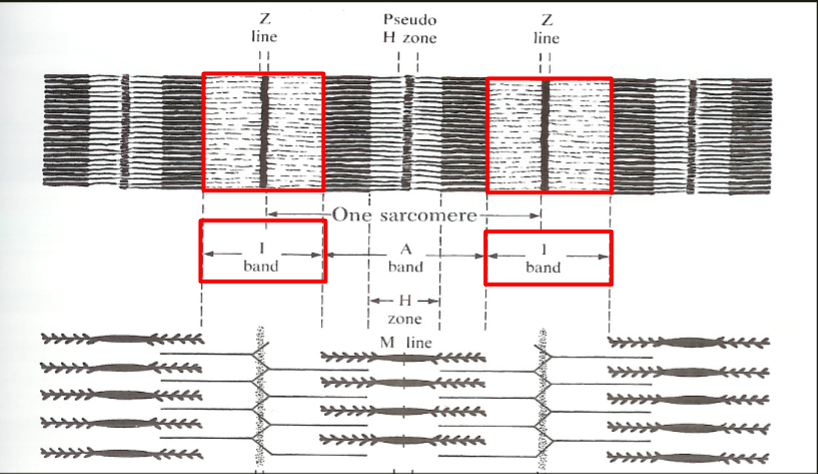
What color are A-bands? What else is the A-band known as?
Dark in color, also called the “dark band”

What causes the striations seen in skeletal muscle?
Alternating patterns of I and A-bands
What are Z-lines?
Also called Z-bands, bisectors of the I-bands

What is a sarcomere? What is it made up of?
The smallest contractile unit of muscle
Spans from one Z-line to Z-line
Contains 1 full A-band and 2 half I-bands

What two types of filaments do sarcomeres contain?
Thick filaments, composed of mostly myosin
Thin filaments, composed of mostly actin

Which filament is the most abundant (by mass)?
Myosin
Myosin and Actin are known as ____ proteins
Contractile
Troponin and Trypomyosin are known as ___ proteins
Regulatory
(T/F) Individuals filaments change length during muscle contraction.
False
Thin filaments slide over thick filaments to shorten the sarcomere—there is no change in length to the filaments themselves
What is Titin?
The largest protein found in a sarcomere
Part of its cytoskeleton
Think Titan
What part of the myosin head allows it to participate in muscle contraction?
ATP-binding site
What are the two forms of actin?
G-actin and F-actin
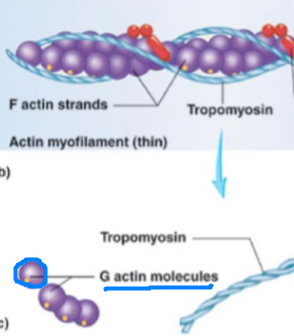
What is G-actin?
individual, free actin protein molecules
Aka, the singular bead
What is F-actin?
many G-actin molecules polymerized together into a long filament
Aka, the string of beads
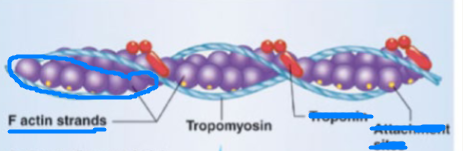
How many G-actin molecules are associated with one tropomyosin molecule?
7
What are thin filaments attached to?
The Z-line
What is the neuromuscular junction?
Where motor axons terminate, causing innervation of the skeletal muscle cells
The place where the nervous system tells the muscle to contract

What is a motor unit?
The neuron and the fibers it supplies
Neurons can innervate one to hundreds of muscle cells
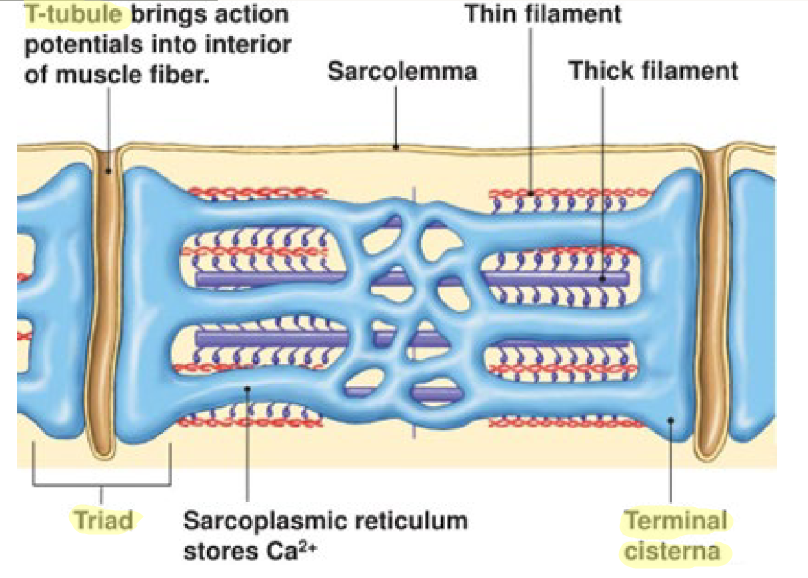
What is the sarcoplasmic reticulum?
The specialized endoplasmic reticulum of a muscle cell
Stores and releases calcium ions, which are necessary for contraction to take place
What structures does the sarcoplasmic reticulum contain?
A triad: one t-tibule and 2 terminal cisterna

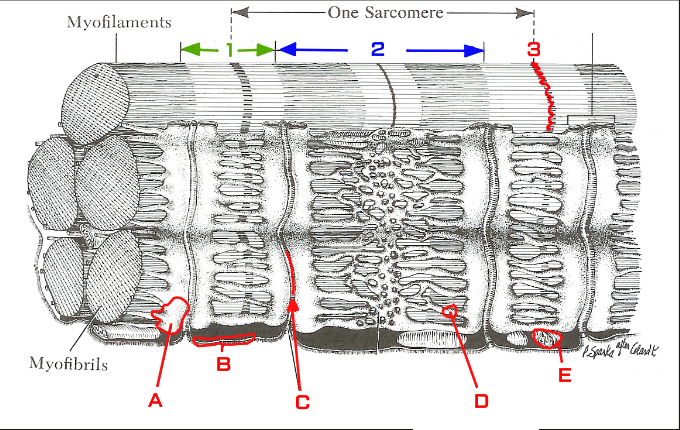
What is 1 referring to?
The I-Band
Its light!
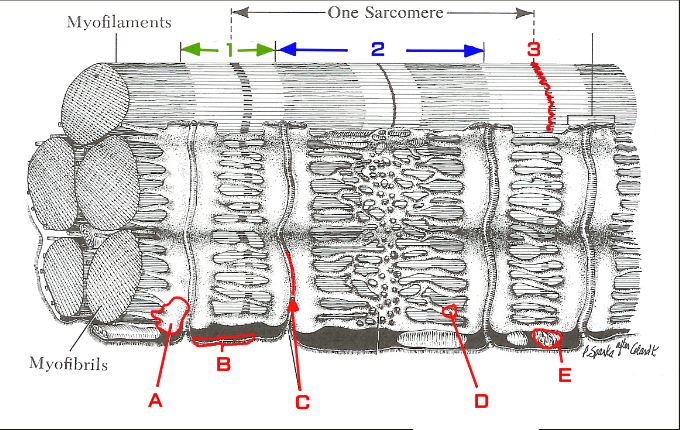
What is 2 referring to?
The A-band
Its dark!

What is 3 referring to?
The Z-line
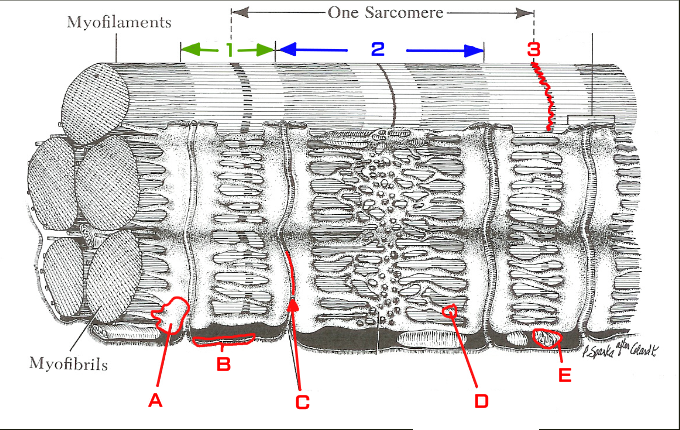
What is structure A?
Terminal cisterna

What is structure B?
Sarcolemma
Referring to the outer “shell”

What is structure C?
Transverse-tubule
T-tubule

What is structure D?
Longitudinal tubule

What is structure E?
Mitochondria
What are the four isoforms of myosin?
Type I
Slow oxidative (SO)
Type IIA
Fast oxidative (FO)
Type IIX
Fast glycolytic (FG)
Type IIB
Ditto, FG
What kind of contraction speed does Myosin’s Type I have? Type II? What are the relative sizes of their mitchondria?
Type I — slow
Large
Type II — fast
Small
Type IIA larger than IIB & IIX
What color are Myosin’s Type I and IIA? What kind of metabolism do they use?
Red, oxidative
What color are Myosin’s Type IIX and IIB? What kind of metabolism do they use?
White, glycolytic
What type of myosin fibers to cattle not have?
Type IIB
What are the characteristics of smooth muscle?
Specialized for slow and sustained contractions
Single centrally located nuclei
Involuntary
Ducts, digestive tract, veins, arteries, etc

What are the characteristics of cardiac muscle?
Strong, continuous contractions
Involuntary
Appears striated due to the arrangement of contractile proteins
Joined end to end via intercalated discs; anchors
Heart

Which protein is the most abundant throughout the body?
Collagen
Myosin is the most abundant protein in ______ while Collagen is the most abundant protein in ____
Muscle, the body
What does Collagen influence in meat?
Quality, primarily tenderness
Are the crosslinks in collagen stronger or weaker in young animals?
Weaker
Easily broken; explains why meat from younger animals is more tender
What allows an animal to pick up its head?
The ligamentum nuchae / nuchal ligament
As an muscle grows, there are primary and secondary perimysium levels. What does this impact?
Tenderness
Where is intramuscular fat deposited?
In the perimysium
Where is intermuscular fat deposited?
In the epimysium