Division: Mastigomycota
 Call Kai
 Learn
 Practice Test
 Spaced Repetition
 Match
 Flashcards
 Knowt Play
1/62

Earn XP
Description and Tags
for more on the Plasmodiophora refer back to the ppt
Name | Mastery | Learn | Test | Matching | Spaced | Call with Kai | Chat |
|---|
No analytics yet
Send a link to your students to track their progress
63 Terms
Mastigomycota Characteristics
produce both uniflagellate or biflagellate zoospores
whiplash or tinsel flagellum
mostly aquatic and/or terrestrial
filaminentous and have coenonytic mycelium
unicellular form show pseudosepta
saprophytes or parasites
what are pseudosepta
false cross walls
all mastigomycota produce motile flagellate zoospores during
asexual reproduction
Sexual reproduction for mastigocycota is
isogamy or heterogamy and Oospore
Division : Mastigomycota is divided into
Haplomastigomycotina and Diplomastigocotina
Classification of Haplomastigomycotina
Chytridiomycetes
Hyphochytrimycetes
Plasmodiphoromyctes
Hyphochytrimycetes
anteriorly uniflagellate, aquatic fungi whose thallus is holocarpic ,and their vegatative systems is rhizoidal or hypa-like with intercalary swellings
Plasmodiphoromycetes
known as endo-parasitic slim molds. they are obligate parasites of freshwater algae, aquatic fungi, and higher plants. somatic body consists of necked holocarpic plasmodium
Chytridiomycetes
posteriorly uniflagellate zoospores they occur as saprobes on plants and animals remain in water while other members occur as parasites on algae and aquatic animals
classification of sub division : Chytridiomycetes
Chytridiales
Harpochytridiales
Blastchytridiales
Monoblepharidales
Order : Chytridiales
live as parasites or saprophytes
found in soil or aquatic environments
grow internally in algae or water mold
thallus is holocarpic or eucarpic
cell wal made of chitin
zoospores are spherical, posteriorly uniflagellate, and the flagellum is whiplash type
Sexual reproduction of Order : Chytridiales
by motile gametes released from gametangia
Synchytrium endobioticum
about 200 species worldwide
their vegetative consists of minute endobiotic holocarpic thallus.
do not develop any mycelium
produce summer sporangia haploid and winter sporangia diploid
zoospores attack the tubers
summer sporangia haploid
thin walls
winter sporangia diploid
thick walls
Reproduction in Synchytrium
both sexually and asexually , and the thallus transforms into holocarpic
Synchytrium endobioticum division
Mastigomycota
Synchytrium endobioticum Subdivison
Haplomastigomycotina
Synchytrium endobioticum Class
Chrytridiomycetes
Synchytrium endobioticum Order
Chytridiales
Synchytrium endobioticum Family
Synchytriaceae
what cause wart disease of potato
Synchytrium endobioticum
Pathology Synchytrium endobioticum
disease of potato
quarantine in effect in many countries to limit introduction
Biotrophic pathogen
causes hypertrophy of host
motile spores can function as zoospores
Synchytrium endobioticum has two different sporangia
winter sporangia - long lived stages
summer sporangia - short lived
Biotrophic pathogen
a lot of plant-pathogenic fungi establish a long-term feeding relationship with the living cells of their hosts, rather than killing the host cell as part of the infection proces.
Sexual Reproduction
2n
Asexual Reproduction
1n
why do zoospores migrate in soil water for a limited distance (50nm)
because they are short-lived and must encyst and infect susceptible host tissue within 1-2hr after their formation
After infection by zoospores
host cells enlarge and haploid sori form inside the host cells while neighboring hots cells begin to proliferate , resulting in the characteristics.
each sours contain
one to nine summer sporangia
rapidly repeating secondary disease cycles results in
an extensive invasion of host cells and rapid onset of gall formation
young galls
a nutrients sink and expand rapidly at the expense of other plant tissue
Favorable conditions of Synchytrium endobioticum
warm temperatures with enough humidity
winter sporangia can remain viable for up to 20-30 years
survive at depths of 50 cm in the soil
Control of Warts
largely on the breeding of resistance varieties of potato
Snowdrops
immune from the disease and could be planted on land heavily infected without developing warts
Plasmodiophora division.
Mastigomycota.
Plasmodiophora Subdivision.
Haplomastidomycotina.
Plasmodiophora class
plasmodiophoromycetes
Plasmodiophora order
Plasmodiophorales
Plasmodiophora Family
plasmodiophorceae
Club roots
caused by Plasmodiophora brassicae
club root disease found in
cabbage, cauliflower, turnip, and radish
Plasmodiophora characteristics
obligate endoparasites of aquatic and terrestrial plants, algae and fungi. causes both hypertrophy and / or hyperplasia
Hypertrophy
enlargement of host cells
hyperplasia
abnormal multiplication of cells

A
Posteriorly uniflagellate zoospores. (whiplash flagella)

B
Anteriorly uniflagellate zoospores. (tinsel flagella)

C
Anteriorly biflagellate zoospores. (whiplash and tinsel flagellum)

D
Laterally biflagellate zoospores. ( tinsel upwards and whiplash downwards)

E
Laterally biflagellate zoospores. (both whiplash)

Synchytrium endobioticum causes wart disease of potato

Sexual reproduction

Asexual reproduction

cells undergoing isogamy, plasmogamy, and karyogamy

resting spore in a wart of a potato

zoosporangium

Plasmodiophora brassicae

A
In the root

B
In the soil
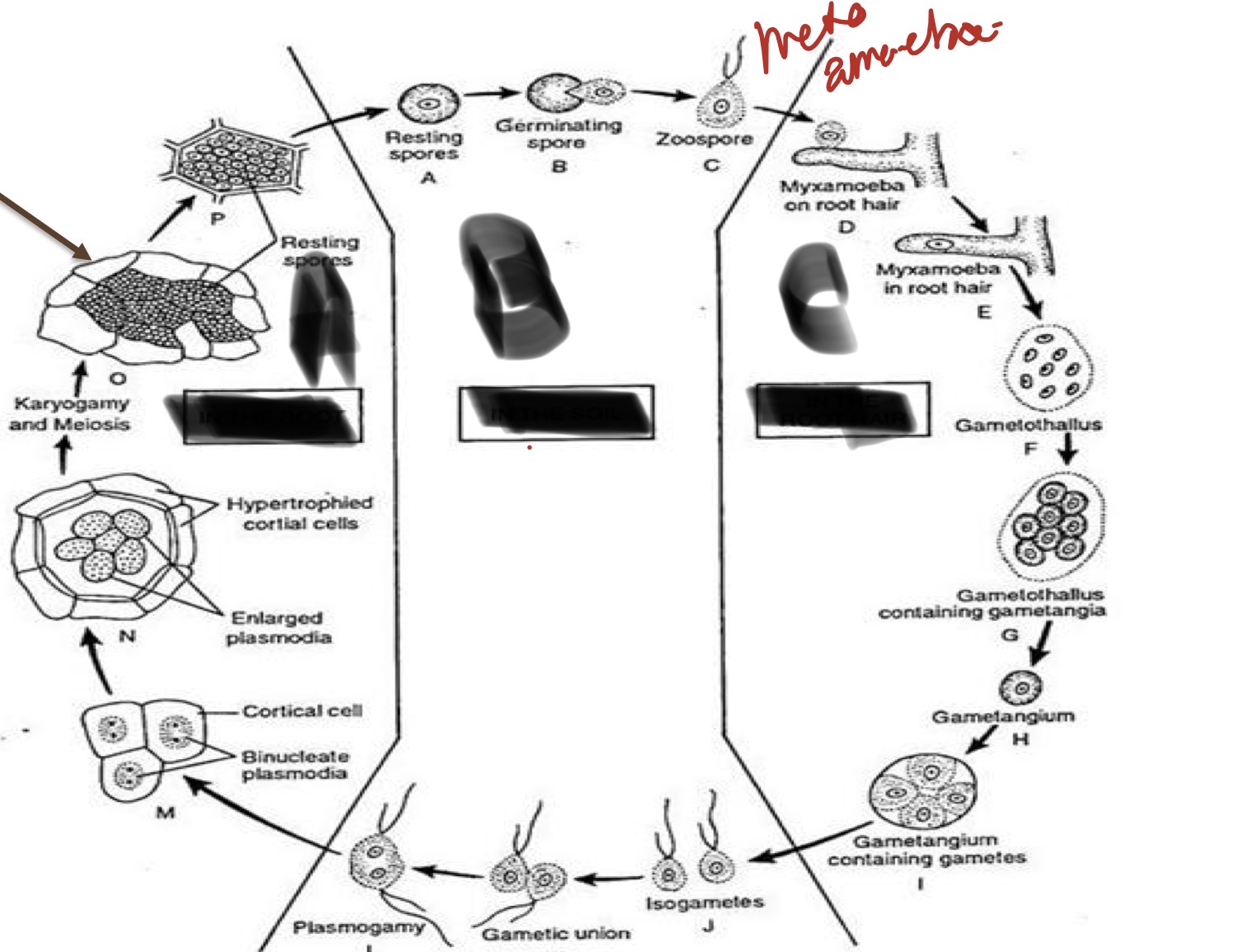
C
In the root hair

the life cycle of a Plasmodiophora
Holocarpic
denoting a fungus in which the entire thallus is differentiated into a reproductive sporangium when mature
Eucarpic
denoting a fungus in which the thallus is differentiated into vegetative and reproductive regions