Liquidity Sweeps
 Call Kai
 Learn
 Practice Test
 Spaced Repetition
 Match
 Flashcards
 Knowt Play
1/3

There's no tags or description
Looks like no tags are added yet.
4 Terms
What is a liquidity sweep?
A liquidity sweep is a market phenomenon where significant players, such as institutional traders, deliberately drive prices through key levels to trigger clusters of pending buy or sell orders.
Occurs when large institutions or market participants execute large orders, triggering pending buy or sell orders at levels of liquidity.
The goal of a liquidity sweep is to create the necessary liquidity for these large market participants to enter or exit positions with minimal slippage. Once these pending orders are triggered, the market often reverses direction, creating rapid price movements.


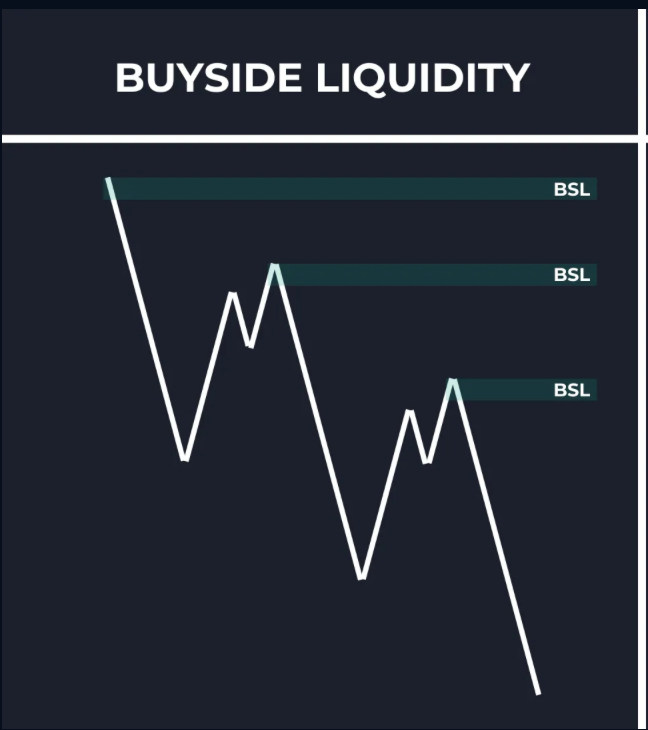
Buy side liquidity. (BSL)
BSL refers to the levels on the chart where short sellers have their stop losses set.
These levels are typically found at highs/lows of ranges and are seen as areas where traders exit losing positions.

Sellside liquidity. (SSL)
The levels where traders who are long have their stop losses.
These levels are typically found at highs/lows of ranges and are seen as areas where traders exit losing positions.

The difference between liquidity sweeps and grabs.
With a liquidity sweep, price goes above or below a level of liquidity and then comes back up. Price can consolidate above or below the level for a while though and it will still be considered a liquidity sweep once it trades back above or below the liquidity level.
Liquidity grabs occur in just one candle stick. A candle will go above or below the liquidity level and quickly shoot back up. This type of candle will have a large wick and a small body, similar to the ‘Dragonfly Doji’ or ‘Gravestone Doji’ candle. For bullish liquidity grabs, or grabs at sellside liquidity, the large wick indicates a lot of buyers stepped into the market. For bearish liquidity grabs, or grabs at buyside liquidity, the long wick indicates a lot of sellers stepped into the market.
