Chpt 6: Ballistic Skills
 Call Kai
 Learn
 Practice Test
 Spaced Repetition
 Match
 Flashcards
 Knowt Play
1/39

There's no tags or description
Looks like no tags are added yet.
40 Terms
What is a Ballistic Skill?
A skill where a performer applies force to an object to project it
E.g., throwing, kicking, & striking
What are the 3 forms of Throwing?
Underhand (one/two hands)
Side arm
Overarm (one/two hands)
List the 2 Assessments associated with Throwing
Product measures (outcome): accuracy, distance, & ball velocity
Process mechanisms (movement pattern): developmental sequence
Open kinetic chain
What are the 3 prominent characteristics of Early Overarm Throwing?
Throw involves mostly arm movement (ONLY the arm)
Elbow is pointed up
Throw is executed by elbow extension alone (no rotation, stepping, etc.)
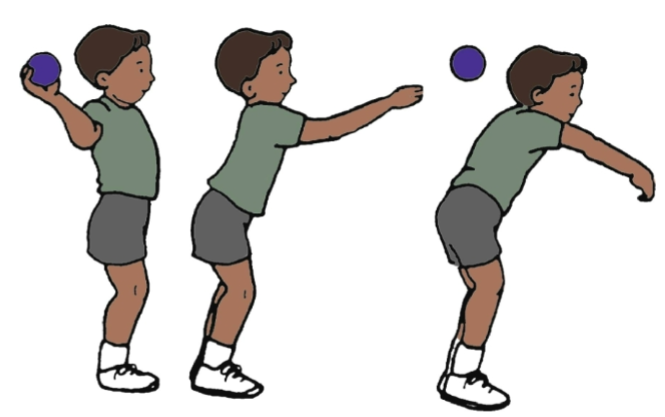
Identify the 4 major characteristics of Proficient Overarm Throwing (Force Production)
Thrower uses preparatory windup (weight shifts & trunk rotates back; arm swings)
Thrower uses opposite leg, long step, & differentiated trunk rotation
Hips are turned, but the rest of the upper body/arm is still in the previous plane
Upper arm and forearm lag
Movements are sequential to transfer momentum
Open kinetic chain

What are Validated Developmental Sequences?
Sequences of advances in the performance of a skill
They fall in the same fixed order for all individuals
Sequences have been confirmed by a longitudinal study
Trunk Action (3) - Developmental Changes in Overarm Throwing
None (no forward or backward movements)
Block rotation (torso follows the same direction)
Differentiated rotation (torso moves in the opposite direction)
Backswing (4) - Developmental Changes in Overarm Throwing
None
Shoulder (only occurs at the level of the shoulder)
Upward backswing (a little bit of lag, but the action remains up)
Downward, circular backswing (starts down & behind rather then up)

Upper arm action (3) - Developmental Changes in Overarm Throwing
Oblique
Aligned but independent
Lagging (hand follows the arm)
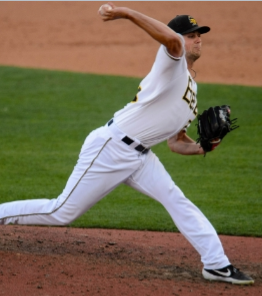
Forearm action (3) - Developmental Changes in Overarm Throwing
No lag
Lag
Delayed lag (further exaggerated)
Foot action (4) - Developmental Changes in Overarm Throwing
No step
Homolateral step (same leg & arm)
Short contralateral step (leg & opposite arm)
Long contralateral step

Developmental Changes in Overarm Throwing: Childhood (4)
Throwers do not achieve same step for each body component at same time
Some step combinations are observed more frequently than others
Not everyone reaches the highest step in each component
Those who participate in overarm sports at a young age
Developmental Changes in Overarm Throwing: Adulthood/Aging (5)
Older adults demonstrate moderately advanced steps
Differences observed between sexes
Ball velocities are moderate in older adults (at the 8 or 9 year old level)
Musculoskeletal constraints might influence movement pattern used. Loss of ROM & slower arm speed
Change is slow, involves decline (& more variability) in performance but is still highly trainable
How might movement change when Throwing for Accuracy?
Throwers may use lower developmental steps for accuracy throws than for forceful throws
When required to throw a greater distance, differences between throws are minimal (more focus on force production)

Define Kicking
When a player strikes a ball with their foot
Kicker must have perceptual abilities & eye-foot coordination to make contact (kicking a moving ball is difficult for children)

What are the major characteristics of Early Kicking? (2)
No step is taken with nonkicking leg
Kicking leg pushes forward
What are the major characteristics of Intermediate Kicking? (3)
Introduction of a run-up
Non-kicking leg still behind the ball (should be beside)
Foot is no longer facing forward, now pointed to the side (allowing for a larger surface area)
What are the major characteristics of Proficient Kicking? (5)
Preparatory windup is used (trunk is rotated back, kicking leg cocked, & knee bent)
Trunk rotates forward
Movement is sequential: thigh rotates forward, the lower leg extends
Arms move in opposition to legs
Non-kicking foot is anchored right beside the ball (rather than behind)
T or F; the study of kicking in children has been extensive
False; movement pattern changes are not well documented
List the 4 key Observing Kicking Patterns as a Teacher/Coach
Placement of support feet/foot
ROM & extension of kicking leg
Range of trunk motion
Arm opposition
Define Punting
The ball is dropped from the hands and kicked
List the 5 characteristics associated with Early Punting
Ball is tossed up rather than dropped
Punter often contacts the ball with toes rather than the inside of the foot
Short step
Arms drop to sides
Kicking knee flexed at contact
List the 5 characteristics of Proficient Punting
Arms are extended to drop ball before final stride (to align ball with foot)
Arms then drop to side and move in opposition to legs
Punter leaps onto supporting leg & swings punting leg vigorously up to make contact
Punting leg is kept straight; toes are pointed
Ball dropped early
Ball Release Phase (4) — Development changes in Punting
Upward toss
Late drop from chest height
Late drop from waist height
Early drop from chest height
Ball Contact phase (arms) (3) — Development changes in Punting
Arms drop
Arm abduction
Arm opposition
Ball Contact phase (leg) (3) — Development changes in Punting
No step or short step, ankle flexed
Long step, ankle extended (toes pointed)
Leap and hop

What is the scientific term for a tool used in sports (baseball bat/glove, racket, etc.)?
Implement
Define Striking
Using a body part (hand/foot) or an implement (bat, racket, etc.) to forcefully hit an object
Mechanical principles are similar for all striking tasks
List the 2 characteristics of Early Sidearm Striking
Chopping motion (more down than side —> elbow extension)
Little leg & trunk movement

List the 2 characteristics associated with Intermediate Sidearm Striking
More sideways motion implemented (straight sidearm movement rather than chopping)
Still little leg and trunk movement
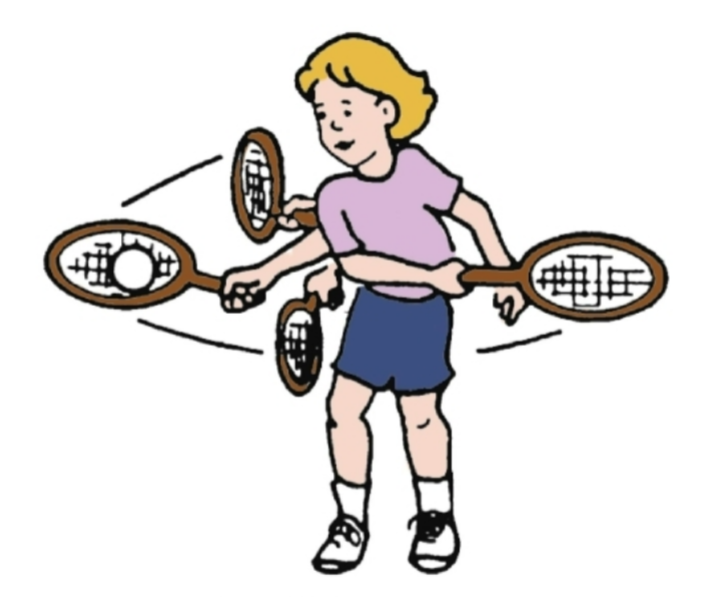
List the 5 characteristics of Proficient Sidearm Striking
Sideways preparatory stance and long step
Differentiated trunk rotation
Horizontal swing through large ROM (arms extended before contact)
Sequential movements
Similar to proficient baseball pitching, players will bring their arm down & back to start
List the 5 Developmental Changes in Sidearm Striking
Sequences for foot & trunk in overarm throw can be used
Trend is toward use of trunk rotation (none, then blocked, then differentiated
The plane of swing progresses from vertical to horizontal (advances may have low to high swing progression)
Grip changes from power grip to “shake-hands” grip
Elbows are held away from body and extended before contact
List the 4 characteristics of Early Overarm Striking
Trunk rotation is limited
Striker swings with collapsed elbow
There is little to no lag with swing forward
Movement looks like early throwing
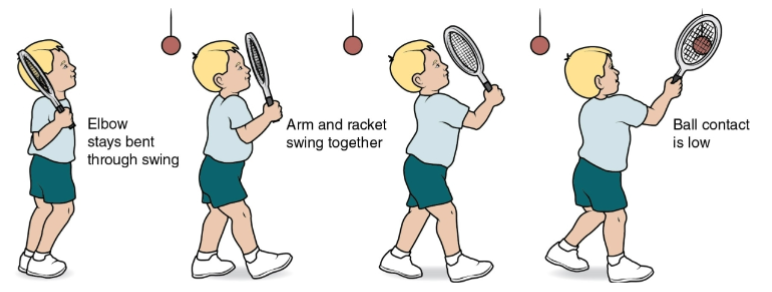
List the 4 characteristics of Proficient Overarm Striking
Lower & upper trunk are rotated more than 90o
Elbow is held between 90 & 119o at start of forward movement
Racket lags behind arm in forward swing
Movement is sequential

Trunk Movement (3) — Developmental Changes in Overarm Throwing
No trunk rotation
Minimal trunk rotation
Total trunk rotation
Elbow (3) — developmental Changes in Overarm Throwing
Very small or large angle
Intermediate angle (2-89o)
Ideal angle (>90o)
Spinal & Pelvic ROM (3) — Developmental Changes in Overarm Throwing
Rotation of less than 45o
Rotation between 45 & 89o
Rotation of 90o or more
Racket Action (3) — Developmental Changes in Overarm Throwing
No racket lag
Racket lag
Delayed racket lag
List the 3 Changes in Older Adults — Striking
Older golfers reach peak force earlier in swing
Older golfers may need to exert more force than young golfers for the same shot
Most older golfers were just as accurate as younger golfers
Why are Interventions important for Motor Skill Development (3)
Children benefit from instruction on fundamental motor skills
Childhood is an important time for developing proficiency
Importance of multi-sport children & athletes