BI210 Exam 2
 Call Kai
 Learn
Learn Practice Test
 Spaced Repetition
 Match
Match Flashcards
 Knowt Play
1/49

There's no tags or description
Looks like no tags are added yet.
Name | Mastery | Learn | Test | Matching | Spaced | Call with Kai | Chat |
|---|
No analytics yet
Send a link to your students to track their progress
50 Terms
The term “r-selection” refers to selection
for high population growth rates.
There are advantages and disadvantages to sexual reproduction. The low levels of genetic variation resulting from sexual reproduction may be beneficial in challenging environments.
False
Genetic divergence between populations over time can lead to speciation, the process by which one species splits into two or more species. Speciation requires the evolution of reproductive barriers between populations.
True
Which statement about the r–K continuum is true?
It involves an ecological trade-off.
Which organisms would be most likely to be K-selected?
Lions
Which of the following has resulted from commercial fishing for cod?
A reduction in the age and size at which fish become sexually mature
Which of the following cannot be an example of evolution?
After repeated exposure to high temperatures, an individual turtle can tolerate heat more successfully.
Tall people generally have tall parents, and short people tend to have short parents. Based on this observation, we can infer that height is
a heritable trait.
In cod fishing, older and larger fish are more likely to be retained in nets than younger and smaller fish. Despite the removal of these large breeders, the population is still reproducing. How do you think cod characteristics have changed due to the selection pressure from over-fishing?
Selection has led to decreases in the size of fish at the age of maturity.
Evergreen foliage would most likely be found in which of Grime’s categories of plants?
Stress-tolerant

Based on the graph, the largest mass extinction occurred about _______ million years ago.
250
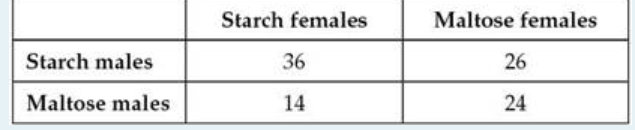
Suppose that, following the experiments by Dodd, Drosophila pseudoobscura are fed one of two diets (starch or maltose) for many generations. Once they have adapted to the new food sources, individual females from the starch treatment are given a choice between a male adapted to starch (a starch male), or a male adapted to maltose (a maltose male). When 50 females have chosen a mate, the experiment is repeated with females adapted to maltose. According to the results, what percentage of starch females chose maltose males?
28%
Although natural selection acts on individuals, an individual does not evolve – either it has a favored trait or it does not. Only populations evolve.
True
Suppose a population of shorthorn cattle has only two alleles (R and r) at a locus. If the frequency of R is 0.37, what is the frequency of r?
0.63
All plants and some algae have a complicated life cycle with both a multicellular diploid _______ stage and a multicellular haploid _______ stage. This type of life cycle is called _______.
sporophyte; gametophyte; alternation of generations
Which pair of evolutionary processes can introduce new alleles into a population?
Gene flow and mutation
Grasshoppers and crickets share many similar characteristics such as general body form, elongated hind wings (which they use for jumping), and particular wing structures. The simplest hypothesis that would explain the similarities between these insects is that they resulted from
shared ancestry.
Fitness
The genetic contribution of an organism’s descendants to future generations
Dispersal
The movement of organisms or propagules from their birthplace
Iteroparous
Having the capacity to reproduce multiple times in a lifetime
Isogamy
The production of equal-sized gametes
Direct development
A simple life cycle that goes directly from fertilized egg to juvenile without passing through a free-living larval stage
Allocation
The relative amounts of energy or resources that an organism devotes to different functions
Anisogamy
Production of two types of gametes of different sizes
Semelparous
Reproducing only once in a lifetimes
Which classification scheme or metric is generally most helpful for comparing life histories across broad ranges of size or taxonomy?
Charnov’s dimensionless ratio (c)
Which statement about the impacts of climate change on the snowshoe hare is true?
The number of days of camouflage mismatch has increased.
Which statement about Lack’s experiments on clutch size is true?
They demonstrated ecological trade-offs.
They showed that the life histories of birds vary depending on their geography.
(Both a and c)
Trophy hunting in bighorn sheep has had an inadvertent evolutionary consequence: the sheep have become _______ and their horns have become _______.
smaller; smaller
There is a trade-off between offspring size and number, such that organisms tend to produce large numbers of relatively small offspring or small numbers of relatively large offspring.
True
Which process can produce new combinations of alleles in a population?
Recombination
Which statement about the r–K continuum is true?
Most species are intermediate between the two extremes.
Adaptive radiations can be promoted by factors such as the removal of competitor groups by a mass extinction or the evolution of a major new adaptation.
True
Natural selection modifies populations by favoring individuals with some heritable traits over other individuals.
True
Four clownfish individuals of the species Premnas biaculeatus live in a single anemone. Albert measures 15 cm, Barry is 12 cm, Cindy is 8 cm, and Diane is 6 cm. Based on what you know about clownfish biology, which statement is most likely true?
Barry is the only breeding male.

Refer to the diagram, showing four cases of selection on egg number in a population of flour beetles. The solid blue line represents the frequency of the original population, and the dashed red line represents the frequency distribution after eight generations. Which graph most likely represents a case of disruptive selection?
Graph C
K-selection
In the r-K continuum used for classifying life history strategies, the selection pressure for slower rates of increase faced by organisms that live in environments where population densities are high (at or near the carrying capacity, K).
Morphs
Discrete phenotypes with few or no intermediate forms.
r-selection
In the r-K continuum used for classifying life history strategies, the selection pressure for high population growth rates faced by organisms that live in environments where population densities are usually low.
Paedomorphic
Resulting from a delay of a developmental event relative to sexual maturation.
Sequential
hermaphroditism
Resulting from a delay of a developmental event relative to sexual maturation.
Metamorphism
An abrupt transition from a larval to a juvenile life cycle stage that is sometimes accompanied by a change in habitat.
Life history strategy
An abrupt transition from a larval to a juvenile life cycle stage that is sometimes accompanied by a change in habitat.
Life history
The major events relating to an organism's growth, development, reproduction, and survival; these events include the age and size of first reproduction, the amount and timing of reproduction, and longevity.
Phenotypic plasticity
The ability of a single genotype to produce different phenotypes under different environmental conditions.

According to the graphs, in 2005 the sheep, on average, weighed approximately _______ than sheep weighed in 1976.
20 kg less
Which statement about genetic drift is false?
It tends to decrease genetic differences among different populations.
Which process is least likely to be the direct cause of appreciable change in allele frequencies over short periods of time?
Mutation

The graph shows the relationship between the trunk diameter and the leaf mass of ponderosa pine trees from both moist and desert climates. According to the graph, a tree in a desert climate with a trunk diameter of about 40 cm would have about the same leaf mass as a tree in a cool moist climate whose trunk diameter is about _______ cm.
30

Three different genotypes of garter snakes (A, B, and C) were reared at different temperatures. Four individuals were in each trial. The table below presents their weights (in grams). Based on these data, which genotype appears to show phenotypic plasticity?
Genotype A only