interplay between emotional and physical health
 Call Kai
 Learn
 Practice Test
 Spaced Repetition
 Match
 Flashcards
 Knowt Play
1/23

There's no tags or description
Looks like no tags are added yet.
24 Terms
maximising detection of physical health influences on behavioural change
A combination of physical and behavioural history
A chronological approach to the gathering of this information
Evaluation of the history in light of the physical and emotional assessment of the patient
Where doubt still exists about the origins of the behavioural changes a range of further investigations can be carried
challenge
In many cases when the concern raised by a caregiver is in relation to behavioural change the significance of the physical health history can be overlooked
Past illness, previous accidents and ongoing physical conditions should be considered as potential influencing factors
In the context of shelter medicine often the history of these events may not be available
the link

interplay between emotional and physical health - related to
influence of emotional health on physical disease
physiological stress
behavioural responses
influence of physical disease on emotional health
physiological stress
peripheral expression of stress response is modulated via 2 systems
sympatho-adreno-medullary axis
hypothalamic-pituitary-adrenal axis

SAM axis
The SAM axis mediates the initial rapid response to an immediate stressor
Activation of the sympathetic nervous system leads to release of catecholamines (adrenaline and noradrenaline)
The result is a state of physiological readiness for response
Manifestations of SAM axis activation include
mydriasis
increased heart rate
increased blood pressure
cutaneous vasoconstriction
an alert state
increased plasma glucose and free fatty acid concentrations
Behavioural responses of flight, fight and freeze
HPA axis
The HPA axis mediates the slower response to a stressor, with effects in minutes to hours or days
Hypothalamus - release of corticotropin releasing hormone and arginine vasopressin
Stimulate the release of adrenocorticotropic hormone from the pituitary gland
Leads to production and release of GCs from the adrenal glands.
Peripherally circulating GCs, cortisol and corticosterone, provide negative feedback
Behavioural responses of repulsion, avoidance, inhibition and appeasement
allostasis
Mediators associated with physiological stress protect the body in the short term and promote adaptation by the process known as allostasis
In the long run allostatic load causes changes in the body that can lead to disease

allostatic load
Allostatic load is “the cost to the individual of chronic exposure to elevated or fluctuating endocrine or neural responses resulting from chronic or repeated challenges that the individual experiences as stressful”
It is the individual interpretation of events which is most important in determining their impact
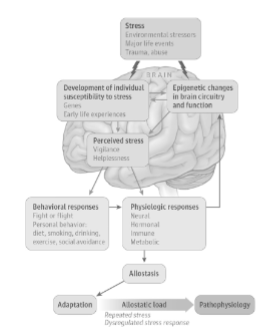
effects of physiological stress on physical health
Physiological change due to emotional challenge can impact on physical health
A common sign of chronic stress is repeated ill health
If there is a history of recurrent illness it is essential to ask questions about potential emotional health factors
It is important to investigate the potential for physiological stress to be a factor in
diseases associated with breakdown of mucosal integrity
physical health issues related to altered immune function
cases involving weight management
issues of pain perception
common physical disease related indicators of physiological stress incl
dermatological conditions
stress related grooming patterns
repetitive licking
immune function factors
urinary tract conditions
Feline idiopathic cystitis
= This disease is a great example of the interplay between natural behaviour, emotional state and physical disease
= It has been shown by various studies that “stress” is a risk factor for FIC
= Recent research has also suggested that those cats suffering from FIC have a difference in the way in which they respond to “stress”
GI conditions
impact of physiological stress on mucosal integrity
influence of stress related mediators such as cytokines on gut pathways
= Kynurenine pathway (KP) - major route of tryptophan catabolism influencing serotonin availability
impact of microbiome on gut-brain axis function
weight management
obesity
= influence of sympathetic/ parasympathetic balance on glycogen storage deposits
hypo/anorexia
immune function effects
viral/ bacterial/ protozoan impact
parasitic impact
issues of pain perception
acute
surgical
accidental
chronic
inflammatory pain
neuropathic pain issues
feline idiopathic cystitis
In clinical terms many of these cats may present with clearly medical symptoms such as straining to urinate
Others may present with behavioural signs such as unacceptable house soiling or overgrooming
Behavioural investigation is necessary in order to fully treat the physical health condition
In particular, an understanding of feline social groups, resource distribution and resulting stress issues for cats must be understood
Environmental effects on emotional state can influence physical disease
When environments, both social and physical, do not cater for species specific behavioural needs this leads to negative (protective) emotion and resulting physiological stress
Some environmental factors can have a direct effect on physical disease risk and progression
Human misperceptions may lead to presentation of water in ways that make it unattractive cats thus limiting their water intake
Restricted water intake can be a factor in renal disease
When patients are in a protective emotional bias they display behaviours of repulsion, avoidance, inhibition and appeasement
These responses have the potential to influence physical health eg
Repulsion leading to injury or transfer of infectious agents through salivary exchange
Avoidance leading to bolting and RTAs or leading to social avoidance which influences access to vital resources
Inhibition leading to physical vulnerability or reduction in self-care
Appeasement leading to physical vulnerability
An engaging emotional bias leads to behaviours of approach and interaction which can also impact on physical health eg
Desire-seeking related object play leading to stick injuries
Desire-seeking approach leading to ingestion of toxins eg chocolate and raisins
When patients are in high state of emotional arousal, regardless of valence, they will display displacement and drainage behaviours
These have the potential to interplay with physical health eg
Drainage – chewing leading to dental damage or ingestion of foreign bodies
Displacement – self licking leading to dermatological issues
what is the link between physical and emotional health may be related to
influence of emotional health on physical disease
influence of physical disease on emotional health
heath model
capacity - sink size
input - valence
drainage - resilience
emotional arousal can be thought of as the result of balance betwen capacity, input and drainage
it is represented by level of emotion in sink
emotional health considerations
The outward manifestation of behavioural change is dependent on the valence of emotion triggered by the stimulus as well as the threshold of response to the stimulus and the salience of that stimulus – which tap is turned on and the flow rate of that emotional input
However it is also dependent on the emotional state of the individual in terms of arousal – the amount of emotion present in the emotional sink and the efficiency of emotional drainage
The level of arousal and the valence of emotion and can be influenced by physical ill health
examples residue
due to an emotional health issue
due to emotional effects of a physical health issue
due to pain - which has both physical and emotional components
emotional valence
Presence of physical ill health can also influence emotional valence
Limitations of mobility can lead to a more protective emotional bias
Physiological consequences of physical disease can influence emotional bias, for example as a result of endocrine disorders
Neurological compromise can influence emotional motivation
developmental link between physcial health and behavioural change
Severe illness in the first few weeks of life can have serious implications in terms of behavioural development
Kittens and puppies that are ill may be isolated from adequate socialisation and “habituation”
They may also develop negative associations with certain forms of handling due to the necessity for medication and nursing intervention
In such cases behavioural change may not be evident until weeks or months after the physical problem
The early health issues may be long since forgotten by caregiver and veterinary surgeon alike
Chronological history taking is therefore important
In the shelter context early life history may not be available
Developmental link between emotional and physical health
The link between emotional development and physical disease is a two-way street
Adequate and appropriate early learning is essential for successful development of emotional control mechanisms
Poor emotional control and lack of emotional intelligence increases risk of protective emotional bias and high emotional arousal both of which can influence physical health
Where emotional development is compromised and young animals experience emotional trauma there is evidence that this can predispose individuals to a range of physical health conditions later in life
This concept is well established in the field of human medicine – Adverse childhood event (ACE)
This connection also needs to be considered in the context of veterinary medicine and the effects of early behavioural development considered in physical health conditions
immediate link between current physical disease and behavioural change
Cases where underlying physical health conditions are directly responsible for the behavioural change
The behavioural change is a sign of the physical health condition
In some cases the link may be obvious
In others the link is more subtle
Acute pain and confrontational behaviour – the dog that snarls and
snaps or cat that hisses and scratches when its fractured limb is manipulated
House soiling as a result of polydypsia and polyuria from a medical cause – the diabetic that is obviously drinking excessively
obvious link between current physical disease and behavioural change
One area of significant overlap between physical health and behavioural change lies in the field of neurology
When signs are consistent with neurological involvement it will lead to consideration of differentials such as:
Epilepsy
Space occupying lesions
Congenital neurological defects
Inflammatory processes within the nervous system
subtle link between current physical disease and behavioural change
In some cases the association between the physical disease state and the presentation of the behaviour may be less obvious, for example:
Onset of anxiety as a result of endocrine imbalance
Relationship between hypertension and behavioural change
Non-”aggressive” responses to pain
learned association between current physcial disease and behavioural change
Onset of repulsion and avoidance responses to stimuli, such as people
or dogs, which have been linked with pain through association
In the early part of the association process the link may be obvious
With time a process of generalisation may lead to expression of
problematic behaviours in decreasingly obvious contexts