AH 3320 Q11: UTIs and STIs
 Call Kai
 Learn
 Practice Test
 Spaced Repetition
 Match
 Flashcards
 Knowt Play
1/63

There's no tags or description
Looks like no tags are added yet.
64 Terms
“Big 3”
Chlamydia
Gonorrhea
Syphilis

________ people are disproportionately burdened by STIs
Young = 15-24 yrs
Average number of new STIs each day
1,000,000
How many new curable urogenital infections in people ages 15-49?
376.4 million
2 reasons for urethritis
Bacteria and viruses
Seuxal disease in the past
Cause of gonorrhea
Cured with treatment?
Gonorrhea = bacterial infection = Neisseria gonorrhoeae
Can be cured with right treatment BUT some drug-resistant strains

Cause of chlamydia
Chlamydia = bacterial infection = Chlamydia trachomatis
CAN be cured with correct treatment

Virulence factor of N. gonorrhoeae
Pilli → anchor to urehtra → urethritis
Avirulent strains of N. gonorrhoeae have Pilli: (True/False)
FALSE → avirulent strains → Do NOT have Pilli
Enter urethra → CANNOT adhere → flushed out by urine
Avirulent strains of N. gonorrhoeae cause infection: (True/False)
FALSE → avirulent strains = lack ability to cause disease
3 symptoms of urethritis
Burning urination
Frequent urination
Urethral discharge
Gonococcal urethritis:
Intracellular/extracellular?
Gram-negative/gram-positive?
Shape?
Gonococcal urethritis:
Intracellular
Gram-negative
Diplococci
What does the absence of intracellular gram-negative diplococci on a urethral Gram stain indicate?
Non-gonococcal urethritis (NGU)
What is the most common cause of non-gonococcal urethritis?
Chlamydia trachomatis
How is C. trachomatis described on Gram stain?
Gram indeterminate = cannot be reliable stained with a Gram stain
Why can't C. trachomatis be stained with a Gram stain?
It lacks peptidoglycan
Structurally, C. trachomatis is gram negative. What features support this?
Outer membrane, inner membrane, and LPS
What is the taxonomic classification of C. trachomatis (Family, Genus, Species)?
Family = Chlamydiaceae
Genus = Chlamydia
Species = C. trachomatis
A negative Gram stain for diplococci in urethritis suggests what next step?
Test for non-gonococcal urethritis (NGU) causes like chlamydia (e.g., NAAT)
Pelvic inflammatory disease pathogen
PID = Bacterial infection (Chlaymida, gonorrhea)
Is pelvic inflammatory disease curable?
Yes
What may happen as a result of pelvic inflammatory disease?
Permanent scarring of reproductive organs
What may untreated pelvic inflammatory disease lead to?
Interfility
Nearly all causes of community-acquired pelvic inflammatory disease (PID) are _________ transmitted
SexuaIIy
2 most common causes of pelvic inflammatory disease (PID)
2 additional pathogens that may accompany
2 most common:
N. gonorrhoeae
C. trachomatis
2 additional pathogens:
S. pyogenes
H. influenzae
What may happen is urethritis treatment is delayed?
Infection may spread → uterus → PID (15% of time)
Group most affected by pelvic inflammatory disease (PID)
Young, sexuaIIy active women
Most common gynecological disease seen in ER
Pelvic Inflammatory Disease (PID)
Estimated # of cases of Pelvic Inflammatory Disease (PID) per year
1 million causes/year
Where does cervical microbes in pelvic inflammatory disease (PID) spread to? 4 places
Endometrium, fallopian tubes, ovaries, surrounding pelvic structures

3 risk factors for pelvic inflammatory disease (PID)
Younger age (highest incidence in teenagers)
Multiple sex partners
Previous history of PID
2 ways to prevent pelvic inflammatory disease (PID)
Condoms
Spermicidal agents
6 symptoms of pelvic inflammatory disease (PID)
Lower abdominal pain (during or after menstruation)
Pain worsened by lntercourse
1/3 of causes accompanied by uterine bleeding
Fever
Vaginal discharge
Nausea/vomiting

3 diseases that may present with similar clinical findings as pelvic inflammatory disease (PID)
Diverticulitis
Pancreatitis
Perforated bowel
There are tests available for pelvic inflammatory disease (PID): (True/False)
FALSE → no specific test available for PID
2 minimum diagnostic criteria for PID
Pelvic pain or lower abdominal pain
Cervical motion tenderness (CMT) or adnexal tenderness or uterine tenderness
Treatment of PID
Antibiotic ~ 14 days

5 ways to reduce risk of PID
Safe sex
Contraception
Get tested
Request partner to be tested
Don’t douche → upsets bacterial balance in vagina
Most common non-viral sexually infection
Trichomoniasis
Trichomoniasis type of infection
Trichomoniasis = parasitic infection
How many infections does Trichomoniasis cause per year in U.S."?
How many Trichomoniasis cases worldwide?
7 million a year in U.S.
180 million+ cases worldwide
3 Trichomoniasis symptoms: Women vs. Men
Women
Irritation/itching to vaginal area
Frothy, colored vaginal discharge
May negatively affect pregnancy outcome
Men
Mild symptoms at most
Discharge
Pain during urination

Number of bacteria, viruses, and parasites known to be transmitted through sexuaI contact
30
Prevalence vs. Incidence
Prevalence = estimated number of infections in given time
Incidence = estimated number of new infections (diagnosed or undiagnosed)
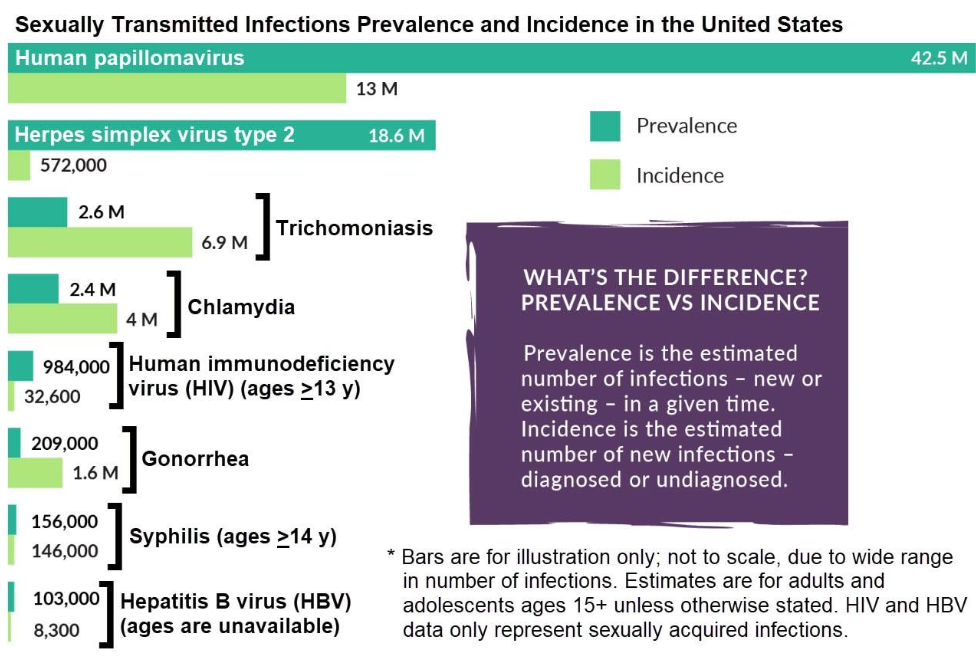
Slide 31
Slide 31