Chromatography
 Call Kai
 Learn
 Practice Test
 Spaced Repetition
 Match
 Flashcards
 Knowt Play
1/16

There's no tags or description
Looks like no tags are added yet.
17 Terms
Chromatography (Overview) types
Chromatography techniques are used to analyze and or separate proteins based on physical and or chemical characteristics.
This video will cover principles of chromatography and then describe specific features of
size exclusion chromatography aka gel filtration
ion exchange chromatography
affinity chromatography.
Principles of Chromatography
a key characteristic of chromatography is a stationary phase represented by gray circles with a specific physical or chemical characteristic.
The other main component of chromatography is a mobile phase represented here in blue, which is a liquid solution that can surround or move through the stationary phase.
Proteins in the mobile phase represented here in red can interact with the beads of the stationary phase based on physical or chemical properties.
column chromatrography
leaving the column terminology
Chromatography is often performed using a column containing the stationary phase and a mobile phase that runs through the column.
Proteins present in the mobile phase flowing through the column can interact with a stationary phase. As the mobile phase exits, the column samples can be collected.
The proteins that go through the column are referred to as eluting from the column,
different samples collected are often called elution fractions
depending on the characteristics of the stationary phase different proteins may travel through the column at different rates and or bind to the stationary phase and remain in the column.
Size Exclusion Chromatography (Gel Filtration)
what effects elution order
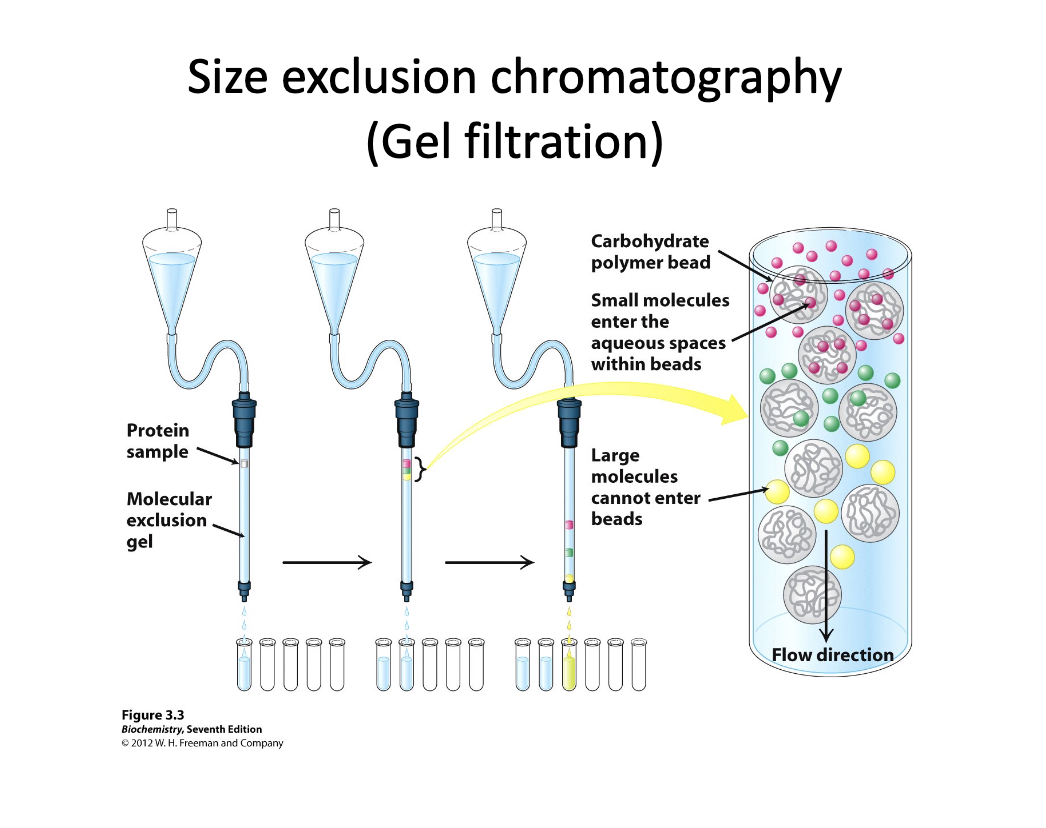
Size exclusion chromatography, also called gel filtration separates proteins primarily based on size.
The elution of a protein or protein complex can be assumed to be based on molecular weight, but the shape of a protein or protein complex can also influence how quickly approaching or a protein complex can move through the column.
The beads used for the stationary phase are porous and allow some molecules to enter the beads.
Large molecules represented by yellow circles in the diagram flow through the column quickly because they can't enter the space inside the beads and are only present in the mobile phase surrounding the beads.
Small molecules represented by red circles in this diagram flow through the column more slowly because they can enter into the beads and therefore access more of the space within the column.
Medium size molecules represented by green circles in this diagram can run into the beads somewhat, but not as much as smaller molecules leading to an intermediate rate of moving through the column.
The largest proteins exit the column or elude first and the smallest proteins take the most time to flow through the column and loop last.
Different samples or fractions are collected over time to separate the proteins that elute at different times.
Ion Exchange Chromatography
what is the stationary phase
how to elute stuff
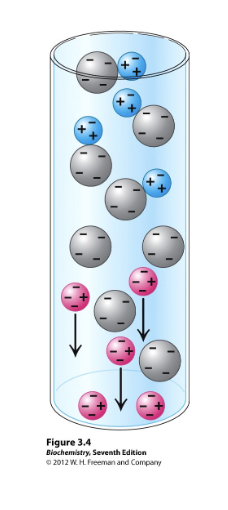
In iron exchange chromatography, proteins are separated based on charge.
The stationary phase has an associated charge, either positive or negative, and proteins with the opposite charge are attracted to and bind the stationary phase.
Proteins bound to the stationary phase can be eluted from the column by adding salt, the charged ions in the salt can interact with the stationary phase, displacing the charge proteins and allowing the proteins to flow through and the loop from the column.
Cation Exchange Chromatography
In cation exchange chromatography the stationary phase is negatively charged. Proteins with positive charges or cations can bind to the negative charges of the stationary phase.
Proteins with negative charges flow through the column without binding to the stationary phase.
Anion Exchange Chromatography
In anion exchange chromatography the stationary phase is positively charged proteins with negative charges or ions can bind to the positive charges of the stationary phase.
Proteins with positive charges flow through the column without binding to the stationary phase.
Affinity Chromatography
Affinity chromatography techniques are based on a specific interaction between the protein of interest and another molecule called a ligand.
The protein of interest in the mobile phase can bind specifically to the ligand in the stationary phase, but proteins that do not bind to the ligand flow through the column
proteins bound to the stationary phase can be eluted off a column by adding free ligand which displaces the bound proteins.
In this example,
a glucose binding protein represented by the yellow crescent (mobile phase?) can bind to glucose represented by the green G that is attached to the beads of the stationary phase represented by the gray circles. The addition of free glucose molecules represented by the red G releases the glucose binding proteins from the stationary phase and allows the protein to flow through the column and be collected.
Summary of Chromatography
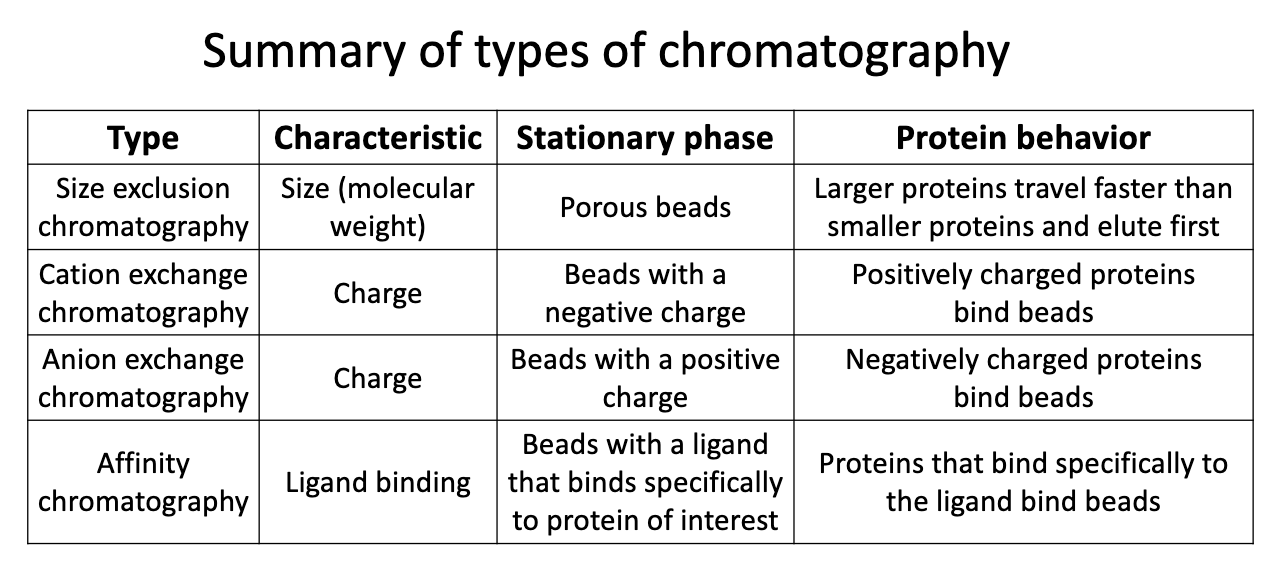
This video covered four types of chromatography summarized in this table that separate proteins by size charge or ligand binding in each type of chromatography.
The stationary phase consists of beads with specific characteristics that determine how proteins in a sample interact with the beads and how fast the proteins flow through the column, or whether or not they bind to the column.
Different types of chromatography can be used alone or in combination to separate and analyze protein
Principles of Chromatography
Involves a stationary phase which can be small beads with a particular chemical or physical characteristic
Involves a mobile phase which is a liquid solution that can surrounded or move through the stationary phase
Proteins present in the mobile phase can interact with the stationary phase based on physical or chemical properties

Column Chromatography

Size exclusion chromatography (Gel filtration)
Ion Exchange Chromatography
• Separates proteins based on charge
• Stationary phase has a charge (positive or negative)
• Proteins with the opposite charge bind to stationary phase
• Proteins bound to the stationary phase can be eluted from the column by adding salt
Cation Exchange Chromatography
• Stationary phase is negatively charged
• Proteins with positive charges (cations) in the mobile phase can bind to the stationary phase in the column
• Proteins with negative charges flow through the column
Anion Exchange Chromatography
• Stationary phase is positively charged
• Proteins with negative charges (anions) in the mobile phase can bind to the stationary phase in the column
• Proteins with positive charges flow through the column
Affinity Chromatography
• Stationary phase with specific molecule (ligand) that binds proteins of interest
• Proteins of interest in the mobile phase can bind to ligand in the stationary phase
• Proteins that do not bind the ligand flow through the column
• Proteins bound to the stationary phase can be eluted from the column by adding free ligand

Summary of types of chromatography