Unit 3 - permanent dentition
 Call Kai
 Learn
 Practice Test
 Spaced Repetition
 Match
 Flashcards
 Knowt Play
1/22

There's no tags or description
Looks like no tags are added yet.
23 Terms
▪Largest & most prominent incisor
▪Mesial angle sharp, Distal rounded
# of roots 1
# of cusps 0
Maxillary CENTRAL incisor

▪Often Peg-shaped or Congenitally missing
▪Developed Marginal Ridges often end in Lingual Pit
▪Smaller and rounder than Central
# of roots 1
# of cusps 0
Maxillary LATERAL incisor

▪Longest tooth in the arch
▪Single cusp is long and sharp
▪Prominent Cingulum
# of roots 1
# of cusps 1
Maxillary Canine / CUSPID

▪Only Bicuspid with 2 ROOTS
▪Buccal cusp slightly higher
▪Replaces 1st Primary MOLAR
# of roots 2
# of cusps 2
Maxillary 1st BICUSPID/ Premolar

▪Very “wrinkled” from secondary grooves
▪Cusps are similar in size
▪Replaces 2nd Primary MOLAR
# of roots 1
# of cusps 2
Maxillary 2nd BICUSPID/ Premolar

▪5 unequal cusps
▪Including Cusp of Carabelli
▪Has an OBLIQUE RIDGE
▪Largest Maxillary Molar
▪Erupts around 6 years old
# of roots 3
# of cusps 5
Maxillary 1st Molar
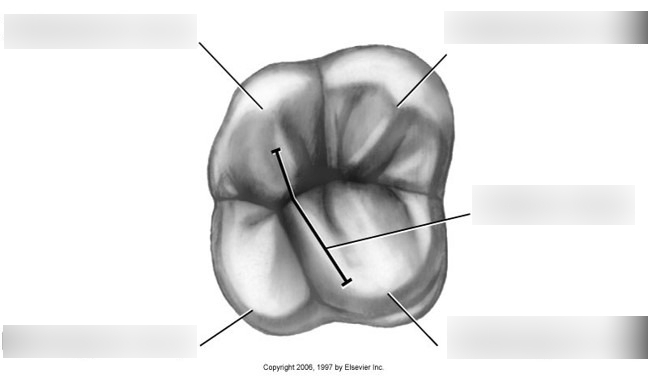
▪Has an OBLIQUE RIDGE
▪Erupts around 12 years old
# of roots 3
# of cusps 4
Maxillary 2nd Molar

▪Vary in form
▪Often Congenitally Missing
▪Often Impacted
▪Usually don’t erupt until early 20’s
# of roots varies
# of cusps varies
Maxillary 3rd Molar

Primary & Permanent Maxillary molars have
▪ 3 roots
▪ Unequal sized cusps
▪ Oblique ridge
▪Smallest tooth in the mouth
▪Very symmetrical (Slightly Rounded distal)
# of roots 1
# of cusps 0
Mandibular CENTRAL incisor

▪Slightly larger and rounder than central (More Rounded distal)
# of roots 1
# of cusps 0
Mandibular LATERAL incisor

▪Shorter and Cusp less sharp than Maxillary Canine
(More Rounded distal)
• Lingual smoother
# of roots 1
# of cusps 1
Mandibular CUSPID / Canine

▪Short Lingual cusp causes Occlusal surface to slope lingually
▪Deep Mesial Marginal Groove
▪Replaces the 1st Primary Molar
# of roots 1
# of cusps 2
Mandibular 1st BICUSPID / Premolar

▪Most Common: 3 cusps
▪Large Buccal cusp &
▪2 small Lingual Cusps
▪Replaces the 2nd Primary Molar
# of roots 1
# of cusps 2 - 3
Mandibular 2nd BICUSPID / Premolar

▪5 Equal sized cusps
▪Largest Mandibular Molar
▪Erupts around 6 years of age
# of roots 2
# of cusps 5
Mandibular 1st Molar

▪4 equal sized cusps
▪Main develpomental grooves form a “+”
▪Erupts around 12 years of age
# of roots 2
# of cusps 4
Mandibular 2nd Molar

▪Vary in Form
▪Roots often Fused together
▪Often Congenitally Missing
▪Often Impacted
# of roots varies
# of cusps varies
Mandibular 3rd Molar

Primary & Permanent Mandibular molars have
▪ 2 roots
▪ Equal sized cusps
What teeth have 3 roots
maxillary molars
What teeth have 2 roots?
mandibular molars & maxillary 1st bicuspid
What teeth have 5 cusps?
1st molars
What teeth have 4 cusps?
2nd molars
What teeth have oblique ridges?
maxillary molars