Stress and Strain
 Call Kai
 Learn
 Practice Test
 Spaced Repetition
 Match
 Flashcards
 Knowt Play
1/9

There's no tags or description
Looks like no tags are added yet.
10 Terms
A bar is pulled with 100 N at each end. What internal force crosses a cut through the middle?
100 N. Either half needs 100 N at the cut to balance the pull at its end.
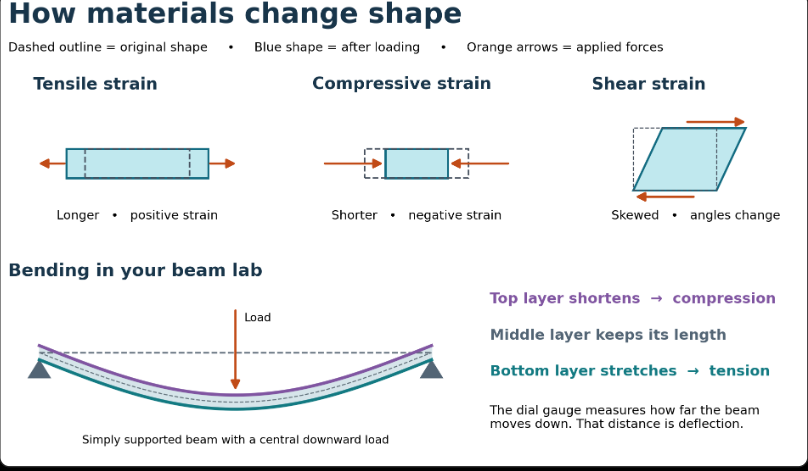
How do you calculate normal stress in a uniformly stretched bar?
sigma = F/A. Divide the axial force by the cross-sectional area.

A 200 N pull acts on a bar with a cross-sectional area of 10 mm². What’s the stress?
200/10=20 N/mm2=20 MPa

What signs do tensile and compressive normal stresses usually have?
Tension is positive and compression is negative.
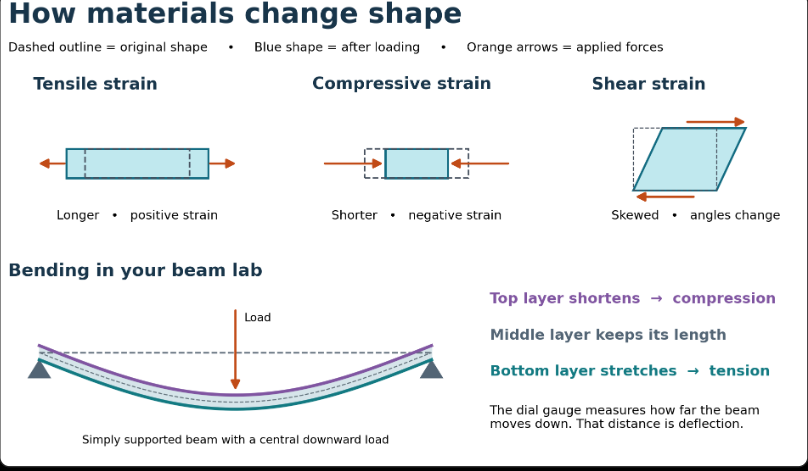
A 200 mm bar stretches to 201 mm. What’s its strain?

How do you find E from a stress–strain graph?
Take the gradient of the initial straight section, with stress on the vertical axis and strain on the horizontal axis.

Two materials experience the same stress in their linear elastic ranges. Which stretches less?
The one with higher (E). , A larger (E) gives a smaller strain.

How can you tell whether deformation was fully elastic?
Remove the load. Full recovery means the deformation was elastic. A permanent change means some plastic deformation occurred.
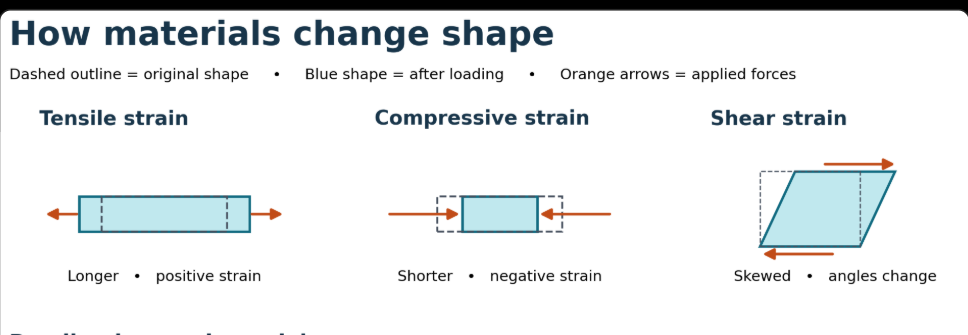
How do you tell normal stress and shear stress apart on a cut surface?
Normal acts perpendicular to the surface. Shear acts parallel to it. An angled cut through a stretched bar can show both.
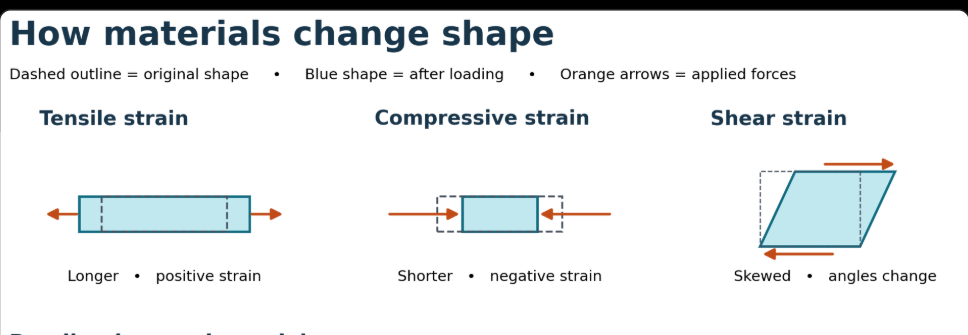
What does shear strain measure, and which modulus relates it to shear stress?
