Unit 3 - Bio 180-271 - Muscular System: Slides 48-118 (Excludes Tables)
 Call Kai
 Learn
 Practice Test
 Spaced Repetition
 Match
 Flashcards
 Knowt Play
1/56

There's no tags or description
Looks like no tags are added yet.
57 Terms
Define Muscle Hypertrophy
The enlargement of stimulated muscle

In what (4) ways does muscle hypertrophy affect the muscles?
Increases diameter of muscle fiber
Increases the number of myofibrils
Increases mitochondria number
Increases glycogen reserves
Define Muscle Atrophy
The reduction in muscle size, tone, and power

How can muscle atrophy be prevented/reduced?
Through electrical stimulation, which acts as a replacement for neuronal stimulation (when the body is unable).
How are skeletal muscles classified?
Based on fascicle organization
Name the four classifications of skeletal muscles
1. Parallel muscles
2. Convergent muscles
3. Pennate muscles
4. Circular muscles

Define Parallel Muscles
Muscles that contain muscle fibers that are parallel to the long axis of the muscle;
contains a central, spindle shaped, muscle body;
Tendons at the ends of muscle are moving parallel with one another

Define Convergent Muscles
Broad areas of muscle fiber converge on a tendon, aponeurosis, or raphe

Define Pennate Muscles
Muscles that form an angle with the tendon;
contain more myofibrils and develop more tension than parallel muscles;
Tendons at the ends of the muscle are moving perpendicular

Define Circular Muscles
Sphincter muscles;
Muscles that guard body entrances

Define Origins
The fixed point of attachment of a muscle

Define an Insertion
One moving point of attachment of a muscle

What are the origins and attachments of muscles typically attached to?
Most origins and insertions attach to the skeleton
Where are origins and insertions typically located in relation to one another?
Typically, origins are proximal to insertion
Define Action and name an example
Movement produced by muscle contraction;
ie. flexion, extension, adduction, abduction, etc.

Why do different muscle groups work together?
To maximize efficiency
Which muscles reach tension first: smaller or larger muscles?
Smaller muscles
Define an agonist
The prime mover;
produces a particular movement
Define Antagonist
Opposes movement of a particular agonist
Provide an example of agonist and antagonist
When you contract the biceps brachii, the triceps brachii may oppose the movement
Define Synergist
A smaller muscle that assists a large agonist

Name the two possible roles of a synergist and an example of each
A synergist may...
1. act as a fixator by stabilizing the agonist muscle (ie. deep low back muscles)
2. act as an initiator by starting a movement (ie. brachialis)
What is the platysma known as?
"The shaving muscle"

Name the six extrinsic eye muscles
1. Inferior rectus
2. Medial rectus
3. Superior rectus
4. Lateral rectus
5. Inferior oblique
6. Superior oblique

What are the extrinsic eye muscles collectively responsible for?
The movement of both eyes
True or False: The Levator palpebrae superioris is an extrinsic eye muscle.
False
What is the role of the Trochlea?
The Trochlea "holds onto" the superior oblique.

Define Mastication
The process by which found is ground and crushed up by teeth;
chewing
Name the four muscles of Mastication
1. Masseter muscles (elevates AND closes)
2. Temporalis muscles (elevates)
3. Medial Pterygoid muscles
4. Lateral Pterygoid muscles

Define lateral excursion
Rocking the jaw side to side;
A unique action to the pterygoid muscles

What is the role of the pterygoid muscles in mastication?
To align teeth during mastication by tensing to prevent lateral excursion

How are the muscles of the tongue named?
According to origin and insertion.
What are the muscles of the tongue called?
Extrinsic Tongue Muscles

What does "-glossus" mean?
"Tongue"
What does "-genio" refer to?
The inner portion of the mandible
Name the Pharyngeal constrictor muscles
• Superior constrictor
• Middle constrictor
• Inferior constrictor
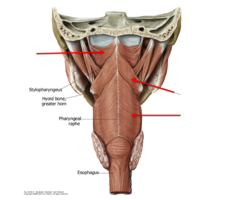
Role of the pharyngeal constrictor muscles
move food into the esophagus
Define Laryngeal elevator muscles
Muscles that elevate the larynx (to close the epiglottis)
Name the Palatal muscles
• Levator veli palatini (elevates the soft palate)
• Tensor veli palatini (tenses the soft palate)
Role of the Palatal Muscles
To lift the soft palate
What is the name for the spinal extensor muscles?
Erector Spinae

What is the role of most muscles of the back?
Extension
Name the Superficial Spinal Extensors (agonist) of the back
• Iliocostalis - most lateral
• Longissimus - in the middle
• Spinalis - most medial

Name the Deep Spinal Extensors of the back
• Semispinalis group
• Multifidus muscle
• Interspinalis muscles
• Intertransversarii muscles
• Rotatores muscles

Where are the spinal flexors located?
In the neck (cervical) and lumbar region
Name the Neck Flexor muscles
• Longus capitis
• Longus coli
Name the Lumbar Flexors
Quadratus lumborum
True or False: The external anal sphincter is a muscle
False
True or False: The external anal sphincter is made up of muscle fibers
True
What kind of muscles does the coccyx attach to?
Muscles that have to do with voluntary defecation
Which set of muscles wraps around the ribs?
Serratus Anterior
Name the three major regions of the trapezius
• Upper Trapezius (1)
• Mid-trapezius (2 & 3)
• Lower Trapezius (4)

Which muscles are underneath the Trapezius?
The Rhomboids
Name the four muscles of the Rotator Cuff
• Teres minor
• Subscapularis
• Infraspinatus
• Supraspinatus
Which two rotator cuff muscles work closely together?
The Teres Minor and the Infraspinatus:
Both act as lateral rotators
Role of the Biceps Brachii
Acts as the agonist to flexion at the elbow

How many branches of the facial nerve are there?
Five
