Exam 2 Quinn
 Call Kai
 Learn
Learn Practice Test
 Spaced Repetition
 Match
Match Flashcards
 Knowt Play
1/76

There's no tags or description
Looks like no tags are added yet.
Name | Mastery | Learn | Test | Matching | Spaced | Call with Kai | Chat |
|---|
No analytics yet
Send a link to your students to track their progress
77 Terms
oxid of 2o ROH: what reagents?
Na2Cr2O7, H2SO4, H2O or CrO3, H2SO4, H2O, (What key intermediate do these form?)
oxid of 2o ROH: what product?
ketone

oxid of 2o ROH: what mechanism?

Oxidation of 1o ROH: what reagents?
H2CrO4, H2O to get carboxylic acid (how do we make H2CrO4?), PCC/Dess-Martin and CH2Cl2 to stop at aldehyde
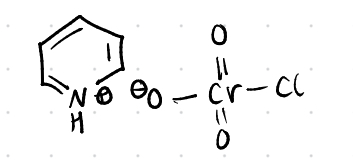
Oxidation of 1o ROH: draw PCC
Oxidation of 1o ROH: draw Dess-Martin

what is —OAc?

Oxid 1o ROH: What Product?
carboxylic acid or aldehyde
Oxid 1o ROH to carbox acid: mechanism?

Oxid 1o ROH to aldehyde: mechanism with PCC?

Oxid 1o ROH to aldehyde: mechanism with D-M?

Oxid 2o ROH: do these reagents also work on Oxid 1o ROH?
H2CrO4 will —> 1o to carbox acid, but need PCC or D-M to stop at aldehyde.
what does PCC or D-M do to 2o ROH
—> ketone
Tosylate Formation: what are the reagents?
TsCl and Pyridine

Tosylate Formation: what are the products?

Tosylate Formation: mech?

Esterification rxn: reactants?

Esterification reaction: products?

Intramolecular Esterification mechanism

Esterification mechanism

Williamson Ether reactants
1) NaH or Na+ 2) R-LG
What does second step williamson ether reactant have to be?
1o or 2o ROH, unhindered (mostly 1o since 2o will give a major E2 product)

Williamson Ether mechanism


Williamson Ether mechanism
product

ROH rxn with H-X reactants?
just H-X!
ROH rxn with H-X products?
-X where -OH was (stereochem?) BUT also possible elimination
ROH rxn with H-X mechanism?
2 possible! Sn1 for 3o OH, Sn2 for 1o, 2o can be either (don't forget C+ rearrangement)

What reagents can you use for ROH rxns with PX3? (what can PX3 be)
PCl3, PCl5, PBr3, P/I2
ROH rxn with PX3 products?
inverted -X where -OH was
which ROHs does PX3 react with and why?
1o and 2o because Sn2, no C+ rearrangement, 3o has too much steric hindrance
What can you use to switch out a 1o -OH for an -X? by what type of rxn(s)?
H-X or PX3 by Sn2
What can you use to switch out a 2o -OH for an -X? by what kind of rxn(s)?
PX3 preferred since no C+ rearr (Sn2), but can use H-X if okay to risk Sn1
What can you use to switch out a 3o -OH for an -X? by what kind of rxn(s)?
Can't use PX3, have to use H-X and has to be Sn1 (risk C+ rearr)
ROH rxn with PX3 Mech

what does the drawing of the Px3 for I look like if you wanna use it with ROH

if you see PCl5 what do you do to react with ROH
PCl5 —> PCl3
what is thionyl chloride?
Cl2-S=O
what do you call Cl2-S=O
thionyl chloride
which rxn(s) can you use to get inverted -X in place of -OH
1o ROH can use HX or PX3, 2o ROH can use PX3, 3o ROH can do sn1 with HX but that yields racemic mixture so no way to predict stereochem
which rxn(s) can you use to get conserved configuration -X in place of -OH (and what _ary) ROHs does this work on?
rxn with SOCl2, thionyl chloride, works on 1o and 2o ROHs
reactants in ROH with thionyl chloride rxn?

products in thionyl chloride rxn?

ROH w/ SOCl2 mech

give 4 acids with non-nuc cbs
H2SO4, HF, H3PO4, HNO3
ROH dehydration reactants
H2SO4, HF, H3PO4, or HNO3 with H2O and heat
ROH dehydration products
alkene and water
what 3 things keep in mind for ROH dehydration?
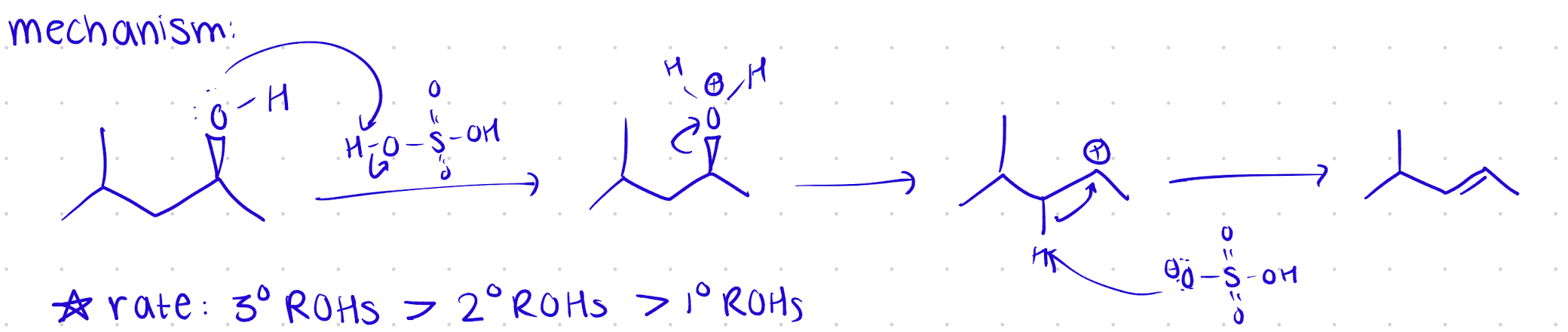
1) 3o > 2o > 1o because of C+ 2) C+ can rearrange 3) = will form between C+ and most substituted adjacent C
ROH dehydration mechanism
pinacol rearrangement reactants
H2SO4, HF, H3PO4, or HNO3 with H2O
pinacol rearrangement product
ketone with alkyl shift in mech

pinacol rearrangement mech

What two rxns from last unit do we know to form ketones and aldehydes?
Friedel-Crafts Acylation and Ozonolysis of Alkenes

Hg-cat hydration reagents
HgCl2, H2SO4, H2O, then HCl for the acid-cat tautomerization
Does hg-cat hydration form mark or anti-mark enol?
mark
Hg-cat hydration products
mark enol —> ketone
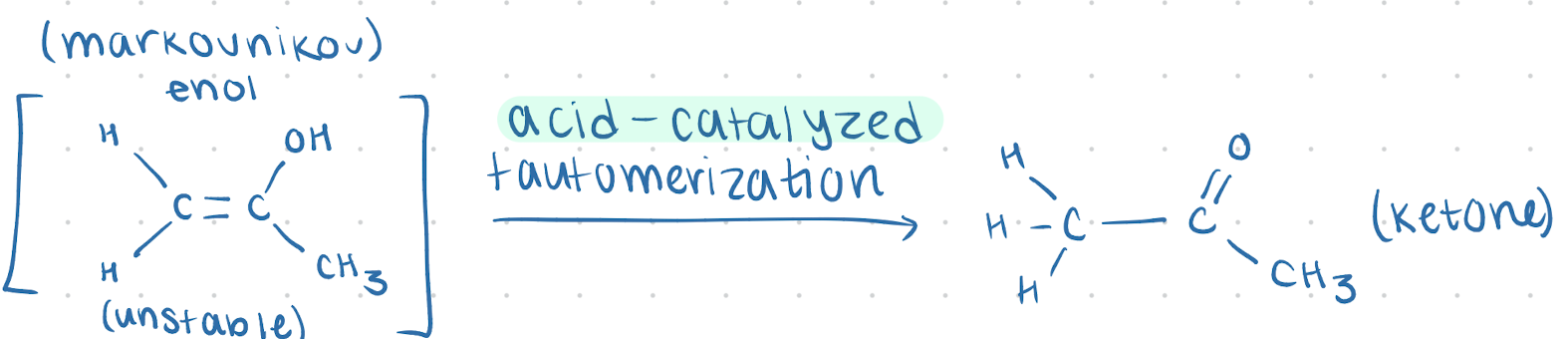
Acid-cat taut mech for hg-cat hydration (of alkynes)

Hydroboronation/Oxidation of alkynes reagents
1) Sia2BH 2) H2O2, -OH, then -OH and H2O for base-cat taut
Hydroboronation/Oxidation of alkynes products
anti-mark enol —> aldehyde
Does hydroboronation/oxidation make mark or anti-mark enol?
anti-mark
base-cat taut for hydroboronation-oxidation mech

synthesis of ketones from carboxylic acids reagents
1) R-Li (xs) 2) H3O+

carboxylic acid and R-Li mechanism (what reagent missing)

synthesis of ketones from nitriles reagents
1) R’—MgX, 2) H3O+, then more H3O+ to hydrolyze

synthesis of ketones from nitriles mech

2 ways to make acyl chlorides
1) adding SOCl2 and pyr to R-OH and 2) adding SOCl2 and pyr to carbox acid
reduction of acyl chloride to aldehyde reagent
LiAl(OtBu)3H
reaction of acyl chloride to aldehyde mechanism

Rxn of acyl chloride to ketone reagent
R—Cu-—R +Li
rxn acyl chloride to ketone mechanism

what does hydride reduction do
ketone —> alcohol
hydride reduction reagents
2 options: 1) LiAlH4 2) H3O+ or 1)NaBH4 2) ROH
hydride reduction mechanism

what does organometallic addn do
aldehyde—>alcohol (replacing -H with -R)
organometallic addn reagents
2 options: 1) R-Li 2)H3O+ or 1) R—Mgx 2)H3O+

organometallic addn example mech

hydration reagents each way
ketone —> H20 and H2SO4 —> 2 Rs and 2 OHs attached to central C
2 Rs and 2 OHs attached to central C —> H2SO4 and H20
hydration mech
