ZOOL 406 - Amphibian Lab Material
 Call Kai
 Learn
Learn Practice Test
 Spaced Repetition
 Match
Match Flashcards
 Knowt Play
1/187

Earn XP
Description and Tags
content from Dr. Alison Murray and TA Declan Rourke
Name | Mastery | Learn | Test | Matching | Spaced | Call with Kai | Chat |
|---|
No analytics yet
Send a link to your students to track their progress
188 Terms
What are the three extant amphibian groups?
Caudata (salamanders)
Anura (frogs and toads)
Gymnophiona (caecilians)
All orders
What is metamorphosis?
Reorganization of the body to change from generally aquatic larval form to (generally) terrestrial adult form
What does the beginning of most amphibian life look like?
Eggs are deposited in water and hatch into larvae (bill-bearing larval salamanders or tadpoles)
Larval stage length varies (7 days - 3 years)
What are some exceptions to an aquatic larval stage?
In some terrestrial habitats, the eggs undergo direct development and hatch into miniature adults
What are some changes seen in metamorphosis?
Regression of gills, formation of lungs
Degeneration of tail and tail muscles (anurans)
Development of limbs
Formation of dermal glands
Reorganization of the intestinal tract including switch from herbivorous to carnivorous diet
Modifications of excretory system with switch from ammonia waste to urea in some forms
Loss of tail “fins” in some salamanders
Do all amphibians undergo complete metamorphosis?
No.
What are some shared traits of all amphibians?
Mouth usually large; small pedicellate teeth in upper or both jaws; two internal nares open into anterior part of mouth cavity.
Forelimbs of some much smaller than hind limbs, in others all limbs small; webbed feet often present; no true nails or claws; forelimbs usually with 4 digits but some have 5 and sometimes fewer; some are legless
Moist, permeable skin – it is a major respiratory surface, and one that limits the habitats available to these animals
Skin glands – the integument is also important in terms of the glands that are present, and pigments that are part of courtship behaviors and defensive mechanisms
What does jaw articulation look like in amphibians?
Jaw articulation is between the articular (lower jaw) and quadrate bones (upper)

What does an amphibian spinal cord look like?
Mostly bony with varying number of vertebrae with zygapophyses (extensions which join one vertebra to the next); notochord does not persist in living forms, unlike early fossil tetrapods

What do amphibian body forms look like?
Body forms vary greatly from elongated trunk with distinct head, neck and tail to a compact, depressed body with fused head and trunk and no intervening neck
What are some skin characteristics you’ll find in most all amphibians?
Skin smooth and moist with many glands (mostly mucus), some of which may be poison glands; pigment cells (chromatophores) common and of considerable variety
What are chromatophores?
Pigment cells in skin
What are the three types of colouring seen in amphibians?
Cryptic
Aposematic
Mimicry
What is cryptic colouring?
Skin resembles background
Protection from predators
What is aposematic colouring?
Amphibian is brightly or conspicuously colored but noxious
Warns away smart predators that remember a past unpleasant experience with a brightly colored prey and avoid it the next time
What is mimicry?
Amphibian resembles a poisonous or aposematic species but is not actually poisonous itself
Is amphibian skin always smooth?
No, sometimes it contains keratinized structures
Eg. spadefoot toad
What adaptations are found in amphibian skin that help with cutaneous respiration?
Highly vascularized
Brumation (like hibernation) occurs in some species whereby successive molts are retained to prevent desiccation (water loss)
Frogs uptake water through pelvic patches
Hellbenders (cryptobranchidae) have highly vascularized skin folds
Warts may be found on the skin of most anurans
Specialized mucous and poisons glands are found in some species
Poison glands are concentrated in strategic areas
Eg. parotid glands
What does the circulatory system look like in amphibians?
Three-chambered heart, two atria and one ventricle; adults with double circulation (i.e., pulmonary circuit)
Skin abundantly supplied with blood vessels (cutaneous respiration)
What does the respiratory system look like in amphibians?
Respiratory organs include lungs (absent in plethodontid salamanders), skin, and gills
External gills in the larval form and may persist throughout life in neotenic forms
What does reproduction look like in amphibians?
Sexes separate
Mostly internal fertilization in salamanders and caecilians
Mostly external in frogs and toads
What are the three main styles of reproduction/birth seen in amphibians?
Predominantly oviparous (egg-laying)
Some ovoviviparous (eggs develop without maternal nourishment and hatch internally)
Viviparous (bear live young)
What are the two main measurements taken of amphibians?
Snout-vent length (SVL)
Tail length
What is SVL?
Snout-vent length - measured from the tip of the snout to the caudal end of the cloacal aperture
Anurans normally measured from tip snout to caudal end of urostylar projection (vent is often difficult to find)
What is tail length?
Measurement taken from the caudal end of the cloacal aperture to the tip of the tail
Note and measure separately any part of the tail that has been regenerated
What are some methods for marking amphibians?
Toe clipping
Pattern mapping
Passive integrated transponder (PIT) tags
VIE tags
No need for specifics, just know these methods exist
What is Lissamphibia?
Group that encompasses the three major living groups of amphibians (anurans, caudata, gymnophions)
NOT monophyletic → doesn’t include any fossils/ancestors
What is order Anura?
“Tail-less” frogs and toads
How does a frog’s body proportions reflect its saltatory locomotion?
Lengthened hind limbs, shortened forelimbs (for grasping)
Short, solid neck
Fused vertebrae
Posterior vertebrae fused into a single strong element
What are some features found in frogs?
Dorsolateral ridges
Parotid glands
Nuptial pads
Expanded finger tips
What are dorsolateral ridges?
Found in ranid frogs → contain concentrations of poison glands
What are parotid glands?
Found in bufonid toads → contain concentrations of poison glands
Located behind eyes
What are nuptial pads?
Anuran accessory breeding structures on one digit of each forelimb
Used to help male grip female in amplexus
What are expanded finger tips?
Found in tree frogs → contain glands that produce a sticky secretion that “glues” them to trees, rocks, etc
What characteristics do we look at when identifying anurans?
Cranial bones
Pectoral girdle
Vertebrae
Presacral ribs
Sacrum-urostyle articulation
Shape of terminal phalanges
What are the main cranial bones found in frogs?
Palatine
Frontoparietal
What is a palatine?
Cranial bone in frogs that is typically reduced to a thing bridge between the maxilla and vomer in modern anurans, reduced even in fossil forms
What are the primitive and derived conditions of the palatine?
Present - Considered primitive
Absent - Considered derived, fused to the point of absence with either vomer or maxilla
What is the frontoparietal bone?
Cranial bone in frogs → can by fused or paired
Fossil frogs can display both states or even absence
What are the primitive and derived conditions of the frontoparietal bone?
Paired → Considered the primitive state, but lasts into many modern groups
Fused into a single element → Considered derived, but appears in some fossil lineages
What are the two conditions of the anuran pectoral girdle?
Arciferal
Firmisternal
What is the arciferal pectoral girdle?
Condition of the anuran pectoral girdle where epicoracoid cartilages are fused anteriorly, but are separate and overlapping posteriorly
What is the firmisternal pectoral girdle?
Condition of the anuran pectoral girdle where epicoracoid cartilages are fused anteriorly and posteriorly, and usually have an omosternum present
What are the primitive and derived conditions of the anuran pectoral girdle?
Arciferal → considered primitive
Firmisternal → considered derived in some groups
What do vertebrae look like in anurans?
High number than five indicates a more primitive frog/toad
Advanced = fused = less vertebrae
What are the three conditions of anuran vertebrae?
Opisthocoelous
Procoelous
Amphicoelous

What are opisthocoelous vertebrae?
Anterior surface of centra is convex, posterior surface is concave
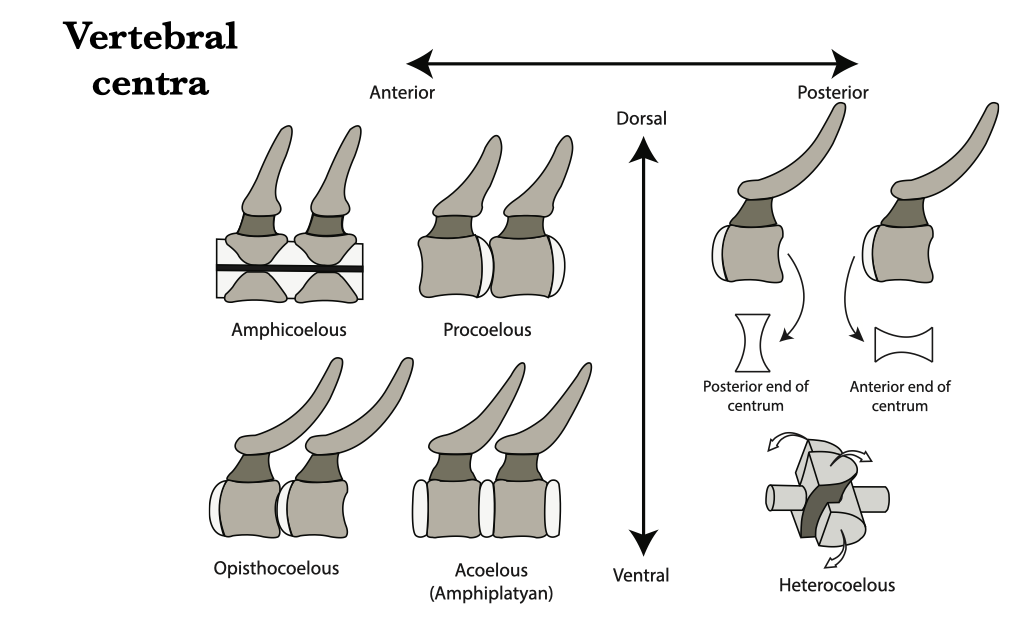
What are procoelous vertebrae?
Anterior surface of centra is concave, posterior surface is convex

What are amphicoelous vertebrae?
Both anterior and posterior surface of centra are concave

What do presacral ribs look like in anurans?
Can be present or absent, but most modern anurans display the absent condition
What do present presacral ribs look like in anurans?
Can vary in number, all classify as free ribs (not attached to a sternum)
What do absent presacral ribs look like in anurans?
Transverse processes of the presacral vertebrae lengthen to support the thoracic elements in the place of free ribs
What are the primitive and derived conditions of presacral ribs in anurans?
Present → considered primitive
Absent → considered derived
What is sacrum-urostyle articulation?
An essential joint for the saltatory locomotion primitive to anurans
Functions by extending and dorsoventrally aligning the urostyle and ilia with the trunk, thereby transferring the energy from a jump to the center of gravity of the frog
What are the four different conditions of sacrum-urostyle articulation?
Cartilaginous
Reduced/lost zygapophysial articulations
Bicondylar
Fused
What is cartilaginous sacrum-urostyle articulation?
No bony impediment to extension
Associated with the purely saltatorial motion primitive to all anurans
What is reduced/lost zygapophysial sacrum-urostyle articulation?
Eliminates vertebral constraint on extension
Also associated with saltatorial locomotion
What is bicondylar sacrum-urostyle articulation?
Reduces joint to purely hinge-like flexion/extension
The most common condition
Found in frogs that are capable of saltation, but tend to be terrestrial or arboreal ‘walkers’ and ‘climbers’
What is fused sacrum-urostyle articulation?
Eliminates all movement of the joint
Associated with the inability to jump
Found in burrowing walkers and purely aquatic forms
Morphology reported for Pelobatidae and Pipidae
What does the shape of terminal phalanges tell us about anurans?
Can be loosely correlated with the presence of claws and/or finger pads
What are the three main shapes of terminal phalanges found in anurans?
Pointed
Blunt
Bifurcated
What do pointed terminal phalanges say about anurans?
Indicating presence of ‘claws’ or hardened finger tips and a burrowing or aquatic habit in which superior grip is needed
May also have expanded finger pads if intercalary cartilage is also present proximally
Webs for aquatic, keratinous epidermis for fossorial
What do blunt terminal phalanges say about anurans?
Indicating a broad terrestrial/aquatic habitat
What do bifurcated terminal phalanges say about anurans?
Indicating the presence of broad finger pads and a climbing habit
What are tadpoles usually stored in?
Formaldehyde → they’re too squishy for other alcohols, they will literally disintegrate
Diagram of different tadpole measurements
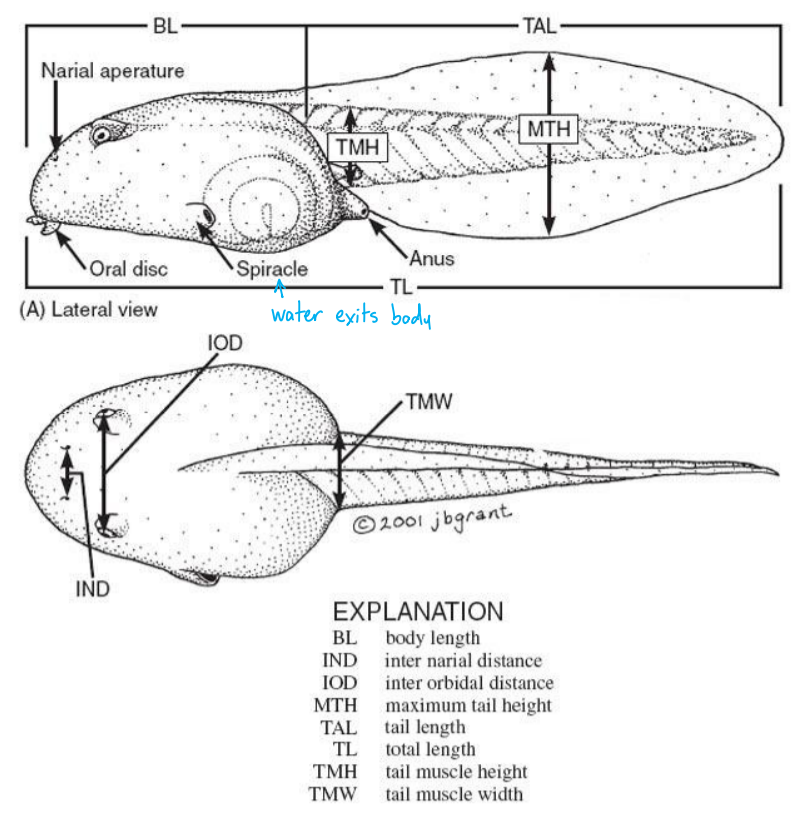
Diagram of different tadpole mouth features
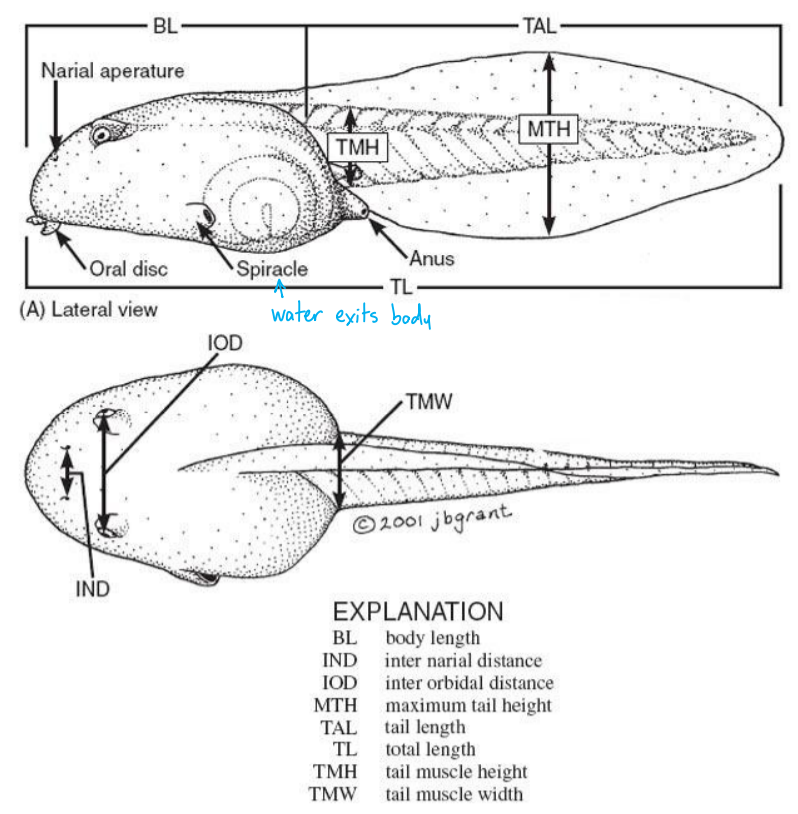
Photo of tadpole mouth

What are the 10 anuran families found in North America?
Ascaphidae/Leiopelmatidae
Pelobatidae/Scaphiopodidae
Rhinophrynidae
Pipidae
Leptodactylidae/Eleutherodactylidae
Hylidae
Dendrobatidae
Bufonidae
Microhylidae
Ranidae
What are the 8 anuran species found in Alberta?
Spea bombifrons – Plains Spadefoot Toad
Bufo boreas – Western Toad
B. cognatus – Great Plains Toad
B. hemiophrys – Canadian Toad
Pseudacris maculata – Boreal Chorus Frog
Rana luteiventris – Columbia Spotted Frog
R. pipiens – Northern Leopard Frog
R. sylvatica – Wood Frog
What is the common name of family ascaphidae?
Tailed frogs
May be a subfamily of Leiopelmatidae
What are some characteristics of family Ascaphidae/Leiopelmatidae?
Copulatory/intermittent organ found only in males forms a “tail” – it is in reality formed by the cloaca and associated muscles
Lack of palatine bone (derived)
Paired frontoparietal bones (primitive)
Arciferal pectoral girdle with distinct sternum (primitive)
9 amphicoelous presacral vertebrae (primitive)
Free ribs on vertebrae 2-5 (primitive)
Cartilaginous sacrum-urostyle connection (saltatorial)
Blunt to pointed terminal phalanges (aquatic)
What is the biology of family Ascaphidae/Leiopelmatidae?
Nocturnal
Clear mountain streams
Voiceless males
What does reproduction look like in family Ascaphidae?
Internal underwater fertilization
Females store sperm long-term (9 months)
Eggs laid in fast moving water with larval stage lasting 2-3 years
Non-ascaphid Leiopelmatids do direct development (no larval stage)
What species of Ascaphidae are found close Alberta?
Ascaphus truei
Ascaphus montanus
What is common name for family Pelobatidae?
Spadefoot toads
What are some characteristics of family Pelobatidae?
Squat toads with warty but soft skin; Crescent-shaped horny projections on side of hind foot, primarily used for digging
No palatine bone (derived)
Paired frontoparietal bones (primitive)
Arciferal pectoral girdle with distinct sternum (primitive)
8 amphicoelous presacral vertebrae (primitive)
Bicondylar sacrum-urostyle articulation (walker/climber)
Blunt terminal phalanges (fossorial)
What is the biology of family Pelobatidae?
Fossorial → burrowing backwards and spending the majority of their lives underground
Depending on environment, has 2–3 month or 1–3 year larval period
Large tadpoles if latter period, resulting in largest European tadpole
What does reproduction look like in family Pelobatidae?
Males chorus around temporary ponds in which eggs are soon deposited
Quick, annual reproduction can be completed in a single period
Nearctic form known for explosive reproductive habits: after heavy rains
Larval stage can be as rapid as 6 days, though usually about a month long
What species of Pelobatidae is found in Alberta?
Spea bombifrons - plains spadefoot
Could be in its own family Scaphiopodidae
What is the common name for family Rhinophrynidae?
Mexican burrowing toad
Pancake frogs
What are some characteristics of family Rhinoprhynidae?
Tiny, cone shaped head, short, robust limbs and large, fat, pancake body
Lack palatines (derived)
Single frontoparietal bone (derived)
Arciferal pectoral girdle that lacks a sternum (primitive)
8 opisthocoelous presacral vertebrae (primitive)
Bicondylar sacrum-urostyle articulation (walker/climber)
Blunt terminal phalanges (fossorial)
What is the biology of family Rhinoprhynidae?
Fossorial devastators of subterranean arthropods
Equipped with epidermal snout armor, double sealable lips, and a tongue that can project straight out of the mouth
Also with hind limbs, possessing spades on the inside edge of the hind feet
What does reproduction look like in family Rhinoprhynidae?
Calling males float in temporary pools
Females eventually deposit several thousand sinking eggs that hatch into tadpoles that aggregate
Develop their lower jaws early and can cannibalize each other
What is the common name for family Pipidae?
African clawed frogs and Surinam toads
Introduced in North America
What are some characteristics of family Pipidae?
Dorsoventrally flattened tongueless adults that still possess a lateral line system, with thick waists, heavy legs and large webbed hind feet
Lack palatines (derived)
Single frontoparietal bone (derived)
Arciferal pectoral girdle with a small sternum (primitive)
6-8 opisthocoelous presacral vertebrae (primitive)
Fused ribs present on the vertebrae 2-4 (primitive)
Bicondylar-fused sacrumurostyle articulation (walker/climber)
Pointed terminal phalanges hardened into claw-like structures (fully aquatic)
What is the biology of family Pipidae?
Most use their forefeet in feeding
Fully aquatic → found in still or slow moving water among vegetation
What does reproduction look like in family Pipidae?
Perform elaborate breeding behaviors involving a series of somersaults
Male to fertilize the eggs and either place them under floating vegetation, in a pocket of skin that forms on the female’s back, or hold them against the female’s back in order for them to fully embed in the dorsal skin
Can be direct or indirect development.
What is the common name for family Leptodactylidae?
White-lipped frogs and tropical grass frogs
Free-toed frogs could be their own family Eleutherodactylidae
What are some characteristics of family Leptodactylidae?
Can be very large
Paired palatine bones (primitive)
Paired frontoparietal bones (primitive)
Modified arciferal pectoral girdle with a distinct sternum [pseudofirmisternal → appears to have fused-up] (between primitive and derived)
8 procoelous presacral vertebrae (primitive)
Bicondylar sacrum-urostyle articulation (walker/climber)
Variable terminal phalanges (terrestrial)
What is the biology of family Leptodactylidae?
Terrestrial
Not in Canada, too cold and dry
What does reproduction look like in family Leptodactylidae?
Eggs deposited in foam nests in a variety of ways:
On top of water
In shallow depressions or burrows near ponds to be washed into ponds with heavy rain
In terrestrial depressions where the female will deposit tropic eggs to feed the tadpoles, or have endotrophic tadpole
What is the common name for family Hylidae?
Amero-Australian tree frogs
What are some characteristics of Hylidae?
Tiny to giant, slender and long legged with blunt head
Paired palatines (primitive)
Paired frontoparietal bones (primitive)
Arciferal pectoral girdle with a distinct sternum (primitive)
8 procoelous presacral vertebrae (primitive)
Bicondylar sacrum-urostyle articulation (walker/climber)
Pointed terminal phalanges → toes often tipped with expanded discs (generally arboreal)
What is the biology of family Hylidae?
Most are arboreal, though the Albertan species is one of the few terrestrial species
What does reproduction look like in family Hylidae?
Males call and females deposit eggs in wide ranging aqueous habitats from tree holes and bromeliads to lakes and streams
Some species have parental care:
Male nestmaking and egg-guarding
Trophic egg deposition in bromeliads to feed hatched tadpoles
What species of Hylidae is found in Alberta?
Pseudacris maculata - Boreal chorus frog
What is the common name for family Dendrobatidae?
Poison frogs
What are some characteristics of family Dendrobatidae?
Boldly colored (aposematic) skin with numerous poison glands
Paired palatines (primitive)
Paired frontoparietal bones (primitive)
Firmisternal pectoral girdle with a distinct sternum (derived)
6-8 procoelous presacral vertebrae (primitive)
Bicondylar sacrum-urostyle articulation (walker/climber)
T-shaped (bifurcated) terminal phalanges (arboreal)
Possess a small pair of bony plates on ends of digits called supradigital scutes
What is the biology of family Dendrobatidae?
Diurnal frogs found in riparian, terrestrial or semiarboreal microhabitats in tropical rainforests
Derives some alkaloid toxins from their diet of ants