SCI Material World Y10
 Call Kai
 Learn
 Practice Test
 Spaced Repetition
 Match
 Flashcards
 Knowt Play
1/56

There's no tags or description
Looks like no tags are added yet.
57 Terms
What is an atomic number?
The number of protons in an atom.
What is a mass number?
The total number of protons and neutrons in a nucleus.
What are protons?
Positively charged particle found inside the nucleus of an atom.
What is a nucleas?
Central part of an atom that consists of protons and neutrons
What is a neutron?
A particle found inside the nucleus of an atom, it has no charge (is neutral).
What are electrons?
A negatively charged particle found in electron shells the move around the outside of the nucleus.
What is an element?
A pure substance made up of only one kind of atom.
What is a compound?
A substance made from two or more different elements that have been chemically joined.
What is a molecule?
Two or more atoms chemically bonded or joined together. It doesn't matter if the atoms are the same or are different from each other.
What is a mixture?
A substance made of two or more different chemical substances that are not bonded together
What is a metal?
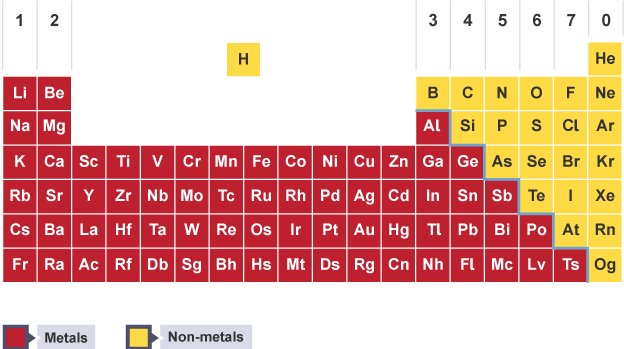
These elements are located on the left hand side of the periodic table. Mainly hard,shiny, malleable,heat and electrical conductor.
E.g. copper.
What is a non-metal?
These elements are located on the right hand side of the table, with the exception of hydrogen.
What is an acid?
A substance that produces hydrogen ions (H+) when dissolved in water.
What is a base?
A substance that accepts hydrogen ions (H+) or that dissolves to release hydroxide ions (OH-).
What is an alkali?
A soluble base.
What is an indicator
A substance that undergoes a distinct observable change to indicate if a substance is an acid,a base or neutral eg blue and red litmus paper, universal indicator.
What is a litmus?
A piece of paper that changes its colour to indicate if a substance is an acid, base or neutral.
What is neutralisation?
A chemical reaction between an acid and a base which produces a more neutral solution (salt and water)

Name the parts and where.
Red spheres: Protons
Yellow spheres: Neutrons
Red & yellow spheres: Nucleus
Blue spheres: Electrons
Black rings: Electron orbit
What charge does the nucleus emit?
Positive.
What charge do electrons emit?
Negative
How many electrons fit into the shells?
First: 2
Second: 8
Third: 8
Fourth: Any remaining.
What is the weight of protons?
Heavy.
What is the weight of neutrons?
Heavy.
What is the weight of electrons?
Light.
How do you find the atomic number?
With the number of protons.
How do you find the atomic mass?
By adding the protons and neutrons.
What do you get if you add the protons and neutrons?
The atomic mass.
How do you get protons?
The atomic number.
How do you get neutrons?
Atomic mass number - Atomic number.
How do you get electrons?
The atomic number.
What determines an element?
The number of protons.
What can you get from the atomic number?
Protons and electrons because they weigh the same.
How are elements listed?
By the size of their atomic number/protons.
What are the columns called in a periodic table?
Groups.
What are the rows called in a periodic table?
Periods.
Where are metals on the periodic table?
The left side.

Where are the non-metals on the periodic table?
The right side.
What does a chemical formula mean in the terms of the number of atoms?
Small numbers on the bottom right is the quantity of the element in the molecule.
E.g. H2O = 2 hydrogen & 1 oxygen.
Elements inside of parenthesis/brackets apply to every like in algebra.
E.g. Al(NO3)3 = 1 Al (aluminum), 3 N (nitrogen), and 9 O (oxygen).
A coefficient is placed in the front of the formula to show the overall number of atoms/molecules.
Write the formulae of the following molecules: O2, H2, H2O, CO2.
2 Oxygen
2 Hydrogen
Water
Carbon dioxide
Metal + Oxygen =
Metal Oxide
Metal + Water =
Metal Hydroxide + Hydrogen
Metal + Acid =
Metal Salt + Hydrogen
What is the test for oxygen?
The glowing splint test.
Place a piece of magnesium oxide half the size of your pinkie nail and 20ml of hydrogen peroxide into a test tube. Place a glowing splint just above the liquid.
A glowing ember means there is oxygen.
What is the test for hydrogen?
Put magnesium ribbon into a test tube alongside 20ml of dilute hydrochloric acid. Seal the top of the test with with your thumb to collect the gas. Place a splint over the top of the test tube.
If it burns with a loud squeaky pop then there is hydrogen.
What is the test for carbon dioxide?
Place three pieces of calcium carbonate into a boiling tube with 10ml of dilute hydrochloric acid. Place plug the top half of the boiling tube filled with limewater.
The lime water gets milky when carbon dioxide bubbles through it.
Strong acid turns:
Blue litmus = Red
Red litmus = Red
Universal Indicator = Red
Weak acid turns:
Blue litmus = Red
Red litmus = Red
Universal Indicator = Yellow
Neutral turns:
Blue litmus = Blue
Red litmus = Red
Universal Indicator = Green
Weak Alkali turns:
Blue litmus = Blue
Red litmus = Blue
Universal Indicator = Blue
Strong Alkali turns:
Blue litmus = Blue
Red litmus = Blue
Universal Indicator = Violet
What does hydrochloric do?
Separates into hydrogen ions and chloride ions.
Is water neutral?
Yes.
It is a concoction of equal H+ and OH+.
Acid + Base =
Salt + water
How do you make salt?
Acid + Base = Water + Salts
Acid + Base =
Metal Salt + Water
Acid + Metal Oxide =
Metal Salt + Water + Carbon Dioxide