Hazards exam 2
 Call Kai
 Learn
Learn Practice Test
 Spaced Repetition
 Match
Match Flashcards
 Knowt Play
1/32

There's no tags or description
Looks like no tags are added yet.
Name | Mastery | Learn | Test | Matching | Spaced | Call with Kai | Chat |
|---|
No analytics yet
Send a link to your students to track their progress
33 Terms
earthquake definition
actual motion/slip across a fault when stress overcomes friction
where to earthquakes occur
convergent boundaries
transform boundaries
divergent boundaries at the transform faults
fracking
extension zones
intraplate fault zones
shallow and deep crust
upper mantle (deep as 800 km)
intraplate and transform faults only active in shallow crust (20 km deep)
seismology definition
study of earthquakes and the interior of the earth through seismic waves
info comes from the time it takes waves to travel through earth
types of seismic waves
surface waves
body waves
p waves
s waves
what are seismic waves
a propagation of deformation or strain through the material
p-waves
primary waves
SOUND waves
longitudinal waves (compression and dilation)
propagate parallel to the direction of travel
change shape and volume of material
s-waves
secondary waves
transverse waves (shearing)
the shearing does not permanently deform the material, only changes shape not volume
propagate parallel to the direction of motion
velocity of p wave equation
k (kappa) = compressibility (resistance to volume reduction) (bulk modulus)
μ (mu) = shear modulus (resistance to shear) (rigidity modulus)
ρ (rho) = density

velocity of s wave equation
μ (mu) = shear modulus (resistance to shear)
ρ (rho) = density

which waves can travel through fluids
p waves (not s waves) (mu = 0 in liquids)
snells law
tells you when a wave hits a surface of different density whether it will be refracted, reflected, or absorbed

how does wave velocity change with depth in the earth
velocity increases with depth in the earth
density also increases with depth, and since it is the denominator, that means mu (shear modulus) must increase faster
following this, p wave velocity must increase faster than s wave velocity
total internal reflection
when the waves make it back to the surface because they hit the critical angle and reflected in the earth
velocity density paradox
seismic waves travel faster in denser rocks even though density is on the denominator. this is because the elastic moduli (kappa and mu) increase with density as well but at a faster rate
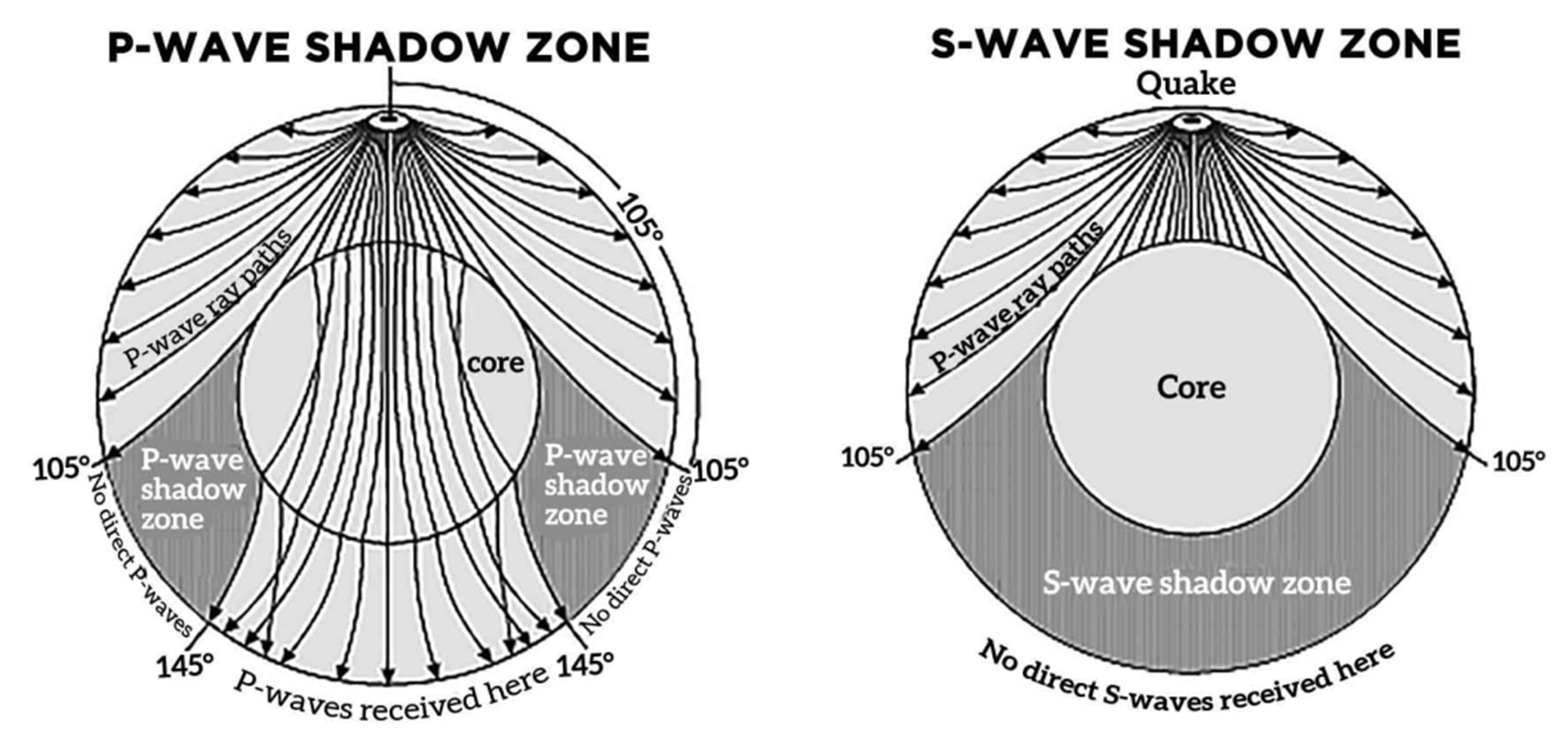
shadow zones
locations where the primary p and s waves don’t reach
p waves: 104 - 145 degrees
s waves: 100 - 100
what do seismograph stations produce
3 seismograms: up-down, N-S, E-W
p waves = mostly up-down
s waves = mostly N-S, E-W
surface waves = all 3
types of surface waves
rayleigh = rolling waves, long period
love = snake like waves
Richter scale
logarithmic, 1-9
calculates energy of earthquake based on amplitude of waves
high proportion of low frequency waves = more energy
the seismic moment (Mo)
more consistent measurement of energy released in an earthquake than richter scale
fundamental measure of eq size

classes of earthquakes

convergent = major - great
transform = moderate - major
divergent = minor - light
fault surface
whole plane of the fault
fault trace
fault intersection with earth’s surface (can see fault scarp)
hypocenter
focus - origin of earthquakes in 3D space
epicenter
location on surface directly above the origin of earthquake
types of faults and their stress
normal = extensional
reverse = compressional
strike-slip = shear
Modified Mercalli Scale
non-scientific scale of earthquake intensity that measures shaking and destruction (impact on people)
how we measured eqs through time
very first seismometers were balls balanced on pedestals - could see which direction was initial jolt
Kiyoo Wadati - waves diminish with distance
Charles F Richter - amplitude on seismograph can be adjusted for epicentral distance, measured surface waves also
Keiiti Aki - seismic moment (Mo), dislocation theory
Gutenberg and Richter energy equation
log10Es ~~ 4.8 + 1.5Ms
Ms = richter scale
problem: saturation. did not work for high values (greater than 6)
moment magnitude (Mw)
Hiroo Kanamori: 𝑀w= 2/3 log10(𝑀o)−6.1 — defined magnitude based on energy (opp of richter)
scaled final equation: 𝑀w= 2/3 log10(𝑀o)−10.7
for eqs >3.5 Mw
fault creep
motion between major earthquakes
gradual, slow slip
more or less aseismic
due to rock type (at surface but also because of changes at depth), pressure conditions, post-eq creep, location of stress
associated with structure damage, mass wasting
deep slip
Fault slip that occurs below where most large earthquakes occur. This deep portion of the two sides of the fault may be sliding aseismically (creeping)
slow earthquakes
hours-months long and recurrence interval of months-years
can accompany megathrusts
and maybe predict megathrusts? (post or pre)
careers in volcanology
geochemist - gas
Geophysicist- seismic
Volcanologist – Ash/tephra
Emergency management – coordinate evacuation, public information,