Chemistry Lecture 3 Exam
 Call Kai
 Learn
 Practice Test
 Spaced Repetition
 Match
 Flashcards
 Knowt Play
1/24

There's no tags or description
Looks like no tags are added yet.
25 Terms
Properties of Waves
Wavelength (λ) is the distance between identical points on successive waves.
Amplitude is the vertical distance from the midline of a wave to the peak or
trough.Frequency (v) is the number of waves that pass through a particular point in
1 second (Hz = 1 cycle/s).
The speed (u) of the wave = λ x v

Light as a Wave
Maxwell (1873), proposed that visible light consists of electromagnetic waves
Electromagnetic radiation is theemission and transmission of energy in the form of
electromagnetic waves.All electromagnetic radiation travels at the same velocity:
Speed of light (c) = 3.00x10^8 m/s3
Wavelength (λ) and frequency (v) are related using
C = λV
Electromagnetic Spectrum

Quantized Energy and Photons
Three observed properties associated with how atoms interact with electromagnetic radiation cannot be explained by waves:
1) The emission of light from hot objects (blackbody radiation)
2) The emission of electrons from metal surfaces on which light is shone (the photoelectric effect)
3) Emission of light from electronically excited gas atoms (emission spectra)
Quantized Energy
Max Planck explained energy by assuming that energy comes in packets called quanta (singular: quantum).
Think of stairs (quanta) versus a ramp (continuous).

Mystery #1, “Heated Solids Problem” Solved by Planck in 1900
When solids are heated, they emit electromagnetic radiation over a wide range of wavelengths.
Radiant energy emitted by an object at a certain temperature depends on its wavelength.
Energy (light) is emitted or absorbed in discrete units
(quantum).
Mystery #2, “Photoelectric Effect” Solved by Einstein in 1905
Light has both:
1. wave nature
2. particle nature
Photon is a “particle” of lighth KE W
hv = KE + W
KE = hv - W
- where W is the work function and depends how strongly electrons are held in the
metal.

The Photoelectric Effect
Einstein used quanta to explain the photoelectric effect.
Each metal has a different energy at which it ejects electrons.
At lower energy, electrons are not emitted
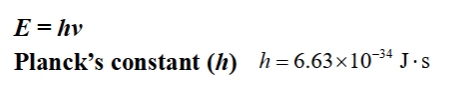
He concluded that energy is proportional to frequency:
E = hv
where h is Planck’s constant 6.626 × 10^-34 Jxs
Atomic Emission of Gas
Another mystery in the early twentieth century involved the emission spectra observed from energy emitted by atoms and molecules.

Atomic Spectrum
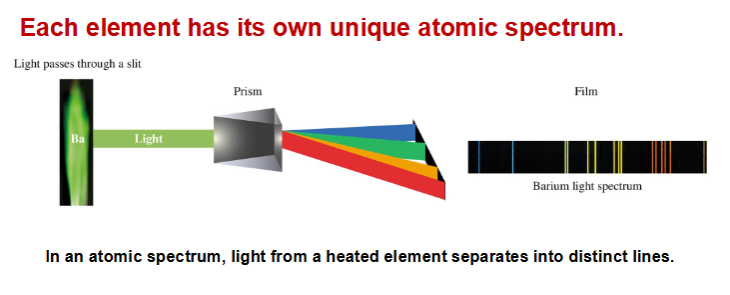
When light from a heated element passes through a prism, it separates into distinct lines of color separated by dark areas called an atomic spectrum.
Line Spectra and the Bohr Model
For atoms and molecules, one does not observe a continuous spectrum (the “rainbow”), as one gets from a white light source passed through a prism
Only a line spectrum of discrete wavelengths is observed.
Each element has a unique line spectrum
Electron Energy Levels
The lines in an atomic spectrum are associated withmthe changes in energies of the electrons.
In an atom, each electron has a specific energy, known as its energy level, which
is assigned principal quantum numbers (n) = (n = 1,
n = 2, …).increases in energy as the value of n increases and
as electrons are farther away from the nucleus.The energy of an electron is quantized—electrons can have only specific energy values.
Electrons and Energy Levels
Electrons with the same energy are grouped in the same energy level.
Energy levels are assigned values called principal quantum numbers (n), (n = 1, n = 2, …).
n increases, as energy increases (farther away from nucleus)
Changes in Electron Energy Level
Electrons move to a higher energy level when they absorb energy.
When electrons fall back to a lower energy level, Light is emitted
The energy emitted or absorbed = differences between the two energy levels.
The Hydrogen Spectrum
Johann Balmer (1885) discovered a simple formula relating the four emission lines to integers.


Bohr’s Model of the Atom (1913)
e- can only have specific (quantized) energy values
light is emitted as e- moves from one energy level to a lower energy level
The Bohr Model
Niels Bohr adopted Planck’s assumption and explained
these phenomena in this way:1) Only orbits of certain radii, corresponding to specific energies, are permitted for the electron in a hydrogen atom.
2) An electron in a permitted orbit is in an “allowed” energy state. An electron in an allowed energy state does not radiate energy, and, therefore, does not spiral into the nucleus.
3) Energy is emitted or absorbed by the electron only as the electron changes from one energy state to another. This energy is emitter of absorbed as a photon that has energyE=hv
h = Planck constant 6.626 × 10^-34 Jxs
Electrons in the lowest energy state are in the ground state, n= 1.
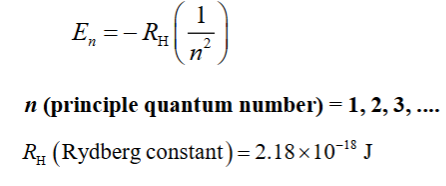
Any energy higher is called an excited state, , n > 1. Since each orbit has a specific value compared to, HR transitions from one energy level to another can be calculated:

Energy State Values
What do the values mean using the Bohr Model?
A positive E means energy is absorbed. A photon is absorbed in this instance.
This happens if nf>ni
A negative E means energy is released. A photon is emitted
in this instance.This happens if nf<ni
Energy Transitions of the Hydrogen Atom

Limitations of the Bohr Model
This model only works for hydrogen (one electron).
1. Classical physics would result in an electron falling into the positively charged nucleus. Bohr simply assumed it would not.
2. Electrons have wave-like properties that must be accommodated.
Important Ideas from the Bohr Model
Points that are incorporated into the current atomic model include the following:
1) Electrons exist only in certain discrete energy levels, which are described by quantum numbers.
2) Energy is involved in the transition of an electron from one level to another.
The Wave Behavior of Matter
Louis de Broglie theorized that if light can have material properties, matter should exhibit wave properties.
He demonstrated that the relationship between mass and wavelength was:

Quantization of Electron Energy
Why is e- energy quantized?
De Broglie (1924) reasoned that e- is both particle and wave.

Heisenberg Uncertainty Principle
How do find a particle that acts like a wave?
Heisenberg uncertainty principle – it is impossible to know simultaneously both the momentum, p (defined as mass times velocity) and the position of a particle with certainty.

The Uncertainty Principle
Heisenberg proposed the dual nature of matter (particle and wave).
He showed that the more precisely the momentum of a particle is known, the less precisely its position is known:
