Physics 1C Formula sheet
 Note
 Call Kai
 Learn
 Practice Test
 Spaced Repetition
 Match
 Flashcards
 Knowt Play
1/30

There's no tags or description
Looks like no tags are added yet.
31 Terms
1. Maxwell’s Equations (Foundational Laws of Electromagnetism)
Gauss’s Law for Electric Fields, Gauss’s Law for Magnetism, Faraday’s Law, Amperes Law

Gauss’s Law for Electric Fields
Use when dealing with electric fields due to a distribution of charges. It connects the electric field to the charge density within a surface.
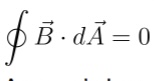
Gauss’s Law for Magnetism
This states that magnetic monopoles do not exist; thus, the magnetic field lines form closed loops. Use this to analyze magnetic fields in enclosed regions.
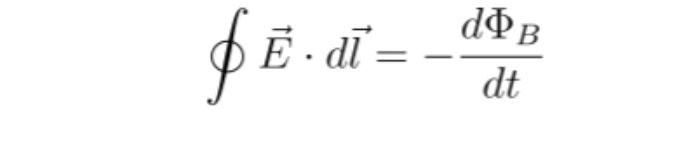
Faraday’s Law
Use when an electric field is generated by a changing magnetic field, as in electromagnetic induction.
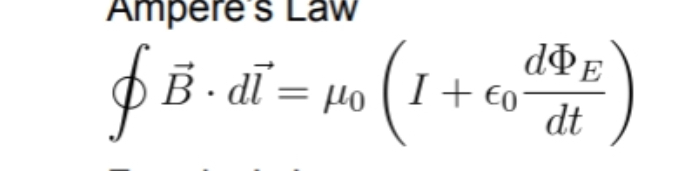
Amperes Law
(with Maxwell’s addition): Use this for magnetic fields generated by electric currents and changing electric fields. It explains how electric currents or time-varying electric fields generate magnetic fields.
Connection of Maxwell equations
Connection: These four laws collectively describe how electric and magnetic fields originate, evolve, and interact, providing the theoretical basis for electromagnetic waves.
2. LC and LRC Circuits (Electrical Oscillations)
LC Circuit, LRC Circuit

LC Circuit
Use for analyzing oscillations in a circuit containing only an inductor (L) and capacitor (C), where energy oscillates between magnetic (inductor) and electric (capacitor) forms.
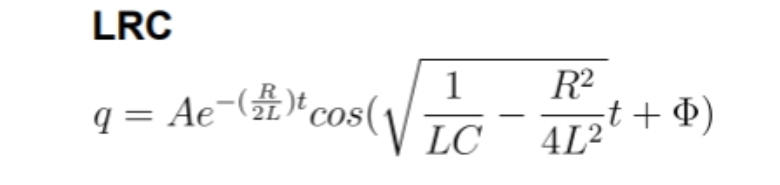
LRC Circuit
Use when resistance (R) is included in the circuit, which causes damped oscillations. This circuit introduces concepts of damping and resonance in AC circuits.
Connection of LC and LRC Circuts
Connection: LC and LRC circuits are key models for understanding how oscillating currents and voltages behave, closely linked to the theory of oscillatory and wave phenomena in fields.
3. AC Circuit Analysis (Alternating Current Circuits)
Impedance and Reactance, RMS Voltage and Current, Power in AC Circuits
Impedance and Reactance
Use to analyze the overall opposition in an AC circuit, especially in the presence of inductors and capacitors. Impedance (Z) combines resistance (R) and reactance (XL and XC ) in a way that determines the phase and amplitude of current and voltage.
RMS Voltage and Current
Use root-mean-square values to calculate the effective voltage and current, crucial for determining power in AC circuits.
Power in AC Circuits in
Use: Pav =Vrms Irms for average power, essential for real-world power consumption analysis.
Connection of AC Circuit Analysis
Connection: The equations here apply directly to electrical energy transfer and are fundamental to understanding how electromagnetic waves interact with matter in conductive environments.
4. Energy in Fields (Electromagnetic Field Energy)
Electric and Magnetic Energy, Poynting Vector
Electric and Magnetic Energy
Use: u=((ϵ0)/2 )*E2+(1/(2μ0))* B^2 for energy density in fields, which is crucial for understanding energy transport in electromagnetic waves.
Poynting Vector
P⃗=(E⃗×B⃗)/ μ0shows the energy flux in an electromagnetic wave, indicating both the direction and rate of energy transfer.
Connection Energy in Fields (Electromagnetic Field Energy)
Connection: Energy equations relate directly to how EM waves carry energy, linking field strengths to the flow of power and intensity.
5. Electromagnetic Waves (Wave Properties and Propagation)
Wave Equation in Vacuum, Wave Equation in Matter
Wave Equation in Vacuum
Use E=cB and c=3×10^8 m/s in vacuum, defining the speed of EM waves and the ratio of electric to magnetic field magnitudes.
Wave Equation in Matter
v= c/sqrt(KKm) and n=c/v , where K and Km are dielectric and magnetic constants. Use these when EM waves travel in materials other than vacuum, affecting speed and wavelength.
connection Electromagnetic Waves (Wave Properties and Propagation)
Connection: Maxwell's equations predict EM waves, which travel without needing a medium and propagate energy. Understanding wave behavior in matter (e.g., refractive index) ties into how light interacts with materials.
6. Radiation Pressure and Intensity
Intensit, Radiation Pressure
Intensity
Use: I= (Emax Bmax)/ 2μ0 to calculate the energy per unit area in EM waves, which is important for applications like solar power.
Radiation Pressure
Prad=I/c describes the pressure exerted by EM waves, relevant in contexts such as solar sails or satellite panels.
Connection Intensity and radiation pressure
Connection: Intensity and radiation pressure are applications of the energy transport and force exerted by EM waves, useful in various engineering and physical scenarios.
Maxwell’s Equations
set up the fundamental rules that govern electric and magnetic fields and their interactions, leading to the discovery of electromagnetic waves.
Circuit Equations (LC, LRC, AC)
show how oscillatory currents create magnetic and electric fields, which in turn can form oscillating waves.
Field Energy and Wave Properties
explain how EM waves carry energy and exert forces, with applications ranging from energy transmission (Poynting vector) to light-matter interactions (refractive index, radiation pressure).
Radiation Pressure and Intensity
apply these theoretical concepts to practical scenarios, linking wave properties to energy transfer and force exertion.