Arch 120 Q2
 Call Kai
 Learn
 Practice Test
 Spaced Repetition
 Match
 Flashcards
 Knowt Play
1/19

There's no tags or description
Looks like no tags are added yet.
20 Terms
Draw an early Christian Basilica
Early Christian
Garden → narthex → nave (center) & aisles → apse.
Based on and inspired by the Roman basilica
Difference between them is that Roman basilicas were concrete, while churches were made of brick, stone, and timber
These churches were plain on the outside but decorative and luxurious on the inside
This was a representation of the human body, how we are plain on the outside but our soul is the beautiful interior
The windows are made of thin, fine marble rather than glass
Built on the site of a destroyed paganistic temple or a Saint’s death spot. (E.g. St Peter in Vatican City)


Acheiropoietos Church, Thessalonkiki
1st half of 5th century
Acheiropoietos means “not made by human hands”
Artwork of Virgin Mary lost during the Ottoman rule gave it its name
It is the oldest church in Thessaloniki and one of the oldest in the world that is still functioning
3 successive mosaic floors under the church’s flooring.
Brick and stone exterior
Baptistry was set off to the side, attached to the main body of the Church
Baptism was a private family matter


Acheiropoietos - interior
1st half of 5th century
Most decoration is gone now, but some remain under the arches
First church in Thessaloniki and was converted into a mosque
Suffered a fire later on, but some of the wooden roof survived
Columns and capitals have a similar style to Corinthian (Theodosian Capitals)
Does not have the original floor anymore after restoration

Acheiropoietos - Theodosian Capitals
1st half of 5th century
Very similar and inspired by Corinthian capital, and was entirely painted
Mosaic in all arches between each capital

Hagios Demetrius, Thessaloniki
Original 5th century; reconstructed after the fire of 1917
Transepts, holds memorabilia of a Saint
Local Thessaloniki saint, bones were taken and placed in the church
5 partite plan (5 aisles)
Holds at least 2,000 people in one congregation

Hagios Demetrius
Original 5th century; reconstructed after 1917
Brick and stone interior, and bell tower on left
Plain exterior

Hagios Demetrius - Interior
Original 5th century; reconstructed after 1917 fire
Originally mosaics covered the interior top to bottom
Colonnades with arches, wooden timber roof, apse mosaic at the end

Hagios Demetrius - Underground church
Early Christian
Found after the Ottomans left
Old church, fountain was found filled with holy water
Terracotta piping system
Ceiling was made during the reconstruction but the rest is original

Hagia Sophia - Constantinople
Early Byzantine
532 - 537 AD
Architects: Anthemius and Isidorus
Dedicated to the wisdom of Jesus (Sophia means Wisdom)
Biggest dome church ever built for a long time, and is still one of the biggest today.
Lower buildings are later Ottoman additions
Union of a rectangular church with a dome in the middle
Made of brick and stone; dome is made of entirely brick which was specially made to be extremely light for the dome
Thick walls; main dome held in place by two half domes
Four stone buttresses also hold up the upper part of the church

Hagia Sophia - Interior
Constantinople
532 - 537 AD
Lots of gold and decoration
Lots of mosaics covering the interior
Second floor was for women
The main decorative element of the church was the dome
All interior windows were strategically place to light the interior of the church up in a specific way

Hagia Sophia - Dome
Constantinople
532 - 537 AD
The base is called a pendentive
Pendentives are spherical triangles made of stone; and in this case are used to carry the dome above and put all weight into the columns below it
40 windows surround the dome

Hagia Sophia, Thessaloniki
Early Byzantine
7th Century
Similar design to the Hagia Sophia in Constantinople, but much smaller
Bricks and stones in interchangeable layers
The exterior is much smoother
Windows are located from ground level and up
Some walls can be three to four feet thick
Women had their own second floor

Hagia Sophia, Thessaloniki
Interior
Early Byzantine
7th Century
Interior was restored after a fire
During the restoration, there was a power change and the conversion was originally for a mosque but then became for a church
The decorations from the mosque were not taken out during the restoration
Classical appearance
3 partite plan (3 aisles)
Mosaic in the apse is from before the restoration of Mary and baby Jesus

Hagia Sophia, Thessaloniki
Early Byzantine
7th century
Dome
Subject of the artwork is the ascension of Jesus
Smaller dome with only 10 windows
Mosaic figures are made to look more human, no halos, made to look realistic

Church of the Holy Apostle, Thessaloniki
Late Byzantine
14th Century
Tall and thin domes
Very decorative exterior
Broken tile design
Churches became wider with multiple domes rather than just having one

Bezesteni Market, Thessaloniki
Ottoman period
15th Century
Made of stone
Small shopping mall for textiles, expensive clothing, sewing work, and jewelry
About 42 to 50 shops located inside, and 30 to 40 shops outside
Domes are supported by pendentives
Second floor does not contain any shops

Bezensteni Market, Thessaloniki
Interior
Ottoman period
15th century
Brick domes were supported by pendentives
42 to 50 shops inside
Second floor contains no shops
Was restored and during restoration they added modern support for the domes

Bay Hamam, Thessaloniki
Ottoman period
15th century
Oldest turkish bath in the area of Greece
Only one of of the many domes that we can see from this point of view, has 20+ domes
Made of stone, bricks on the exterior are only for decoration.

White Tower, Thessaloniki
Ottoman period
15th-16th Century
Built by the Ottomans in replacement of a smaller tower
30 meters tall, made of stone
3 foot thick walls
Stones become smaller as you go up
It was used as a guard tower or defensive tower
The Janissaries were an elite Ottoman infantry, and were stationed in the White Tower. It was their prison and execution site
Executions took place here, so it was nicknamed the Bloody Tower
Later it was painted white, and was given the name White Tower
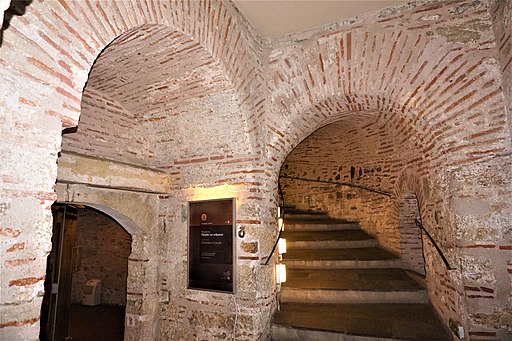
The White Tower, Thessaloniki
Ottoman period
15th - 16th century
Interior brick is only decorative, still made of stone
Base, interior, and all rooms are also made of stone
Rooms are located on the left as you go up the stairs