Topic 2 Atomic Structure
 Call Kai
 Learn
Learn Practice Test
 Spaced Repetition
 Match
Match Flashcards
 Knowt Play
1/17

There's no tags or description
Looks like no tags are added yet.
Name | Mastery | Learn | Test | Matching | Spaced | Call with Kai | Chat |
|---|
No analytics yet
Send a link to your students to track their progress
18 Terms
Subatomic particles
Atoms consist of a positively charged, tiny, dense nucleus, made up of nucleons - positive protons and neutral neutrons.
Negatively charged electrons surround the nucleus in energy levels called shells.
Atoms are neutral as they contain the same number of positive protons and negative electrons.

Mass number, atomic number
Mass number = number of protons + neutrons
Atomic number = no. of protons
Isotopes
→ Isotopes are atoms of the same element that have the same number of protons but different number of neutrons.
They have similar chemical properties, as they still have the same electron configuration.
They have different properties (e.g. density and melting point) because they have different masses due to different no. of neutrons.
Relative atomic mass (Ar) + how to calculate it
The weighted average of the different isotopes of an element relative to 1/12th the mass of a carbon-12 atom.
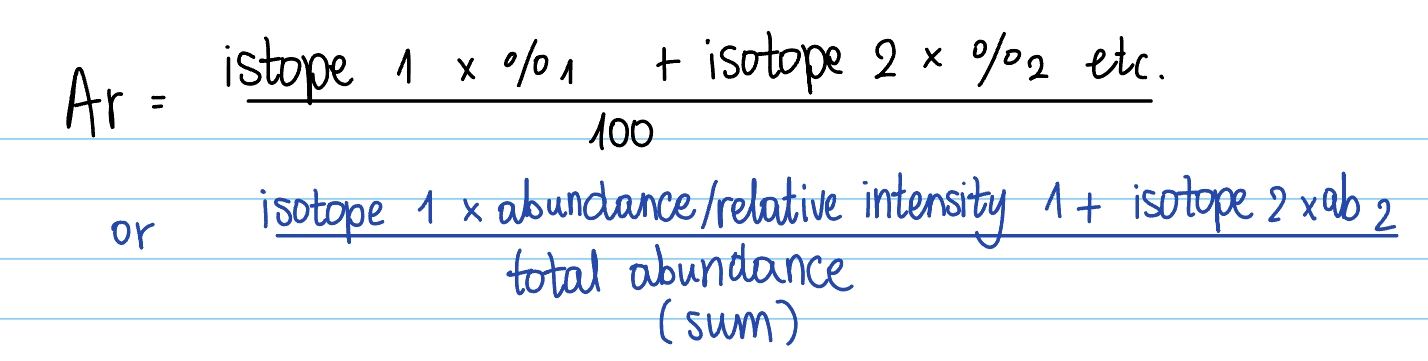
Find percentage composition of an isotope

Subshells
= division of main energy levels
Electrons are arranged in energy levels called electron shells, which have subshells.
s, p, d, f are subshells with sucessively higher energies
EXCEPTION: 4s has lower energy than 3d
(number of energy level (n) = number of types of subshells, e.g. in the 3rd energy level there are 3 types of subshells, s, p, d→ notation = 3s, 3p, 3d)

Orbitals
An orbital is a fixed region of space where there is a high probability of finding an electron.
Each subshell consists of a fixed number of orbitals
s=1, p=3, d=5, f=7 orbitals
Each orbital can hold 2 electrons with opposite spins.

Shapes of orbitals
s orbitals = spherical
p orbitals = dumbbell-shaped (can be Px, Py, Pz)

Max no. of electrons that each main energy level can hold

Rules and principles to follow when deducing the electon configuration
Aufbau Principle: electrons fill lower energy orbitals first(enter lowest energy orbital available)
Hund’s Rule: electrons prefer to occupy orbitals on their own, and only pair up when no empty orbitals of the same energy levels are available
Pauli exclusion principle: Maximum 2 electrons per orbital, which must have opposite spins
Condensed electron configuration
→ replace part of full electron configuration by the previous noble gas, written in square brackets.
e.g. oxygen: 1s²2s²2p4 → [He] 2s² 2p4
The electromagnetic spectrum: relationship between colour, wavelength, frequency and energy across the electromagnetic spectrum
High frequency → high energy, short wavelength
Low frequency → low energy, long wavelength
frequency is directly proportional to energy (since E = h x f, where h is the plank’s constant)
frequency is inversely proportional to wavelength (since c = f x λ , where c is speed, gcse physics equation)

Emission spectrum (plural = spectra)
The pattern of lights emitted that have different wavelengths, produced by atoms emitting photons ( releasing a small packet of electromagnetic energy) when electrons in excited states return to lower energy levels.
Difference between continuous spectrum and line spectrum
Continuous spectrum shows all the wavelengths/frequencies of visible light from red to violet.
(emission) Line spectrum only shows specific wavelengths or frequencies of light, which are shown as coloured lines on a black background.
How are emission spectra produced?
Electrons move/transition between energy levels when they absorb or emit energy, which is in the form of photons, a small packet of electromagnetic energy.
If an electron absorbs an exact discrete amount of energy (possibly due to the atom being heated) , it transitions from a lower to a higher energy level, e.g. from n=2 to n=3
The electron is now in an excited state, which is unstable relative to the ground state (lowest-energy state of an atom).
Therefore the electron emits the same amount of energy it absorbed and transitions back to n= 2.
The amount of energy emitted by the electron in the transition corresponds to the same wavelengths of visible light, e.g. red light.
Thus a red line will appear on the emission line spectrum.
Hydrogen emission spectrum
→ shows 4 different coloured, discrete lines at specific wavelengths on a blackground, that are not evenly spaced and converge at higher energies

What does the hydrogen emission spectrum provide evidence for?
Each electron transition corresponds to a specific line in the emission spectrum, and there are only 4 lines at specific wavelengths instead of a continouous spectrum showing all wavelengths.
→ This suggests that electrons can only exist at certain energy levels.
The lines are not evenly spaced and get closer to each other
→ The energy levels converge at higher energies.
at n= infinity, the electron is completely removed from the atom and is no longer under its influence, it is ionised. (ionisation energy = the amount of energy required to remove one mole of electrons from one mole of gaseous atoms to produce one mole of positive ions)
The complete hydrogen emission spectrum: electron transitions from higher energy levels to n= 1, n=2, n=3
electron transitions from higher energy levels to n=1 : → emit energy that corresponds to (the wavelength of) UV radiation = highest energy transition
electron transitions from higher energy levels to n=2 : → emit energy that corresponds to (the wavelength of) visible light
electron transitions from higher energy levels to n=3 : → emit energy that corresponds to (the wavelength of) infrared radiation = lowest energy transition