oms exam 1
 Call Kai
 Learn
Learn Practice Test
 Spaced Repetition
 Match
Match Flashcards
 Knowt Play
1/99

There's no tags or description
Looks like no tags are added yet.
Name | Mastery | Learn | Test | Matching | Spaced | Call with Kai | Chat |
|---|
No analytics yet
Send a link to your students to track their progress
100 Terms
different understandings of strat comms
replacement for integrated comms (management, marketing, PR, polcomm, etc.)
term for all types of goal-oriented (i.e. economic needs, forming political will, educating citizens) comms initiated by orgs to any kind of stakeholders/audiences
provides understanding for means (paid, earned, owned, shared media), concepts (campaigns, programs), modes (messaging/listening, monologues/dialogues, arguing/persuading/educating)
new role: comms as strategic and decisional (not tactical and supportive) in contemporary, large, private, and publicly treated companies
increasing interest in comms in military and national power context
information warfare (e.g. propaganda)
more cost effective and morally appealing than weapons
strat comms as an alternative term for PR
what is strat comms
the purposeful use of comms by an org in conversations of strategic significance to its goals
not all purposive comms is strategic
includes messaging and listening
convos that have a substantial bearing on the company’s prosperity qualify as strat comms
2 dimensions of crisis
subjective: focus on perceptions of importance of issues, based on collective sense-making and consensus
objective: true impact of an issue (only in retrospect)
taxonomy of strategic issues
identification of issue
strategic: top-down + incorrectly prioritized
strategic: bottom-up + incorrectly deprioritized
strategic: bottom-up & top-down + correctly prioritized
nonstrat: operational/tactical + correctly deprioritized
substantiality of issue
insubstantial: retrospective analysis + objective dimension
substantial: retrospective analysis + objective dimension + external constitution
upper left + bottom right = wrong choices
bottom left = correct, but not strategic – operational
upper right = correct

what makes a problem strategic
resources (critical resource decisions and involvement ab high value assets)
competition [most important] (attempt to gain an edge over competitor in order to evade direct competition)
environment (threatens niches and operations, like tech development, political upheaval)
risk (make-it-or-break-it, like IPOs)
innovation (pioneering efforts, routines are left by the wayside)
engagement (where to employ free resources to the best use)
operational (when orgs alter ways they go about business)
SCM: strat comms management
attempt to manage the comms of strategic significance with regard to focal entity

strat process: 3 steps
strategy formulation & revision
giving sense to actions
strategy presentation
in reports, etc.
strategy execution, implementation & operationalization
resource allocation
strat comms importance
monitoring stakeholder images & expectations
informing & influencing stakeholders
strategy as making choices
comms levels + 3 major traditions
micro: individual
meso: orgs
macro: societal/system
social science: objective, scientific methods –> theories
critical/cultural: reality is subjective (bias)
interpretative/rhetorical: examines discourse, texts, videos, etc.
social evals
traditionally slow/stable
forces changing it: polarization, tech, geopolitical tensions, activism & politicization of business
pos impact: social evals have become more salient & impactful by representing a broader range of interests, values, norms
neg impact: increasing role of AI + algo systems can distort eval processes, amplify signals, erode trust
social evals include: legitimacy, reputation, status, celebrity/infamy, stigma/esteem

traditional bs digital intermediaries
traditional intermediaries (news media & rankings)
few professional gatekeepers curate what becomes visible
which companies/issues people perceive as important
how people eval companies
eval criteria are relatively stable and centralized
orgs have established tactics to influence coverage
slower cycle: reporting, editing, publication
↓
digital platforms (social media, review sites, marketplaces)
a heterogenous (big) crowd of evaluators judges in public
criteria form through algorithms and communities
visibility is continuous, fast, and often outside firm control
social + technological dynamics shape the outcome
digital platforms as social eval intermediaries
they connect evaluators, audiences, evaluated orgs (e.g. review platforms, online marketplaces, social media)
this infrastructure turns evals into visible reputation signals that help people make decisions (signaling theory)
social evals are socially constructed through interactions between members of online communities
influenced by: interaction speed, emotionality, comms intensity, relationships between evaluators
evals are jointly produced by human processes and agentic tech
agentic tech can process info, recommend, judge, assist/exclude human judgements, algo is opaque
platforms can empower previously less-established actors
platforms allow judgement heterogeneity (more diverse stakeholders, values)
orgs face much greater public scrutiny
silent stakeholders can now publicly evaluate
tensions regarding info accuracy
3 lenses on digital platforms
infrastructure
platforms reduce info asymmetries via ratings, reviews & badges that signal past performance
social forums
relationships, discourse
communities of interacting evaluators jointly produce social evaluation outcomes in and through their comms
judgement criteria are negotiated by communities (not by platform)
judgement criteria manifest as interpretative frames that evaluators apply to assess
what makes them powerful: connectivity, speed & emotionality, prolonged visibility
agentic technologies
digital platforms as agents that control, do, have their own logic
algorithms, AI & blockchain shape and co-constitute judgement
filtering and weighting of data
platforms make organizational social evals harder to control
identifying relevant issues (that matter to online communities)
loss of organizational control (social media shifts control)
intensity of interactions (evals can form/change rapidly)
4 typs of visibility
reputation
reputation communities are a critical part of how constituents’ judgments form and change
legitimacy
interactions between evaluators and firms on X shape organizational legitimacy over time
stigma
online groups reduce stigma through deliberate anti-stigma framing tactics
social disapproval
social media communities can become powerful opponents against firms (dislike button, hate comment, etc)
what can orgs do to manage social evals on platforms
design the infrastructure (infrastructure perspective)
reduce info asymmetries through platform design
use reputation badges & context-specific scores
allow responses via permanent replies
build relationships (social forum perspective)
manage evaluations through relationships with communities, not messaging control
firm-centric: identify issues relevant to the org
community/stakeholder-centric: co-create issues together with evaluators
experiment with algorithms (agentic tech perspective)
sense-making replaces control as the core management task
adapt practices reactively to available evaluations and direct feedback
aka playing with the algorithms (seeing what sticks according to the platform), however, it changes so often that it is not successful
how we perceive orgs
by
the pubilc (i.e. new consumers, social media users)
the news & social media (i.e. coverage)
via
interpersonal comms
primary experience
media-mediated comms
importance of media-mediated comms for reputation building
achieves greatest social reach/effect
social media/datafication have socially expanded the process of reputation building
2 camps
visibility of orgs in the media
how salient an org is in the news media
frequency: often – never
reputation & legitimacy (or: trust) of orgs in the media
how an org is evaluated in the news media
tone/valence: pos, neg, neutral
frames
agenda-setting
orgs can influence what we think about via news coverage
the media agenda influences issue setting and issue transfer on the public agenda
salience
first-level: media visibility → public salience/awareness
second-level: attributes emphasised by the media → attributes/evaluations held by the public
agenda-setting criticism
too simplistic:
‘Reality’ → ‘Media reality’ aka the media’s agenda
↘ ↙
Public perception of ‘reality’
undercontextualized influence of the media on public opinion should be reconsidered due to digital structural changes in the public sphere
direction of causality (media → public) is now challenged in hybrid media environment
in the social media landscape, the salience/importance of a subject may be determined by the public and then picked up by the media
eco chambers, filter bubbles, etc.
agenda-building
orgs can influence the media agenda – how the public thinks about xyz
external sources of info, esp political actors, influence the setting and circulation of issues on the media agenda and the public agenda
tone/valence
DSMM: differential susceptibility to media effects model
media messages rarely affect everyone equally
their effects depend partly on characteristics of the person receiving the message.
one important characteristic is the person’s existing attitude toward the company
(e.g. a strong positive reputation can serve as a buffer for damaging info)
org visibility vs media visibility of orgs
org visibility: influence of public agenda on org
media visibility: influence of media agenda on org
what determines how org is covered in news
news value theory: how do ‘events’ become ‘news’
news values/factors help make journalistic decisions
news values determine newsworthiness of stories
more “relevant”/interesting news results in more public activity online
old vs new news values
“old” news values
power elite
celebrity
entertainment
surprise
bad news
good news
magnitude
relevance (personal, community, or society)
follow-up
newspaper agenda
“new” news values (in addition to old news values)
exclusivity
conflict (crisis, war, substantial)
audio-visuals
shareability (attention-grabbing/effective visuals, shocking, simplistic, relevant, clickbait)
drama (“made-up”, trivial)
what has changed in org visibility & reputation/legitimacy building in the times of social media?
control
ease but also more negativity
speed
bulk of content
how do platform dynamics impact agenda-building in the case of CSR comms?
the more the org posts on FB, the more it gets picked out in the news – legacy media matters
the more positive the news about company CSR, the more it improves company reputation
but overall, the news was negative (but corp reputation was less negative/more positive the more positive the news)

news visibility consequences for orgs
negative news courage has more intense effects on reputation than positive news coverage
prior positive reputation buffers the impact of negative news
more visibility of a company in the news is linked to a decline in its reputation
mere exposure effect: repeated exposure to x (e.g. politician) can increase familiarity and lead to more positive evals
CSR paradox
public expects companies to behave responsibly (baseline)
companies actively talk about their responsibility
= skepticism can arise, neg media attention, reputational consequences
+news media don’t reproduce pos CSR messages companies want to communicate
media may therefore cover: environmental pollution, governance violations, irresponsible corporate behavior, other neg CSR issues
legitimacy & why’s it important
generalized perception/assumption that the action of an entity are desirable, proper, or appropriate in socially constructed systems of norms, values, beliefs, and definitions
social norms, moral values, does a company do the right thing
importance
it’s relational: links a legitimacy object (act, org, practice) to an evaluator who confers it first (bestowed view)
legitimacy objects include: a rule, procedure, routine, group, an org, a system of power, etc.
it’s a resource: unlocks material and ideational support (funding, staff, media goodwill) – essential for orgs (possession view)
legitimacy is contested: definition is broad –> scholars keep arguing what “proper” means & for whom
other forms of social judgement (re: legitimacy) & who judges
reputation
image
licence to operate: important to have someone who evaluates critically
trust
status
who judges
media (journalists, socials users)
regulators
investors
advocacy groups
citizens
other types of stakeholders
org features that are judged
pragmatic: does the company contribute to my interests and expectations?
moral: does the company act in line with broader societal expectations?
regulative: does the company meet gov expectations and follow their rules?
cognitive (cultural): does the company have the right to exist?
this legitimacy is either taken for granted or developed over a long time (e.g. pharmacy, the doctor’s) –> it’s not questioned anymore
corporate legitimation
society creates expectations
comms (objective or not) is at the core: if there’s no comms about societal expectations and orgs, it’s hard for us to judge legitimacy
so: society –> comms –> legitimacy
multilevel perspective on legitimacy
individual belief ≠ collective fact
micro: one evaluator’s personal belief that sth is appropriate for its social context (propriety=it’s appropriate)
meso: how much evaluators agree with each other in their propriety beliefs (consensus)
macro: a collective, institutionalized perception exists as a social fact, even if the belief underneath is thin (validity)
media legitimacy
audience-based type of legitimacy
reflected in comms via printed media, tv, or radio, and social media
different functions of mass media and social media in legitimation processes
media as the battleground for legitimacy disputes
media as a source of info for judgements about orgs
media as the amplifier of others’ judgements
media legitimacy as a reflection of public legitimacy?
media legitimacy is also questioned nowadays
media as an institution
involved in the creation, maintenance, and disruption of organizational legitimacy
not only reflects broader social values but embodies, produces, and reproduces particular values and beliefs (agenda-setting and framing)
institutional theory
core shift: “logic of consequences” –> “logic of appropriateness”
asks what actions are considered socially appropriate and legitimate by orgs
–> org behaviour is shaped by the social and institutional environment in which they operate
media influence isn’t random: journalistic routines create logic of appropriateness that determine which orgs/issues receive attention and how they’re portrayed
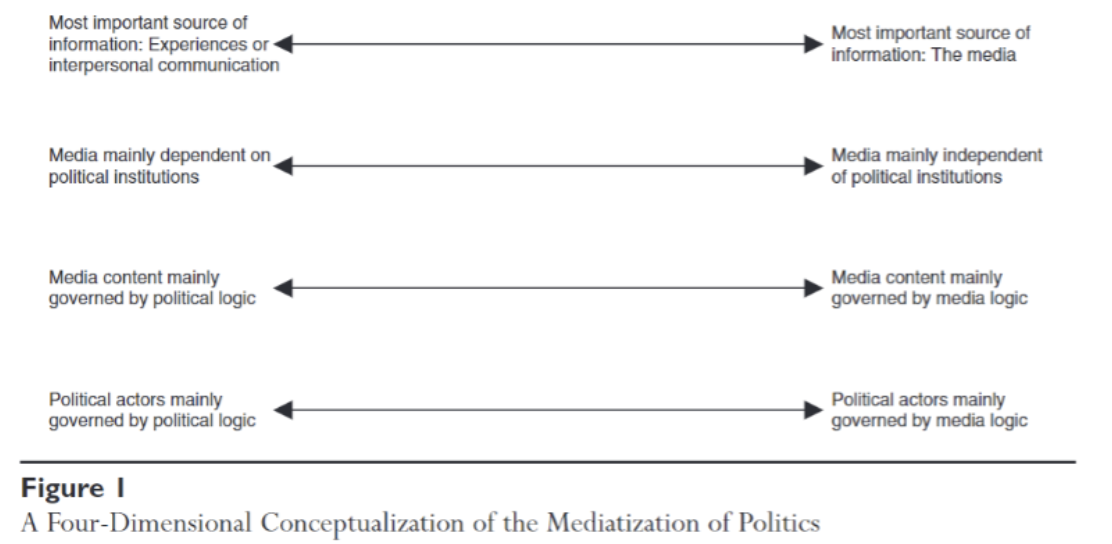
4 phases of mediatization
most important source of info: experiences/interpersonal comms vs media
media dependent vs independent on/of political institutions
media content mainly governed by political logic vs media logic
political actors governed by political logic vs media logic
–> for orgs: media most important source of info, media mainly independent from orgs, orgs adapt to media logic
mediatization of orgs
orgs integrate ideas about the media in contexts where the media was absent previously
eventually these ideas affect org activities, routines, decisions, resource allocation, and comms
e.g. ING Newsroom and TikTok
4 legitimation processes in the news media
A) by default, most orgs are accepted
majority of orgs are “under the radar” aka not featured in news
B) a nr of large public orgs are routinely evaluated
C) some orgs are debated based on poor performance/problematic practices
hence, org’s claim to legitimacy is being questioned (typically in a series of reports) since expectations aren’t met/norms breached
legitimacy is at threat
D) rarely, orgs face disruption as large-scale media storms erupt & corporate responses fail
media storms erupt when problems become scandalas and spread across media outlets & arenas
legitimacy is questioned at a level where it’s almost impossible for the org to address issues

org legitimacy in social media
social media can be considered as contributing to the co-construction of org legitimacy
bc of impact, credibility, and increasing volume, judgments on socials
ppl perceive orgs and their output (on their TLs) & react affectively (e.g. joy, disappointment)
legitimacy is conferred to orgs based on these affect-based responses, which affect judgements
= affect-based responses are verbalized and expressed as evaluative judgements about orgs and their actions
hypertexts
links and blocks of texts are formed via shared content where different users share similar evaluations (co-associations)
co-authorship, fluidity
hypertexts make intended and self-conscious connections, situating them in existing power relations
they’re capable of enabling, coproducing, and/or contesting actors
e.g. a hashtag
tipping point of refracted attention
point is reached when large volumes of heterogeneous evals converge through a hypertext
one clear frame emerges: increases likelihood that new media will cover citizens’ evals with similar legitimacy
reverse agenda-setting
social media democratize news creation to the point that individuals indicate to the news media how and what to focus their coverage on
this phenomenon can be explained by journalists’ increased use of social media as news sources, monitoring the attention that issues attract on social media
framing
media influence how people think about an org by selecting and emphasizing particular aspects of a story
framing = making certain aspects more prominent, which can influence how audiences define, interpret, and evaluate an issue
e.g., coverage focused heavily on CEO, leadership, national identity, company history, etc., rather than structural aspects of the org
mediatization vs mediation
beyond agenda-setting and framing
news media have become an independent institution with their own rules and norms, and orgs increasingly adapt to these rules
mediation: media act as an info-carrying channel between actors
mediatization: media actively select & shape info according to own “media logic”
→ over time, this media logic becomes integrated into how other institutions & orgs operate
bc media coverage can affect their legitimacy, reputation, brand, & policies
media logic: 3 factors
consists of:
journalistic professionalism: journalistic norms, ideals, news values & routines
commercialism: economic/business pressures affecting what media produce
media tech: characteristics of different platforms and tech
crisis
period of time during which the regular org routine is interrupted by an event that poses threats (physical, financial, political, economic, social)
likelihood of loss of trust & reputation increases
role of comms in crisis
although crises have real origins, they are constituted in the communicative interplay
between several actors whose perception of a series of events as a “crisis” produces real consequences for…
political parties, corporate enterprises, financial institutions, protesters, consumers, & the news media
attribution theory
how we interpret others’ actions by assigning causes & motives to their behaviour
in the context of SCCT: based on attributions, people try to determine who is responsible for a crisis (e.g. to what degree is the org responsible)
SCCT: situational crisis comms theory
explains how orgs should respond to crises based on the situation
what makes it situational: attribution of responsibility
attribution of responsibility & crisis comms strategies as central elements of reputation-building/-losing
response should match the level of crisis responsibility stakeholders attribute to the org

crisis types + attribution of responsibility
victim: very low responsibility → e.g. natural disasters, workplace violence, product tampering
org = victim (=couldn’t help what happened)
accidental: moderate/mild responsibility → e.g. technical errors
preventable: high responsibility → e.g. human error, management misconduct
org = fully responsible
contextual modifiers can increased perceived responsibility:
neg prior reputation/relationship
history of previous crises
culture & different voices in the crisis may also matter

crisis cues
natural disasters
workplace violence/outside attack
product tampering: some agent alters a product to make it harmful
technical-error product harm: software/hardware malfunction
technical-error accident: industrial/transpotation accident due to software/hardware malfunction
human-error product harm: employee error
human-error accident: industrial/transportation accident due to employee error
management misconduct: managers’ intentional harmful decision
scansis: managers place stakeholders at risk for financial gain
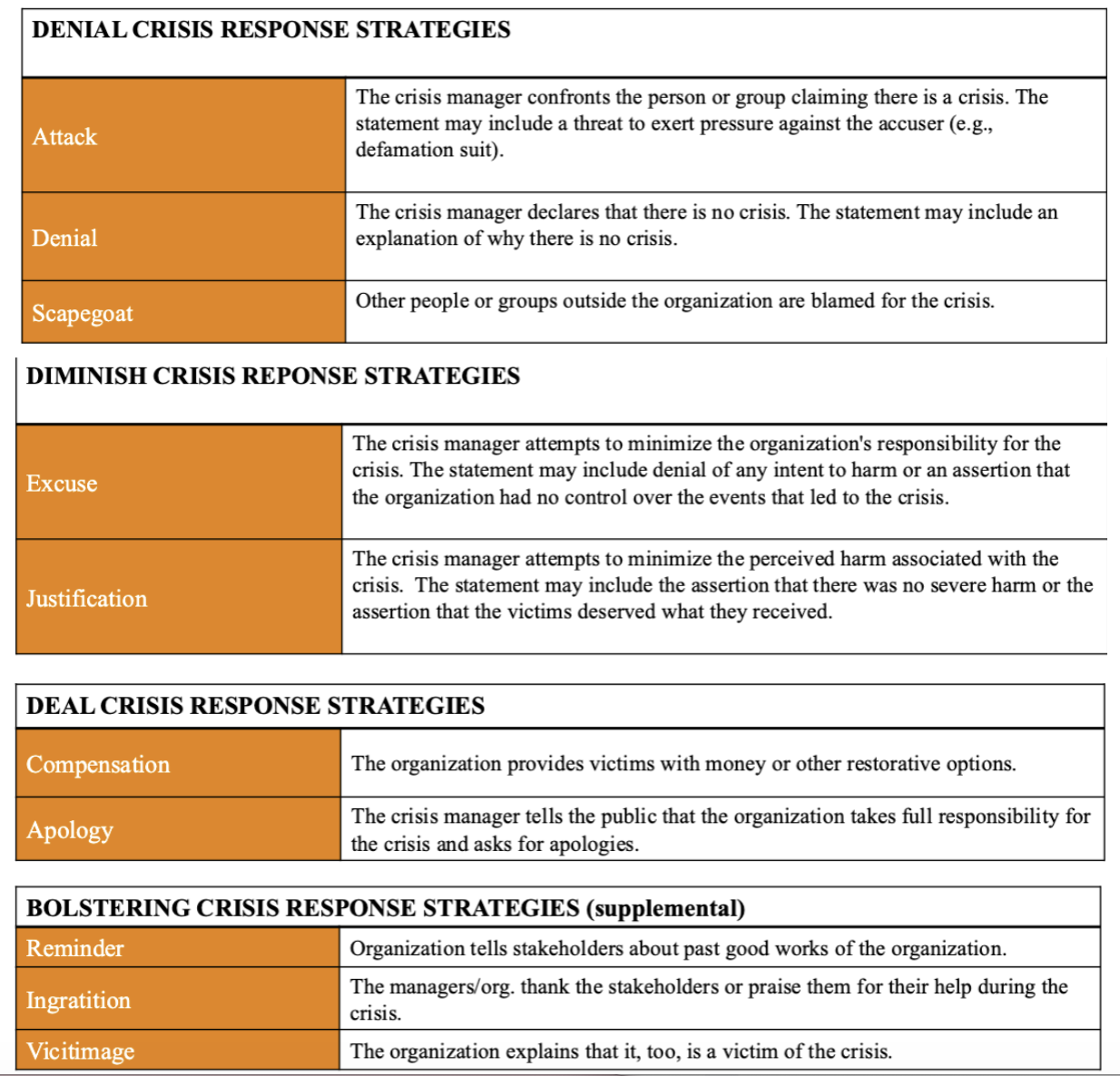
crisis comms strategies/responses
what strategy to choose depends on:
type of crisis –> attribution of responsibility
intensifying factors (crisis & performance history)
timing
ethical base response
instructing info: what people should do to protect themselves physically
adjusting info: helps people cope psychologically (explain what happened, corrective actions, sympathy)
then, if necessary:
deal: apology/compensation → accepts responsibility + focuses on victims
bolstering: reminds people of past good actions/praises helpers → only a secondary/supplementary strategy
diminish: justification/excuse → no longer recommended because research has not shown clear benefits
denial: should not be used for an actual crisis; can worsen damage when the org has responsibility
→ when responsibility is low, ethical base response may be enough
→ when responsibility is high, add reputation-repair strategies such as apology/compensation
crisis response timing: stealing thunder
to use someone else’s idea for one’s own advantage, or to pre-empt them
during crises: comms could take place either
before the problem becomes publicly known & turns into a crisis (stealing thunder or proactive comms)
or after the problem has been known by the public (thunder or reactive comms)
you set the frame/narrative
outcomes of a crisis
public safety
financial loss
or reputation loss
when a crisis is social-mediated, its potentially negative outcomes might be amplified to an unconceivable extent
social forum
everyone can share their opinion on socials (alson on org scandals)
→ (active) comms might become a serious threat for orgs in crises
e.g. Dove, H&M “coolest monkey in the jungle”
SMCC: social-mediated crisis comms
explains how orgs, news media & the public generate, consume, & share info online/offline
before, during & after a crisis
processes are dynamic (e.g. diff social media publics in circles)
3 types of publics (that can generate crisis info)
influential social media creators (create for others to consume, initiate & amplify)
social media followers (consume the content)
consume based on 3 motivations:
issue relevance
info seeking & sharing
emotional venting & support
social media inactives (consume the content via WOM w/ followers & traditional media)
factors that affect whether audiences seek social or traditional media for crisis info
social media & traditional media
convenience
involvement
personal recommendation
info overload
for social media additionally: humour appeal & perceived function of social media
for traditional media additionally: credibility

target audiences of crisis response
victims: who are directly affected by the crisis (e.g. physically, psychologically, or financially injured)
nonvictims: who aren’t injured by a crisis, but can still experience crisis-induced emotions
potential victims: at-risk publics who aren’t harmed by a crisis, but potentially could have been
voyeurs: publics who aren’t at risk for crisis harm, but, nevertheless, pay close attention to how a crisis unfolds
RAT: rhetorical arena theory
assumption that when a crisis occurs, the social space opens to multiple voices to engage in comms activities
the inclusion of social media sub-arenas & how multiple voices are presented & related to each other reflects the dynamics & complexity of crisis comms on social media
regenerative crisis model
the regenerative crisis life cycle indicates that each crisis has its own trigger event
but some factors might be influential enough to change how publics perceive the crisis
e.g. response misconduct or social media users’ neg comments)
and can create new crises (or “secondary crises”) in the original crisis
when the crisis situation changes, a new “sub-crisis” occurs: starts with new trigger events & different topics discussed in a new life cycle
the trigger events of new sub-crises = turning points
the life cycle of a sub-crisis usually overlaps with the original crisis & other sub-crises
emotions in crisis
emotions can be caused by people’s attribution of an org’s responsibility to the crisis
which can be formed by locus of control, intentionality & controllability
attribution-dependent emotions: associated with neg relational outcomes, people’s info processing, & disclosing behaviours
anger, surprise, worry, fear, contempt, alert, disgust, relief
attribution-independent emotions: may lead to supportive behaviours & pos relational outcomes
confusion, shame, sympathy
emotions can be experienced simultaneously
refined SMCC aka SISMI: self-involved social media influencer
self-involved social media influencer can be org/politican/celebrity
rarely discuss the crisis itself – instead, influencers have a clear standpoint (e.g. for/against the org) with strong attitudes/emotional expressions
strategically engage in a crisis by picking an opportune time & sensational rhetoric for their own purposes
usually engage in a crisis for empathy in dialogical comms with the involved publics & to get significant responsiveness from the general public
e.g. Lancôme’s crisis
SISMI vs traditional influential social media creators
SISMI are more strategic in framing & influential
their followers are difficult to persuade
their comms can easily trigger debate & develop a regenerative crisis
unlikely to be affected by org comms
crisis info vetting
publics need to assess the accuracy & credibility of crisis info
primary vetting: assessing the accuracy of info
secondary vetting: assessing the validity of own judgment

crisis info consumption
publics’ perspective: effective crisis comms requires understanding how publics process, transmit & act on crisis info
publics process info to cope with crises
–> understanding crisis emotions
–> info consumption/engagement precedes info seeking & sharing

paracrisis
an org risk that can be seen on social media rather than a real crisis
bc the risk has not been manifested to become an immediate crisis
inout-output model
expains relationships that benefit the org

stakeholder theory + initial model
focus on any group or individual that can affect or is affected by the achievement of an org’s objectives
emphasizes long-term relationships

adapted stakeholder model
different stakeholder levels added

stakeholders vs stakewatchers vs stakekeepers
stakeholders: who have a concrete stake
stakewatchers: who protect the interests of real stakeholders
stakekeepers: who have no stake in the firm but have influence & control
they impose regulations and constraints, while the firm has little reciprocal direct impact on them

stakeholder models’ criticism
(still) not clear regarding an org’s environment
identification & selection of stakeholders
rights or relationships? (legal vs managerial)
central place of the org → management/control?
pre-digital vs digital stakeholder relations
pre-digital
audience: institutional actors (NGOs, activist groups, interest groups)
engagement & relationship: institutional long-term
voices & type of stake: stake in the company
segmentation variable: opinions (sentiment/tone, interests/opinions)
expected impact: segment stakeholders to influence their perception
digital
audience: digital collectives (#boycotters, slacktivists)
engagement & relationship: light form of engagement
voices & type of stake: personal stake, personal publicity, self-enhancement, identity building
segmentation variable: comms behaviour (dependence, influence)
expected impact: engage stakeholders to dialogue with them

issue arenas
real or virtual spaces where stakeholders and orgs interact & publicly discuss a particular issue
ideas and issues are discussed that are of interest to both stakeholders and the org
issues & topics at the centre of comms – not orgs anymore
orgs & stakeholders have a more equal position than traditional models suggest
propose a paradigm change: shift from org-centered thinking & unilateral relationship management to monitoring & dialogue on issue arenas that are outside the org’s control
org survival depends not only on communicating with the “right stakeholders” but also on finding and participating in the right issue arenas
not participating = potentially affecting reputation + legitimacy
they need to listen to multiple voices, not push own viewpoint
controlling may create conflict
different definition of stakeholder: org as stakeholder of an issue
constantly evolving arenas (e.g. crisis)
arenas involve a struggle between different actors, agendas, frames, and interests
orgs usually operate several arenas simultaneously
arenas are interrelated & compete for limited public attention
= model with org as central player outdated
6 axioms of issue arenas
an issue arena is a place where the public debate about an issue is conducted
the interaction takes place in the traditional or virtual media
the actors can be active or passive, one could be “on the stage” or “in the audience”
the arena is dynamic; actors may be more or less active when time passes or leave entirely to go to another arena
an org can be active in multiple arenas, monitoring actions of other parties and/or engaging in actively in the interaction
as the arenas are interrelated, an organization needs to coordinate and balance its communication strategies
issues from an org perspective
disputation: divergent public points of view
expectation: to what extent do the organization’s actions meet public expectations?
impact: positive consequences (e.g., positioning opportunities) or negative impact (e.g., reputational damage)
issue management
the monitoring or scanning of the org environment in order to identify issues and trends, adapt to changes, and/or to decide for managerial or communicative actions that are aimed at creating mutual understanding with relevant stakeholders
proactively identifies emerging problems/changes before they escalate into crises
important for detecting early warnings & potential legitimacy gaps between org behaviour & societal expectations
a systemic process, where issues are managed in an organized and systematic manner that serves strategic decision-making
after monitoring: agenda-setting and decision-making within orgs: how to convince other org actors (e.g., board)?
stakes vs issues
stake: tied to a particular stakeholder and their investment/interest in the org
issue: broader; can involve many actors and does not “belong” to one stakeholder or org
= orgs are thus one participant among many in debates surrounding issues
= involvement can be emotional, ideological, or economic
SLO: social licence to operate
social license to operate constructed in media
is the corporation fulfilling social and moral expectations?
repeatedly renew social “permission” to operate by both anticipating and responding to their social environment
hence, societal engagement becomes especially crucial for corporations now that the socio-political domains and agendas
and therewith those groups who grant corporations their SLO, have the tendency to shift on a regular basis, often in opposing directions
SLO is:
fluid and ongoing;
based on stakeholder perceptions;
capable of being revoked;
closely connected to corporate legitimacy
societal changes that altered orgs’ environment
polarization: opposing principles becoming increasingly separated, stakeholders more often unable to see eye-to-eye
supply side: more niche/partisan media offering ideologically tailored content
demand side: audiences selectively consume information that confirms their existing views (selective exposure/confirmation bias
mediatization: growing social visibility & responsibility of orgs
increased focus on SLO
2 important changes:
orgs receive greater media scrutiny and visibility, often through conflict-, negativity- and drama-oriented coverage
orgs themselves increasingly prioritize comms, PR and media relations internally
4 forms of polarization
dispersion of attitudes
clustering around 2 opposing positions
ideological polarization: positions on different issues become connected
identity-based polarization: systematic differences between social groups
= strengthens in-group vs out-group distinctions
politicization
difficult to escape societal role (with mediatization)
pressure to engage with their environment (renew SLO)
esp socio-political issues high on media/public agenda
politicization of corporations and their environment
corp comms and political issues inherently intertwined
challenges of engaging with polarized issues and renewing SLO
PR & politicization
major shift:
traditional PR: organization-centered → managing relationships/messages
issue-arena approach: issue-centered → monitoring, dialogue, participation and adaptation
= PR becomes a bridging function between orgs & actors
one strategy is insufficient bc arenas involve different actors & interests
CPA might fit some situations, political CSR, etc. others
corporate political activity (CPA)
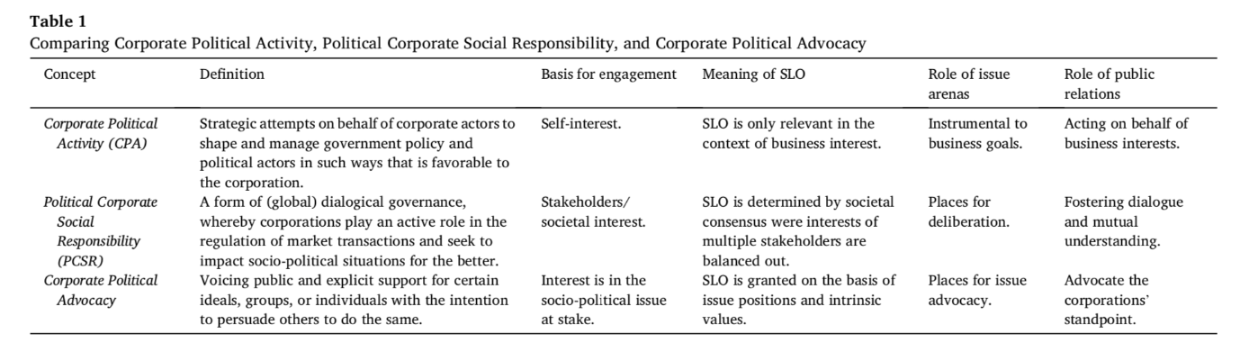
strategic attempts on behalf of corp actors to shape & manage gov policy & political actors in such ways that is favourable to the corp
via lobbying, financial incentives, info, etc.
basis for engagement: self-interest
meaning of SLO: only relevant in the context of business interest
role of issue arenas: instrumental to business goals
role of PR: acting on behalf of business interests
too business-centered
political corporate social responsibility (PCSR)
a form of (global) dialogical governance, whereby corps play an active role in the regulation of market transactions & seek to impact socio-political situations for the better
when govs cannot adequately address societal problems
basis for engagement: stakeholders/societal interest
meaning of SLO: determined by societal consensus where interests of multiple stakeholders are balanced out
role of issue arenas: places for deliberation
role of PR: fostering dialogue & mutual understanding
acts as a broker/mediator
too consensus-oriented: balancing stakeholder interests becomes difficult due to their incompatible political positions
corporate political advocacy
voicing public & explicit support for specific ideals, groups, or individuals with the intention to persuade others to do the same
basis for engagement: interest is in the socio-political issue at stake
meaning of SLO: granted on the basis of issue positions, intrinsic values & moral convictions
role of issue arenas: places for issue advocacy
role of PR: advocate the crops’ standpoint
favoured bc captures situations where corgs publicly choose & promote one position based on their values
= value- & issue-driven > stakeholder-balancing
4 phases of mediatization adapted to the context of orgs
media become the most important source of information
media become/are mainly independent from orgs
media content is mainly governed by media logic (instead of other orgs’ logics) → adaptation to media logic
other orgs (political institutions, other organisations) adapt to the logic of the media → adoption of media logic
normative concerns + new trends
concerns
political interference of corps desirable for all issues?
privatization of social issues?
e.g. corps rolling back DEI, corps pulling out of Russia
trends
from progressive to more conservative values?
increased popularity of rightwing and conservative politicians
americanization?
issue research focuses on US topics (i.e. gun control)
new values pop up, new orgs pop up – what is relevant? how to relate?
comms responses to issues
issues are communicatively constructed (combo of frames, emphases, salience)
when?
issue salience: life cycle phase
agency: active (self-created/-associated/unenforced involvement) or passive issue (involuntary/enforced involvement)
how?
requires reflection
sensitivity of the org’s political, societal and media environments
scenario-thinking
issues lifecycle
if you want to associate yourself with an issue that does not have ownership yet: potential
if you want to bandwagon: current

active vs passive issues
active: self-created/-associated
passive: involuntary/enforced involvement
active vs passive issues (pov: org)
active
proactively trying to put an issue on the public or media agenda, or to establish an association between your org and an ongoing issue
e.g. Ben & Jerry’s LGBTQ+
passive
the other way around: what if the org is involuntarily associated with an issue? which comms options do orgs have in those situations?
e.g. top US chemical firms paid billions to settle water contamination lawsuits (they knew way before, but only acted when they came under backlash)
evaluating issues to guide responses
to what extent is it important? do people care about it?
to what extent is it polarized? is there a unified public ready to act?
variability: do perspectives change or is it predictable?
capability: does it fit the org identity for you to communicate effectively?
involvement: to what extent is the org committed?

OID: organization-issue dynamics model
org ↔ issue ↔ public
treats the relationship between an org and a sociopolitical issue as dynamic rather than treating the issue merely as an external factor
helps to explain whether orgs move between advocacy, accommodation & strategic silence
orgs increasingly face complex, polarized sociopolitical issues and need to decide whether and how to take a stance
stance-taking is an ongoing process involving interaction, exchange, negotiation and recalibration
orgs simultaneously maintain relationships with multiple issues, just as they maintain relationships with multiple publics
they should therefore gather info about an issue's:
development;
societal significance;
risks;
possible trade-offs
= this allows orgs to take more coherent and sustainable positions
2 dimensions: issue complexity & org commitment
issue complexity: importance, divisiveness, variability
commitment: capability, involvement

strong OID means the org…
understands the issue's complexity
has sufficient capability
genuinely invests in the issue;
is prepared to sustain its position;
participates meaningfully in issue-related discourse
= supports reputation, purchase intention, WOM, favourable attitudes
important OID point
an org’s relationship with an issue can change without the org’s underlying values or the issue itself changing
external constraints can alter what the org is actually capable of doing
e.g. Ben & Jerry’s under Unilever
subdimensions of issue complexity
importance
how significant, relevant and urgent an issue is within a particular society/community
importance is not fixed: it differs between publics, industries and points in time
divisiveness
degree of distance/disagreement between opposing positions.
greater distance between positions = greater divisiveness.
depends on context and how the competing positions are defined
variability
situational conditions that cause importance and/or divisiveness to change over time
e.g. political climate, cultural norms, social dynamics, societal consensus, unexpected events
therefore, an issue's complexity is dynamic rather than fixed

subdimensions of org commitment
org commitment: org’s ability and willingness to form, invest in and sustain a relationship with an issue
capability: can the org effectively engage w this issue? aka ability to…
communicate its stance effectively;
maintain stance-action consistency;
create an authentic/truthful connection with the issue;
deal with challenges resulting from stance-taking.
involvement: how much is the org actually committed/invested?
resources allocated to the issue;
investment;
priority given to stance-taking;
persistence despite potential risks;
willingness to influence the issue
shaped by org values, social norms, strategic priorities

stance, accommodation, advocacy
stance: an org’s position in a particular situation, at a particular time, toward a particular public
contingency theory’s basic principle is “it depends”: there is no universally correct stance
stances traditionally exist on a continuum:
pure advocacy ←────────→ pure accommodation
advocacy: organization argues for/defends its own position.
accommodation: organization adjusts or makes concessions toward publics.
orgs can move along this continuum as situations and stakeholder expectations change
positioning
orgs continually determine and adjust their stance throughout issue management, crisis prevention, crisis response and recovery
broader and more dynamic than a single stance
positioning must respond to changes in:
issue characteristics;
public expectations;
media portrayals;
org circumstances
OID adds a Q: how does the org position itself toward the issue itself?