PHYSL 210 Special Senses 1
 Call Kai
 Learn
 Practice Test
 Spaced Repetition
 Match
 Flashcards
 Knowt Play
1/25

There's no tags or description
Looks like no tags are added yet.
26 Terms
Somatic sensation
Sensation from the skin, muscles, bones, tendons, and joints.
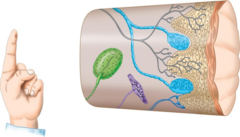
Somatic receptors
Sensory receptors that initiate somatic sensation.
Somatic sensory modalities
Include touch, pressure, posture, movement, temperature, and pain.
Sensory receptors
Specialized cells that generate receptor potentials in response to stimuli.
Receptor potential
A graded potential generated by a sensory receptor.
Stimulus modalities and receptors
Different stimulus modalities are sensed by different specialized receptors.
Meissner's corpuscle
A rapidly adapting mechanoreceptor for touch and pressure.

Merkel's corpuscle
A slowly adapting mechanoreceptor for touch and pressure.

Free nerve endings
Slowly adapting receptors; some detect pain, temperature, or mechanical stimuli.
Pacinian corpuscle
A rapidly adapting mechanoreceptor for vibration and deep pressure.

Ruffini corpuscle
A slowly adapting mechanoreceptor for skin stretch.
Muscle stretch and sodium channels
Stretch increases the opening of specialized sodium channels.
Sodium entry into an afferent fiber
Depolarizes the afferent neuron.
Afferent neuron threshold
Approximately −50 mV.
Threshold depolarization in an afferent neuron
Opens voltage-gated sodium channels and produces an action potential.
Receptor potential and action potential generation
A sufficiently large receptor potential triggers action potentials at the first node of Ranvier.

Receptor cell signaling
A separate receptor cell can release neurotransmitter onto an afferent neuron.

Rapid receptor adaptation
Action potentials cease during sustained stimulation.
Slow receptor adaptation
The receptor potential persists during stimulation, with slight decay.
Stimulus localization
Determining the site of a sensory stimulus.
Overlapping receptive fields
Multiple afferent neurons can respond to stimulation of a shared skin region.
Two-point discrimination
The ability to perceive two nearby stimuli as distinct points.
Lateral inhibition
A mechanism that helps localize stimuli in some sensory systems.
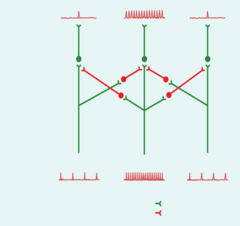
Inhibition at a stimulus edge
Afferent information from the edge is strongly inhibited relative to the center.
Effect of lateral inhibition on contrast
It enhances contrast between the center and periphery of a stimulated region.
Lateral inhibition and localization
Suppressing peripheral information improves the brain's ability to localize sensory input.