ACER 9/14 Lecture #3 Part 1: Atomic Theory
 Call Kai
 Learn
 Practice Test
 Spaced Repetition
 Match
 Flashcards
 Knowt Play
1/8

There's no tags or description
Looks like no tags are added yet.
Name | Mastery | Learn | Test | Matching | Spaced | Call with Kai | Chat |
|---|
No analytics yet
Send a link to your students to track their progress
9 Terms
What is Incandescence? Discuss wavelengths.
the phenomenon where an object emits visible light when at high temperatures
When the atoms of an incandescent object (e.g. lightbulb filament) drop to lower energy states, photons are released in a continuous range of wavelengths that creates the entire visible spectrum when directed through a prism.
How is an Emission Spectrum created?
What does it look like? Why is it important?
When an atomic light source (gas discharge tubes or spectral lamps: gas tubes of hydrogen and helium stimulated by electricity) emits photons of specific wavelengths and those photons go through a prism, a sequence of distinct sharp lines of color is formed.
This sequence of colored lines is an emission spectrum. Every element has a unique emission spectrum.
Why do atomic light sources not create a continuous spectrum of light, unlike incandescent light sources?
Atoms in incandescent solids are packed so tightly together that their electron clouds overlap and their energy states split into trillions of slightly different energy states packed together, allowing for the solid to emit a spectrum of all wavelengths.
Atoms in atomic light sources are further apart and rarely touch, so the atoms can only exist in their normal, discrete energy states.
Absorption Spectrum (how is it created, what does it look like)
Created when white light from an incandescent source passes through an atomic gas source and hits a prism, resulting in a spectrum of light with sharp dark lines
The atoms in the atomic gas source will absorb photons from the white light that match the specific energy they need to move to a higher energy state. The dark lines correspond to those wavelengths that are absorbed.
Appears like an inverted emission spectrum
What are two formulas derived from Planck’s equation for energy? What are these formulas used for?
c = λv
v = c/λ
These formulas can be used to calculate the wavelength or frequency of an EM wave.
Know how to convert a light’s color to wavelength and frequency, and vice versa.
What does Balmer’s equation describe? What is Rydberg’s equation and how is it related?
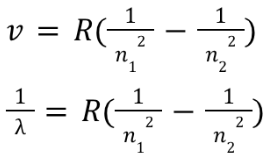
Draw the modern Rydberg’s equation. What is it used for? Don’t explain the constants yet.
Balmer’s formula described the emission spectrum lines of the H atom in the visible light range.
Rydberg’s formula expanded Balmer’s formula to include other series than visible, such as UV and infrared.
The Rydberg formula can be used to calculate the frequency of any electron transition for atoms with one electron. Planck’s equation could then be used to find the energy or wavelength of the specific photon involved in the transition.

What do n1 and n2 represent in Rydberg’s equation? Why does Balmer’s equation not have n1 and n2?
What is the first Balmer line (describe the transition)?
n1 is the lower, final energy state where the electron ends and n2 is the higher, initial energy state where the electron starts falling. Since the electron drops to a lower energy state in order to emit light, n2 should always be greater than n1.
Balmer’s formula uses ¼ instead of 1/n12 because the Balmer series only covers visible light. n = 2 represents the lowest excited state while n = 1 represents the ground state. The first Balmer line is 3-2 (a transition from the second excited state to the first excited state). Ground state isn’t included in Balmer’s formula because the change in energy from excited to ground state is too large a drop and would result in UV light instead of visible light.
What are the two forms of Rydberg’s equation? What is the difference between the two forms (and constants)?
The Rydberg’s equation has two forms for convenience, allowing for direct calculations to either frequency or wavelength. The Rydberg constant is different for the two formulas.
For v: R = 3.29 × 10¹⁵ s-1
For 1/λ: R = 1.097 × 10⁷ m-1
Other than the left side of the formula and the constant, the two forms are the same.
Describe the three series for different final destination energy shells in a hydrogen atom.
(Discuss nf and the type of EM radiation emitted)
Lyman series: consists of transitions where nf = 1 meaning there is a large drop in energy where the electron returns to ground state and emits UV light
Balmer series: consists of transitions where nf = 2 meaning there is a medium drop in energy where the electron moves to the first excited state and emits visible light
Paschen series: consists of transitions where nf = 3 meaning there is a tiny drop in energy where the electron moves to the second excited state and emits infrared light