Care of Mother With Complications of Childbearing: During Pregnancy
 Call Kai
 Learn
Learn Practice Test
 Spaced Repetition
 Match
Match Flashcards
 Knowt Play
1/100

There's no tags or description
Looks like no tags are added yet.
Name | Mastery | Learn | Test | Matching | Spaced | Call with Kai | Chat |
|---|
No analytics yet
Send a link to your students to track their progress
101 Terms
Gestational Hypertension
New-onset hypertension after 20 weeks of pregnancy
Without proteinuria or signs of organ damage
BP ≥ 140/90 mmHg
Occurs after 20 weeks gestation
No evidence of preeclampsia
Often asymptomatic
Preeclampsia
Pregnancy-induced hypertension with evidence of organ involvement
Usually occurs after 20 weeks gestation
Classic Signs:
Hypertension
Proteinuria
Edema (especially face/hands)
Severe Warning Signs:
Severe headache
Blurred vision / visual disturbances
Epigastric or right upper quadrant pain
Hyperreflexia
Decreased urine output
Sudden weight gain
Shortness of breath
Mild Preeclampsia
≥140/90
Proteinuria or mild symptoms
Severe Preeclampsia
≥160/110
Organ dysfunction, severe symptoms of preeclampsia
Magnesium sulfate
Game Changer:
Prevention of seizures for preeclampsia
Calcium gluconate
Game Changer:
Antidote for magnesium toxicity
Left lateral position
Game Changer:
Improves uteroplacental circulation
Non-stress test (NST)
Biophysical profile (BPP)
Ultrasound for growth
Fetal movement monitoring
Fetal Assessment for Preeclampsia
Labetalol
Hydralazine
Nifedipine
Medications used to control severe hypertension for preeclampsia
Decreased/absent deep tendon reflexes
Respiratory depression
Decreased urine output
Toxicity Signs of Magnesium Sulfate
Left lateral position
Positioning to prevent injury for patient with preeclampsia
Eclampsia
Preeclampsia with seizures
Before Seizure:
Severe headache
Visual disturbances
Hyperreflexia
Epigastric pain
Restlessness
During Seizure:
Convulsions
Loss of consciousness
After Seizure:
Postictal confusion
Possible fetal distress
Seizure symptoms in patient with Eclampsia
Side lying position
Positioning during seizure in patient with eclampsia
Severe headache and blurred vision
Game Changer:
Warning signs in patient with Eclampsia
Delivery of fetus and placenta
Game Changer:
Definitive treatment of eclampsia
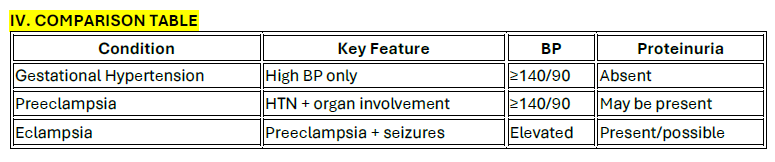
Gestational hypertension, Preeclampsia, and Eclampsia Comparison Review
Gestational Diabetes Mellitus
Glucose intolerance first diagnosed during pregnancy
Usually develops during the 2nd or 3rd trimester
Caused by increased insulin resistance due to pregnancy hormones
24–28
Game Changer:
GDM usually occurs during ___ weeks
Insulin resistance
Game Changer:
GDM is caused by ___ from placental hormones
Insulin
Game Changer:
___ is the drug of choice during pregnancy
Glucose Challenge Test (GCT)
Oral Glucose Tolerance Test (OGTT)
Diagnostic Tests for Gestational Diabetes Mellitus
Macrosomia
Large baby due to excess glucose transfer Fetal/Newborn Complication
Hypoglycemia after birth
High fetal insulin levels after delivery Fetal/Newborn Complication
Respiratory distress
Delayed lung maturity Fetal/Newborn Complication
Birth trauma
Large fetal size Fetal/Newborn Complication
Macrosomia
Game Changer:
Most common fetal complication
hypoglycemia
Game Changer:
After birth, newborn is at risk for ___
B – Blood glucose ↑
I – Insulin resistance
G – Gestational onset
B – Baby macrosomia
A – Assess glucose
B – Breastfeeding encouraged
Y – Yearly diabetes screening after pregnancy
Game Changer:
GDM = “BIG BABY” meaning
Hyperemesis Gravidarum
A severe form of nausea and vomiting during pregnancy
Causes dehydration, electrolyte imbalance, and weight loss
Commonly occurs during the 1st trimester
IV fluids (commonly normal saline or lactated Ringer’s)
Fluid replacement for hyperemesis gravidarum
Vitamin B6 (pyridoxine)
Doxylamine
Ondansetron (as prescribed)
Antiemetic Medications for Hyperemesis gravidarum
Thiamine (Vitamin B1)
Game Changer:
Give ___ before glucose administration in severe cases of Hyperemesis gravidarum. This prevents Wernicke encephalopathy.
hCG
Game Changer:
Common hormone involved in Hyperemesis Gravidarum
Hydration status and weight loss
Game Changer:
Most important assessment for Hyperemesis Gravidarum
Ketonuria
Game Changer:
___ in Hyperemesis gravidarum indicates starvation/decreased nutrition
Placenta Previa
Implantation of the placenta in the lower uterine segment, partially or completely covering the internal cervical os.
Main concern: painless vaginal bleeding during the second half of pregnancy
Painless bright red vaginal bleeding
Game Changer:
Classic sign of Placenta Previa
Complete / Total previa
Placenta completely covers cervical os
Partial previa
Placenta partially covers cervical os
Marginal previa
Placenta reaches edge of cervical os
Low-lying placenta
Placenta implanted near cervix but does not cover os
Ultrasound
Transvaginal ultrasound
Fetal Monitoring
Game Changer:
Diagnostics for placenta previa
Cesarean
Game Changer:
Complete previa usually requires ___ delivery
No digital vaginal examination
Game Changer:
Important safety rule for placenta previa to prevent disrupt placenta and severe hemorrhage
Abruptio Placenta
Premature separation of a normally implanted placenta from the uterine wall before delivery of the fetus.
It is an obstetric emergency because it can cause maternal hemorrhage and fetal compromise
Revealed
Concealed
Mixed
Types of abruption in abruptio placenta
Revealed (External)
Abruption where blood exits through v*gina
Concealed (Internal)
Abruption where blood trapped behind placenta; may have severe symptoms without visible bleeding
Mixed
Abruption where there is a combination of external and internal bleeding
Abruptio placenta
Game Changer:
Painful bleeding + rigid uterus
Hypertension/preeclampsia
Game Changer:
Most common risk factor for abruptio placenta
hypoxia/fetal distress
Game Changer:
Main fetal concern in Abruptio Placenta
Clinical
Game Changer:
Abruptio placenta diagnosis is primarily ___. Treat shock first, then manage delivery
Abortion
Termination of pregnancy before fetal viability
Commonly defined as before 20 weeks gestation or fetal weight <500 g
Threatened
Inevitable
Incomplete
Complete
Missed
Septic
Types of abortion
Cervix status
Game Changer:
___ is key in classification of Abortion
Threatened abortion
Game Changer:
Abortion from closed cervix, pregnancy may continue
Inevitable abortion
Game Changer:
Abortion with dilation → cannot be stopped
Incomplete abortion
Game Changer:
Abortion with retained products → bleeding continues
Missed abortion
Game Changer:
Abortion with fetal death without expulsion
Septic abortion
Game Changer:
Abortion with fever + infection + foul discharge
Iron Deficiency Anemia
A condition where there is decreased hemoglobin due to insufficient iron
Most common anemia in pregnancy
Caused by increased iron demand during pregnancy not met by intake
Oral iron: ferrous sulfate is common
Take with vitamin C to enhance absorption
Iron Supplementation for Iron Deficiency Anemia in Pregnancy
Iron supplements
Best taken on empty stomach (if tolerated)
Avoid taking with milk, tea, or antacids
May cause black stools (normal)
Liver, red meat, fish
Heme iron
Non-heme iron
Beans, spinach, green leafy vegetables
Parenteral iron (IV iron)
Blood transfusion
Medical management for severe anemia in pregnancy
iron deficiency
Game Changer:
Most common anemia in pregnancy = __ anemia
Low serum ferritin
Game Changer:
Diagnostic marker for Anemia
Vitamin C
Game Changer:
Best absorption enhancer for iron deficiency anemia in pregnancy
Black stools + constipation
Game Changer:
Common side effect of iron
Blood volume
Game Changer:
Iron is needed because pregnancy increases ___
Folic Acid Deficiency in Pregnancy
A condition where there is insufficient folic acid (Vitamin B9) intake
Leads to megaloblastic anemia and fetal neural tube defects
Megaloblastic (macrocytic) anemia
Game Changer:
Folic acid deficiency
Neural tube defects
Game Changer:
Most important fetal effect of folic acid deficiency
Examples: Spina bifida and anencephaly
400–800
Game Changer:
Folic Acid Supplementation preventive dose for Folic acid deficiency = ___ mcg/day
Conception
Game Changer:
Folic Acid Supplementation for folic acid deficiency in pregnancy needs to be started before ___
Game Changer:
RBC type for fo= macrocytic (large cells)
Pre-existing diseases
Game Changer:
Medical conditions already present before pregnancy
Example: diabetes, hypertension, heart disease
Co-existing diseases
Game Changer:
Conditions that develop or are diagnosed during pregnancy
Example: infections, anemia, gestational diabetes
Chronic Hypertension
High BP before 20 weeks or before pregnancy
Diabetes Mellitus (Pre-gestational)
Type 1 or Type 2 diabetes before pregnancy
Heart Disease
Most dangerous maternal condition in pregnancy
Chronic Hypertension
Diabetes Mellitus
Heart Disease
Renal Diseases
Thyroid Disorders
Asthma
Common Pre-Existing Diseases in Pregnancy
Anemia
Infections
Gestational Diabetes
Hypertensive Disorders of Pregnancy
Common Co-Existing Diseases in Pregnancy
Maternal disease
Game Changer:
Controlling this is the key to fetal survival
IUGR, placental abruption
Fetal risk from hypertension of the mother
Macrosomia, hypoglycemia
Fetal risk from diabetes of the mother
Preterm birth
Fetal risk from heart disease of the mother
Low birth weight
Fetal risk from renal disease of the mother
Congenital anomalies
Fetal risk from infection of the mother
Basic Emergency Obstetric and Newborn Care
Game Changer:
BEmONC meaning
Services provided at primary health facilities (RHU, BHS, small hospitals)
Comprehensive Emergency Obstetric and Newborn Care
Game Changer:
CEmONC meaning
Provided at hospitals with surgical + specialist capability

BEmONC Signal Functions (7+1) Review

CEmONC Signal Functions Review

Key Differences of BEmONC and CEmONC Review
BEmONC
Game Changer:
Magnesium sulfate for eclampsia if function of the (BEmONC or CEmONC)
Uterotonics
Game Changer:
This prevent postpartum hemorrhage
Neonatal resuscitation
Game Changer:
Required in both levels (BEmONC and CEmONC)