Cable Theory Lecture
 Call Kai
 Learn
 Practice Test
 Spaced Repetition
 Match
 Flashcards
 Knowt Play
1/40

There's no tags or description
Looks like no tags are added yet.
41 Terms
how long a signal decays is given by
cable theory
Cable theory equation

lamina
space constant
tau
time constant
to see how voltage changes over the course of the time is given by

what happens as we move lamina on a current clamp
as we increase lamine our initial voltage decreases by a factor of e. This occurs in a bidrectional fashion across the axon

ri
axial resistance (ohm/cm)
rm
membrane resistance (ohm times cm)
Cm
membrane capacitance (F/cm²)
assumptions in cable theory
membrane parameters, ri, rm, and cm are linear and uniform and constant on all parts of the neuron and are not dependent on membrane potential
ro= 0
passive properties
leak channels
active properities
voltage channels
length constant is
square root of rm/ ri

increase of rm
increases length constant, and voltage travels farther
increase in ri
length constant decreases and voltage doesnt travel as far
R input in an axon
sqrt rm ri / 2

rm
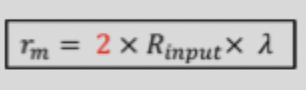
ri

the resistance of an axon can also be given in terms of resistivity
true
what is resistivity
explains how strong things opposes an electric current
membrane resistance in terms of resistivity
rm= Rm/C = Rm/2pia
rm large axon vs rm small axon
rm (large axon) < rm (small axon)
more area= more charge carriers= more conductance = lower resistance
space constant as a function of geometry
uses the resistivities instead
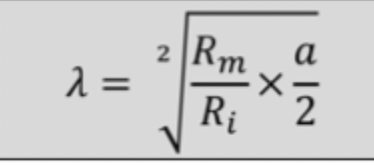
rm in terms of geometry

ri in terms of geometry

bigger radius
voltage decays less
smaller radius
voltage decays more
tau is defined where
when lamina is equal to 1
how does tau change at different points in the axon
it’s one space constant away
time constant is
independent of axon diameter

action potential propagation
dependent on length constant and time constant
length constant
greater is equal to faster velocity
time constant
smaller time constant= faster velocity
length constant is the
only variable that increases with axon diameter
the time constant remains constant!!
myelination
oligodendrocytes and schwann
schwann
PNS
oligodendrocytes
CNS
tau , Ri, and myleination
Ri does not change but Tau does because of Cm. There is a reduction in Cm
lower Cm
lower charge or lower capacitance
does Rm change in myelination
no
myelination and AP
time constant= has a large decrease
space constant= small increase