Class Amphibia
 Call Kai
 Learn
 Practice Test
 Spaced Repetition
 Match
 Flashcards
 Knowt Play
1/32

There's no tags or description
Looks like no tags are added yet.
33 Terms
What is the common name for Class Amphibia?
Amphibians.
What are examples of amphibians?
Frogs, toads, and salamanders.
What does the word amphibian refer to?
An animal that typically lives part of its life in water and part on land.
How do amphibians typically breathe?
Through lungs, skin, and sometimes gills during larval stages.
Why must amphibians keep their skin moist?
Moist skin allows gas exchange.
What is metamorphosis?
The developmental change from a larval form into an adult.

What is a tadpole?
The aquatic larval stage of a frog or toad.
What are the three major orders of amphibians?
Urodela, Anura, and Gymnophiona.

What are caecilians?
Limbless amphibians belonging to Order Gymnophiona.
What is the common name for Order Urodela?
Salamanders and newts.
What is another name for Order Urodela?
Order Caudata.
What body feature distinguishes Urodela from Anura?
They retain a tail as adults.

What is an example of a salamander?
Mudpuppy.
What is the scientific name of the mudpuppy?
Necturus.
What are external gills?
Feathery structures outside the body used for respiration.
What is paedomorphosis?
Retention of juvenile characteristics into adulthood.

Why is the mudpuppy considered paedomorphic?
It retains external gills as an adult.

How do salamanders generally move?
By walking or crawling using four limbs.
What is the common name for Order Anura?
Frogs and toads.
What does Anura mean?
Without a tail.
What body feature distinguishes adult frogs from salamanders?
Adult frogs lack tails and have enlarged hind limbs.
What is the function of a frog's enlarged hind limbs?
Jumping and swimming.

What is a tadpole?
The aquatic larval stage of frogs and toads.
What happens during frog metamorphosis?
The tail disappears, limbs develop, and the body changes into an adult.

What is an American toad?
A species of amphibian belonging to Order Anura.
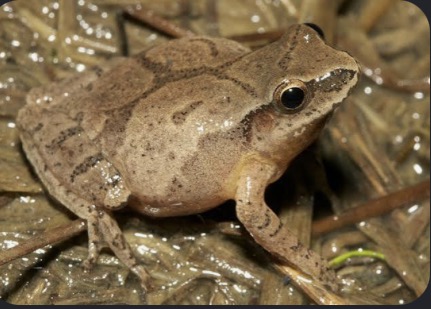
What is a spring peeper?
A small tree frog known for its high-pitched call.

What is an Eastern narrow-mouthed toad?
A small frog-like amphibian with a narrow mouth.

What is an American bullfrog?
A large frog known for its deep call.
Why do frogs produce vocalizations?
To communicate, especially during mating and territory defense.
How can scientists use frog calls?
To identify species and monitor amphibian populations.
Why are frog calls useful for identifying species?
Different species produce distinctive calls.

Southern leopard frog
medium-sized amphibian with dark spots on its back that lives in wetlands, ponds, and marshes in the southeastern United States.