Exam 2 Formulas iPhone - Physics
 Call Kai
 Learn
 Practice Test
 Spaced Repetition
 Match
 Flashcards
 Knowt Play
1/31

There's no tags or description
Looks like no tags are added yet.
32 Terms
Series connection relationships
Current is the same for all individual resistors
Total voltage is the sum of the voltages across the individual resistors

Parallel connection relationships
Voltage is the same for all individual resistors
Total current is the sum of the currents through the individual resistors

Capacitance - Configuration of two conductors/plates
C (Capacitance): The amount of charge a device can store per volt. Measured in farads (F) (coulombs per volt).
Q (Charge): The magnitude of the equal and opposite electric charge stored on each conductor or plate, measured in coulombs (C).
V or V (Potential Difference): The voltage (electric potential difference) across the capacitor, measured in volts (V).

Capacitance - Parallel plate capacitor
A = Overlapping surface area of the conductive plates
d = Separation distance between the two plates

Capacitance - Cylindrical capacitor
L: length of cylindrical capacitors (m)
a: radius of inner conducting cylinder
b: radius of outer conducting cylinder

Capacitance - Spherical capacitor
a: radius of inner conducting sphere
b: radius of outer conducting sphere

Parallel combination of capacitors

Series combination of capacitors
(Take the reciprocal of the final sum (switch numerator and denominator places) to get C-series

Capacitance - Dielectric material effect
κ: dielectric constant of the insulating material placed between the plates (κ=1 in a vacuum, κ>1 for all insulators)
C₀: The original capacitance of the system in a vacuum
So, inserting a dielectric always increases total capacitance

Voltage (Electric Potential Energy) - Configuration of two conductors/plates
V: Electric potential difference (voltage) measured in volts (V).
Q: Electric charge stored on a conductor or capacitor plate measured in coulombs (C).
C: Capacitance, which measures the ability to store charge per unit of voltage, measured in farads (F).

Ohm's Law - Voltage (Electric Potential) in a Circuit

Voltage (Electric Potential Energy) - Fundamental Definition
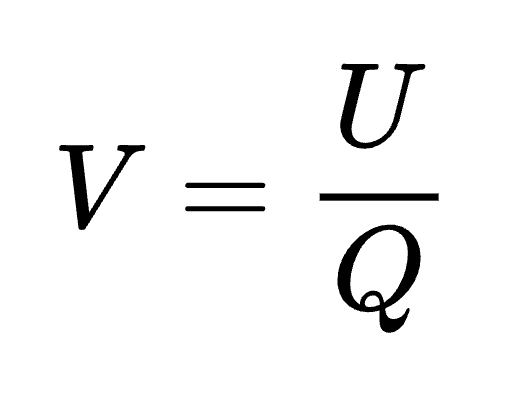
Voltage - Electric Potential Difference between two points
Δ V (Electric Potential Difference / Voltage): Measured in Volts (V). It represents the "push" that moves charges.
Δ U (Change in Electric Potential Energy): Measured in Joules (J). It is the work done by or against an electric field to move the charge.
Q (Electric Charge): Measured in Coulombs (C). It is the amount of charge being moved.

Work done by/on a charge moving through an electric field
This formula determines how much energy is transferred or transformed when a charge moves through an electric field.

Electric Field given Electric Potential (Voltage)
Es=−∇V (also written as ∂ V / ∂ s): The negative gradient (spatial derivative) of electric potential
Gradient is the partial derivative of a polynomial in terms of a variable. Any other variables are treated as constants.
s denotes the direction that Electric Field points

Voltage (electric potential) at a point in space surrounding a point charge
ke (Coulomb’s Constant)
r (Distance): The radial distance from the center of the point charge Q to the point where you are measuring the potential, measured in meters (m)

Voltage (Electric Potential) - Electric Dipole
Above is the potential at a distant point (r, θ ) from a dipole with dipole moment p
An electric dipole is a system consisting of two equal and opposite point charges (+q and -q) separated by a fixed, finite distance (d)

Voltage - Charged rod/line segment
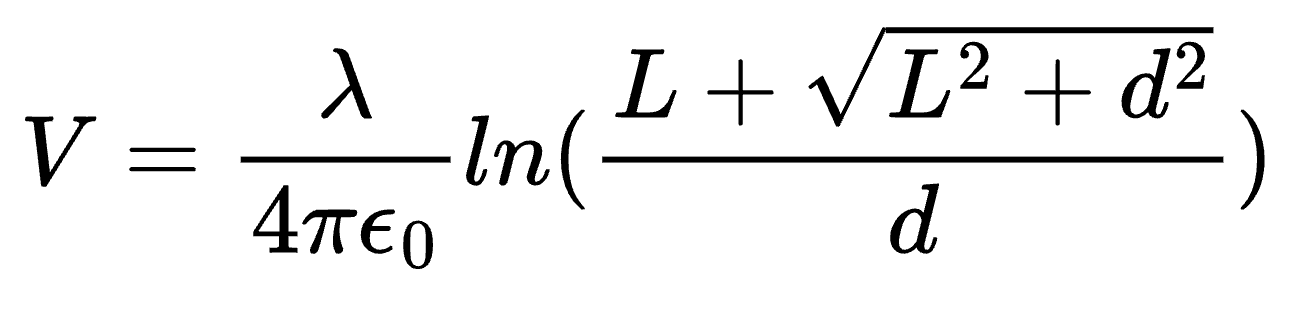
Above is the potential at a perpendicular distance d from the end of a uniformly charged rod of length L and linear charge density λ
The rod is placed along an axis (e.g., the x-axis from x=0 to x=L), and the potential is calculated at a point outside the rod along that same axis, at a distance d from the end (e.g., at x=L+d).
Voltage - Uniformly charged disk
V: The electric potential at a point on the axis, at a distance z from the center of the disk (measured in Volts, V).
: The uniform surface charge density of the disk
ε₀: The permittivity of free space (≈8.86×10⁻¹²)
R: The radius of the charged disk (measured in meters, m).
z: The distance from the center of the disk along its central perpendicular axis (measured in meters, m). This formula assumes z>0.

Kirchhoff's Voltage Law (KVL)
Kirchhoff's Voltage Law (KVL) states that the algebraic sum of all electrical potential differences (voltages) around any closed loop in a circuit equals zero.
So, the sum of all individual voltage drops across the series components equals the total supply voltage (Vin=V1+V2+…)
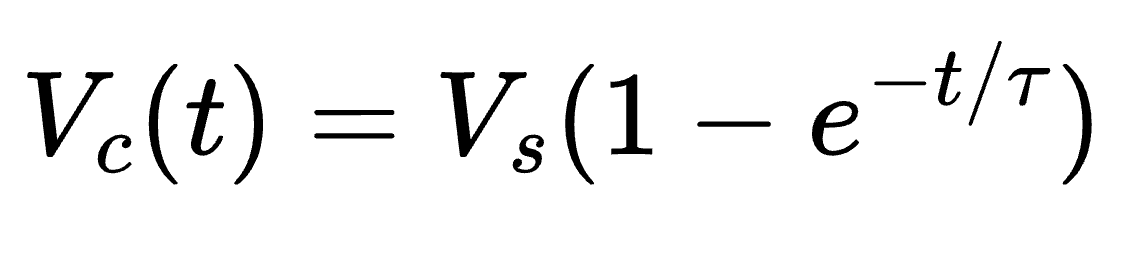
Charging Voltage - RC Circuit
Exponential growth
Vc(t) : The instantaneous voltage across the capacitor at any specific time, t
Vs : The steady DC source or supply voltage (sometimes written as E). This is the maximum voltage the capacitor will eventually reach
e: Euler's number, a mathematical constant (approx 2.71828).
t: The time elapsed since the charging process began (usually when a switch is closed at t=0)
τ : The RC time constant, defined as τ = R × C
Discharging Voltage - RC Circuit
Exponential decay
Vc(t): The instantaneous voltage across the capacitor at any specific time, t
V₀ : The initial voltage across the capacitor at t = 0 (the maximum voltage before discharging starts)
e: Euler's number, a mathematical constant (approx 2.71828).
t: The time elapsed since the charging process began (usually when a switch is closed at t=0)
τ : The RC time constant, defined as τ = R × C

Charging and Discharging Voltages - RC Circuit
Exponential growth/decay
Vc(t) : The instantaneous voltage across the capacitor at any specific time, t
Vs: The steady DC source or supply voltage (sometimes written as E). This is the maximum voltage the capacitor will eventually reach
V₀ : The initial voltage across the capacitor at t = 0 (the maximum voltage before discharging starts)
e: Euler's number, a mathematical constant (approx 2.71828).
t: The time elapsed since the charging process began (usually when a switch is closed at t=0)
τ : The RC time constant, defined as τ = R × C

Voltage between plates (parallel plate capacitor)
V: Voltage or electric potential difference
E: Electric field strength between the plates
d: Distance or separation between the two plates
Q: Total charge stored on one of the plates
ε₀ : Permittivity of free space (approx 8.854 × 10⁻¹² F/m)
A: Surface area of one of the capacitor plates

Kirchhoff's loop rule
The sum of the voltage changes across the circuit elements forming any closed loop is zero.

Kirchhoff's junction rule
The algebraic sum of the currents into (or out of) any junction in the circuit is zero
Algebraic Sum: The sum of all currents meeting at the junction equals zero (treating incoming and outgoing currents with opposite signs, such as positive for entering and negative for leaving)
Conservation of Charge: Electric charge cannot build up, vanish, or be created at a junction in a steady-state circuit. Every electron or coulomb that arrives must depart
Junction (Node): The point or intersection where three or more circuit paths or wires meet.
Example: If currents I₁ and I₂ flow into a junction and split into I₃ and I₄ , then: I₁+I₂ = I₃+I₄

Potential energy U between two point charges

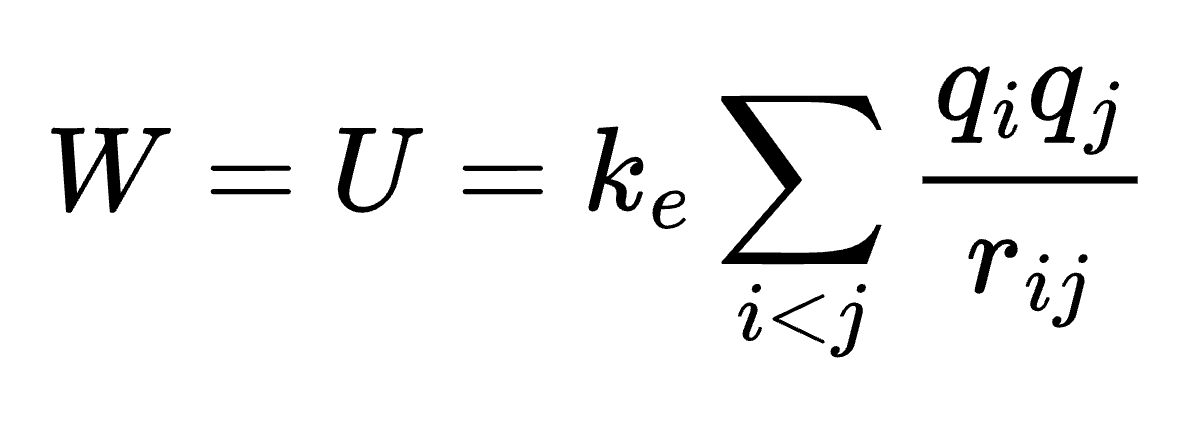
Potential energy U in a system of charges
Total (Potential) Energy Stored in a Capacitor

Electric energy density (in a vacuum)
The energy stored per unit volume in any region containing an electric field of magnitude E

Ohm's Law (Circuit Resistance)

Physical Resistance
ρ : The resistivity of the material
L: The length of the conductor
A: Cross-sectional area of conductor
