1.2 How Markets Work
 Call Kai
 Learn
 Practice Test
 Spaced Repetition
 Match
 Flashcards
 Knowt Play
1/121

There's no tags or description
Looks like no tags are added yet.
122 Terms
What does 'rational' mean in classical economic theory?
Rational in classical economic theory means that economic agents are able to consider the outcome of their choices and recognise the net benefits of each one.
How do consumers act rationally?
Consumers act rationally by maximising their total utility.
What is the assumption of rational decision making?
The assumption of rational decision making is that economic agents select the choice which presents the highest benefits.
True or False?
Producers act rationally by maximising their profits.
True.
Producers act rationally by maximising their profits.
How do workers act rationally?
Workers act rationally by balancing their welfare at work by considering both pay and benefits.
What does it mean for governments to act rationally?
Governments act rationally by placing the interests of thepeople they serve first in order to maximise their welfare.
Define the term 'economic agents'.
Economic agents are individuals or groups involved in economic transactions, such as consumers, producers, workers, and governments.
True or False?
The assumption of rational decision making is flawless.
False.
The assumption of rational decision making is flawed in many ways. For example, economic agents do not have access to perfect information to make a decision.
How can consumers demonstrate irrational behaviour?
Consumers can demonstrate irrational behaviour by being influenced by emotional purchasing decisions rather than a rational computation of net benefits.
What effect does irrationality have on markets?
Irrationality distorts markets and produces fundamentally different outcomes than what would be achieved if all economic agents acted rationally.
Define 'utility' in the context of consumer rationality.
What is the main goal of rational decision making in economics?
The main goal of rational decision making in economics is to select the choice that presents the highest benefits or utility.
What is demand?
Demand is the amount of a good/service that a consumer is willing and able to purchase at a given price in a given time period.
Define effective demand.
Effective demand is when a consumer is both willing and able to purchase a good or service.
What is a demand curve?
A demand curve is a graphical representation of the price and quantity demanded by consumers.
True or False?
A demand curve is always curved.
False.
Economists simplify demand curves into straight lines to make analysis easie
What causes a movement along the demand curve?
A movement along the demand curve is caused by a change in price, assuming all other factors remain constant (ceteris paribus).
What is a 'contraction in quantity demanded?'
A contraction in quantity demanded is an upward movement (left) along the demand curve due to a price rise causing a reduction in demand.
What is an extension in quantity demanded?
An extension in quantity demanded is a downward movement along the demand curve (right) due to a price fall causing an expansion in demand.
State the law of demand.
The law of demand states that there is an inverse relationship between price and quantity demanded.
True or False?
When price rises, quantity demanded extends.
False.
When price rises, quantity demanded contracts.
What are the conditions of demand?
The conditions of demand are the non-price factors that will change the demand for a good/service, irrespective of the price of the good/service.
How does a change in the conditions of demand affect the demand curve?
A change in the conditions of demand shifts the entire demand curve left or right.
What is the difference between a change in demand and a change in quantity demanded?
A change in demand shifts the entire demand curve, while a change in quantity demanded is a movement along the existing demand curve.
What is price elasticity of demand (PED)?
Price elasticity of demand reveals how responsive the change in quantity demanded is to a change in price.
State the formula for PED.
Formula.
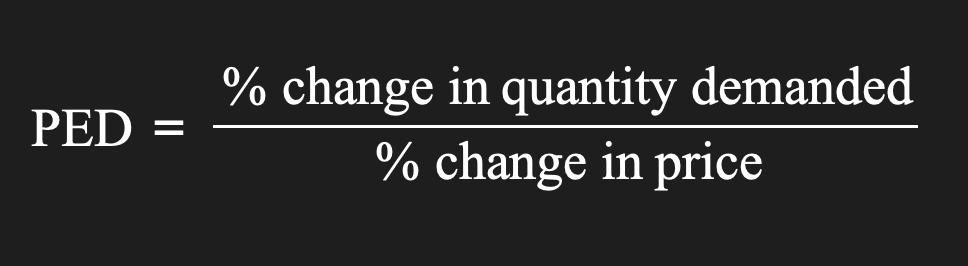
What does a PED value of 0 indicate?
A PED value of 0 indicates perfectly price inelastic demand, where quantity demanded is completely unresponsive to a change in price.
Define relatively price inelastic demand.
Relatively price inelastic demand is when the percentage change in quantity demanded is less than the percentage change in price. E.g. PED = -0.4.
What is unitary price elasticity?
Unitary price elasticity is when the percentage change in quantity demanded is exactly equal to the percentage change in price (PED = -1).
Define relatively price elastic demand.
Relatively price elastic demand is when the percentage change in quantity demanded is greater than the percentage change in price. For example PED = -2.5.
What does a PED value of infinity indicate?
A PED value of infinity indicates perfectly price elastic demand, where any change in price will cause quantity demanded to fall to zero.
What is income elasticity of demand (YED)?
Income elasticity of demand reveals how responsive the change in quantity demanded is to a change in income.
State the formula for YED.

What type of good has a YED value between 0 and 1?
A normal necessity good has a YED value between 0 and 1.
Define a normal luxury good in terms of YED.
A normal luxury good has a YED value greater than +1, meaning the percentage change in demand is greater than the percentage change in income.
What is an inferior good in terms of YED?
An inferior good has a negative YED value, meaning demand decreases when income increases.
What is cross price elasticity of demand (XED)?
Cross price elasticity of demand reveals how responsive the change in quantity demanded for good A is to a change in price of good B.
State the formula for XED.

What does a negative XED value indicate?
A negative XED value indicates that the two goods are complements.
How are goods with a positive XED value related?
Goods with a positive XED value are substitutes.
What does an XED value of zero suggest about two goods?
An XED value of zero suggests that the two goods are unrelated.
What is supply?
Supply is the amount of a good/service that a producer iswilling and able to supply at a given price in a given time period.
What is a supply curve?
A supply curve is a graphical representation of the price and quantity supplied by producers.
True or False?
The supply curve slopes downward.
False.
The supply curve slopes upward as there is a positive relationship between price and quantity supplied.
What causes a movement along the supply curve?
A movement along the supply curve is caused by a change in price, assuming all other factors remain constant (ceteris paribus).
What is an 'extension in quantity supplied?'
An extension in quantity supplied is an expansion in the quantity supplied due to an increase in price, shown as an upward movement along the supply curve.
What is a contraction in quantity supplied?
A contraction in quantity supplied is a reduction in the quantity supplied due to a decrease in price, shown as a downward movement along the supply curve.
What are the conditions of supply?
The conditions of supply are the non-price factors that willchange the supply of a good/service, irrespective of the price level of the good/service.
How does a change in the conditions of supply affect the supply curve?
A change in the conditions of supply shifts the entire supply curve left or right.
What is the difference between a change in supply and a change in quantity supplied?
A change in supply shifts the entire supply curve, while a change in quantity supplied is a movement along the existing supply curve.
True or False?
An increase in costs of production shifts the supply curve to theright.
False.
An increase in costs of production shifts the supply curve to the left.
How does an increase in indirect taxes affect the supply curve?
An increase in indirect taxes shifts the supply curve to the left.
What effect does an increase in subsidies have on the supply curve?
An increase in subsidies shifts the supply curve to the right.
What is price elasticity of supply (PES)?
Price elasticity of supply reveals how responsive the change in quantity supplied is to a change in price.
State the formula for PES.

What does a PES value of 0 indicate?
A PES value of 0 indicates perfectly price inelastic supply, where quantity supplied is completely unresponsive to a change in price.
Define relatively price inelastic supply.
Relatively price inelastic supply is when the percentage change in quantity supplied is less than the percentage change in price. For example +0.6.
What is relatively price elastic supply?
Relatively price elastic supply is when the percentage change in quantity supplied is more than the percentage change in price.For example +1.5.
What does a PES value of infinity indicate?
A PES value of infinity indicates perfectly price elastic supply, where supply is unlimited at a particular price.
What is a factor that influences PES?
Any of the following factors:
The mobility of land, labour and capital
The availability of raw materials
The ability to store goods
Spare production capacity
The time period involved
How does the availability of raw materials affect PES?
If raw materials are scarce, PES will be less than +1 but greater than zero (price inelastic). If they are abundant, PES will be greater than +1 (price elastic).
What effect does the ability to store goods have on PES?
If products can be easily stored, PES will be greater than +1 (price elastic). An inability to store products results in a PES lower than +1 but greater than zero (price inelastic).
How does spare capacity affect PES?
If there is spare capacity to increase production, supply will be price elastic. If there is no spare capacity, supply will be price inelastic.
What is the short run in economics?
The short run is any period of time in which at least one factor of production is fixed.
Define the long run in economics.
The long run is any period of time in which all factors of production are variable.
What is price determination?
Price determination is the process by which prices are set through the interaction of demand and supply in a market.
Define a market.
A market is any place that brings buyers and sellers together totrade at an agreed price.
What is consumer sovereignty?
Consumer sovereignty is the power of consumers to influence the production of goods and services through their purchasing decisions.
What is equilibrium in a market?
Equilibrium in a market occurs when demand equals supply.
what is the market clearing price?
The market clearing price is the price at which sellers are clearing their stock at an acceptable rate and demand equals supply.
Define disequilibrium.
Disequilibrium occurs whenever there is excess demand or excess supply in a market.
What is excess demand?
Excess demand occurs when the demand is greater than the supply at a given price.
How does the market respond to excess demand?
In response to excess demand, sellers gradually raise prices, causing a contraction in quantity demanded and an extension in quantity supplied.
What is excess supply?
Excess supply occurs when the supply is greater than the demand at a given price.
How does the market respond to excess supply?
In response to excess supply, sellers gradually lower prices, causing an extension in quantity demanded and a contraction in quantity supplied.
True or False?
Dynamic markets are constantly changing.
True.
Dynamic markets are constantly changing.
What causes disequilibrium in a market?
Disequilibrium is caused by any change to a condition of demand or supply.
What is the price mechanism?
The price mechanism is the interaction of demand and supply in a free market that determines prices and allocates scarce resources.
What are the three functions of the price mechanism?
The three functions of the price mechanism are to ration, signal and incentivise.
Define the rationing function of the price mechanism.
The rationing function of the price mechanism allocates scarce resources by setting prices that only those who can afford will pay.
What is the signalling function of the price mechanism?
The signalling function of the price mechanism provides information to producers and consumers about where resources are required or not.
Explain the incentive function of the price mechanism.
The incentive function of the price mechanism motivates producers to reallocate resources to more profitable marketswhen prices rise.
Who referred to the functions of the price mechanism as the'mystery of the invisible hand'?
Adam Smith referred to the functions of the price mechanism as the 'mystery of the invisible hand'.
True or False?
The price mechanism only operates in local markets.
False.
The price mechanism operates in all markets including local, national and global.
How does a higher price serve the rationing function in a market?
A higher price serves to ration a valuable product by ensuring only those who can afford it receive it.
What does a shift in demand signal to producers?
A shift in demand signals to producers that demand for a product is strong and they should consider entering the market.
How does a lower price incentivise consumers?
A lower price incentivises consumers to purchase more of a product.
What principle is the price mechanism built on?
The price mechanism is built on the principle of self-interest.
How do producers respond to price signals in global markets?
Producers use world prices to guide their production decisionsin global markets.
What is consumer surplus?
Consumer surplus is the difference between the amount the consumer is willing to pay for a product and the price they actually pay.
Define producer surplus.
Producer surplus is the difference between the amount that the producer is willing to sell a product for and the price they actually receive.
Where is consumer surplus represented on a market diagram?
Consumer surplus is represented by the area above the horizontal line formed by the equilibrium price and the area below the demand curve.
Where is producer surplus represented on a market diagram?
Producer surplus is represented by the area below the horizontal line formed by the equilibrium price and the area above the supply curve.
What is social surplus?
Social surplus is the sum of consumer surplus and producer surplus.
True or False?
Consumer and producer surplus are maximised at market equilibrium.
True.
Consumer and producer surplus are maximised at market equilibrium.
How does an increase in supply affect consumer surplus?
An increase in supply increases consumer surplus.
How does an increase in supply affect producer surplus?
An increase in supply increases producer surplus.
What happens to social surplus when supply increases?
Social surplus increases when supply increases.
How does an increase in demand affect consumer surplus?
An increase in demand increases consumer surplus.
How does an increase in demand affect producer surplus?
An increase in demand increases producer surplus.
What happens to social surplus when demand increases?
Social surplus increases when demand increases.