chem c17 hydroxyl compounds
 Call Kai
 Learn
 Practice Test
 Spaced Repetition
 Match
 Flashcards
 Knowt Play
1/11

There's no tags or description
Looks like no tags are added yet.
12 Terms
How are alcohols classified?
Primary (1°): one alkyl group on C bearing –OH
Secondary (2°): two alkyl groups on C bearing –OH
Tertiary (3°): three alkyl groups on C bearing –OH
Key difference from phenols: in alcohols, –OH is attached to an sp³ C of an alkyl group; in phenols, –OH is directly attached to the benzene ring (sp² C).
Why do alcohols have much higher boiling points than alkanes of similar size?
Alcohols form hydrogen bonds between molecules (in addition to id-id forces), requiring much more energy to overcome.
Boiling point increases with:
Longer alkyl chain → stronger id-id forces
More –OH groups → more extensive hydrogen bonding
Less branching → more surface contact area
What are the reactions of alcohols involving C–O bond cleavage?
Back: Halogenation (nucleophilic substitution): \( ROH + HX \rightarrow RX + H_2O \) (dry HX, heat)
\( ROH + PCl_5 \rightarrow RCl + POCl_3 + HCl \) (r.t.; steamy white fumes of HCl)
Dehydration (elimination): \( ROH \xrightarrow{\text{conc } H_3PO_4, \Delta} \text{alkene} + H_2O \)

What are the reactions of alcohols involving O–H bond cleavage?
Reaction with Na: \( ROH + Na \rightarrow RO^-Na^+ + \frac{1}{2}H_2 \) (effervescence, pop sound)
Esterification: \( ROH + RCOOH \xrightarrow{\text{conc } H_2SO_4, \Delta} RCOOR' + H_2O \)
Acylation: \( ROH + RCOCl \xrightarrow{\text{r.t.}} RCOOR' + HCl \) (steamy white fumes)

How are the three classes of alcohols distinguished by oxidation?
1° alcohol: oxidised to aldehyde (acidified \( K_2Cr_2O_7 \), heat with distillation); further oxidised to carboxylic acid (acidified \( K_2Cr_2O_7 \) or ( KMnO_4 ), heat under reflux)
2° alcohol: oxidised to ketone (acidified \( K_2Cr_2O_7 \) or \( KMnO_4 \), heat)
3° alcohol: not oxidised (no α-hydrogen)
Observation: orange \( K_2Cr_2O_7 \) → green; purple \( KMnO_4 \) → colourless

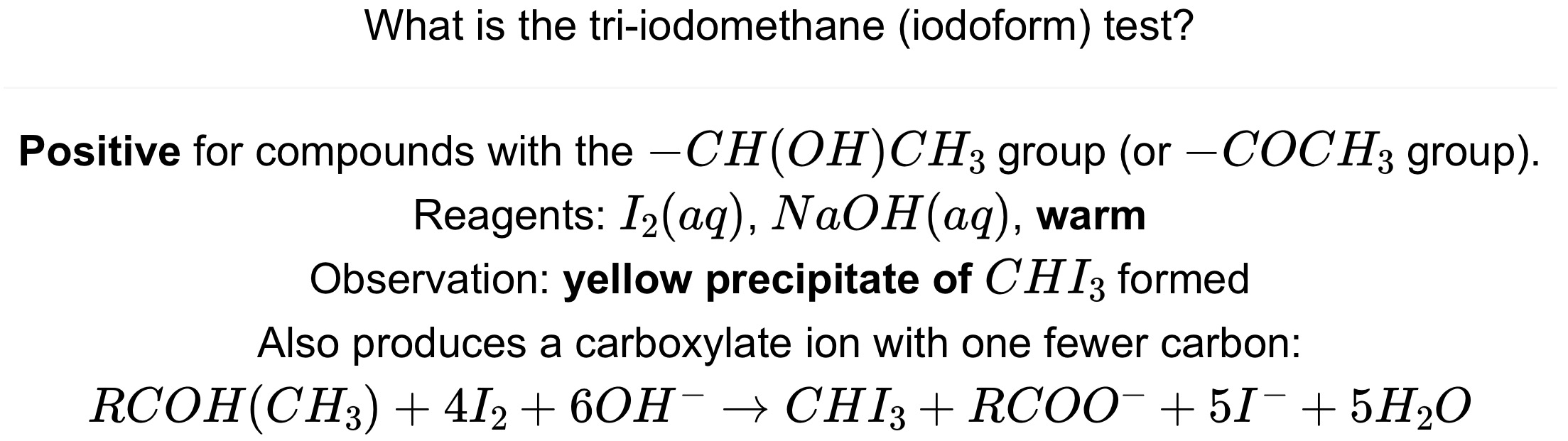
What is the tri-iodomethane (iodoform) test?
Positive for compounds with the \( -CH(OH)CH_3 \) group (or \( -COCH_3 \) group).
Reagents: \( I_2(aq) \), \( NaOH(aq) \), warm
Observation: yellow precipitate of \( CHI_3 \) formed
Also produces a carboxylate ion with one fewer carbon: \( RCOH(CH_3) + 4I_2 + 6OH^- \rightarrow CHI_3 + RCOO^- + 5I^- + 5H_2O \)
What are the reactions of phenol involving the –OH group?
With Na (r.t.): \( C_6H_5OH + Na \rightarrow C_6H_5O^-Na^+ + \frac{1}{2}H_2 \) (effervescence)
With NaOH(aq) (r.t.): \( C_6H_5OH + NaOH \rightarrow C_6H_5O^-Na^+ + H_2O \) (phenol dissolves)
With acyl chloride (r.t.): \( C_6H_5OH + RCOCl \rightarrow RCOOC_6H_5 + HCl \) (steamy white fumes)
Phenol does NOT react with carboxylic acids, \( Na_2CO_3 \), or \( NaHCO_3 \).

What are the reactions of phenol involving the benzene ring?
Bromination (aqueous \( Br_2 \), r.t., no catalyst): \( C_6H_5OH + 3Br_2(aq) \rightarrow 2,4,6\text{-tribromophenol} + 3HBr \) Observation: rapid decolourisation of orange ( Br_2(aq) ) + white precipitate
Nitration (dilute ( HNO_3 ), r.t., no catalyst): Gives 2-nitrophenol and 4-nitrophenol (mixture)
Both occur under milder conditions than benzene because the –OH group donates electron density into the ring.

Why is phenol more acidic than water, which is more acidic than alcohols?
Acidity depends on stability of conjugate base:
Phenoxide ion (C6H5O- ): lone pair delocalises into benzene ring → resonance stabilised → most stable → phenol is strongest acid
Hydroxide ion (OH-): no destabilising or stabilising effect → intermediate
Alkoxide ion (RO-): electron-donating alkyl group intensifies negative charge → least stable → alcohol is weakest acid
Order: Phenol > Water > Alcohol
How do substituents affect the acidity of phenols?
Electron-withdrawing groups (e.g. -NO2, -Cl): disperse negative charge on ( O- ) → phenoxide ion more stable → higher acidity (lower pKa)
Electron-donating groups (e.g. -CH3): intensify negative charge on ( O- ) → phenoxide ion less stable → lower acidity (higher pKa)
Example: ( pKa ) of 4-nitrophenol (7.15) < phenol (10.00) < 4-methylphenol (10.26)
How do you distinguish between alcohol, phenol and carboxylic acid using three reagents?
Reagent | Alcohol | Phenol | Carboxylic acid |
|---|---|---|---|
( Na(s) ) | ✅ ( H_2 ) | ✅ ( H_2 ) | ✅ ( H_2 ) |
( NaOH(aq) ) | ❌ | ✅ dissolves | ✅ |
( Na_2CO_3(aq) ) | ❌ | ❌ | ✅ ( CO_2 ) |
How does the C–O bond in phenol differ from that in alcohols, and what are the consequences?
In phenol, the lone pair on oxygen overlaps with the π cloud of the benzene ring → lone pair delocalised into ring → partial double bond character in C–O bond → bond is strengthened.
Consequences: phenol does NOT undergo:
Halogenation of –OH (no reaction with HX or ( PCl_5 ))
Dehydration (elimination)
Oxidation of –OH group
Esterification with carboxylic acids (only reacts with acyl chlorides) 🚫