Chapter 7: Quantum Theory and Atomic Structure
 Call Kai
 Learn
 Practice Test
 Spaced Repetition
 Match
 Flashcards
 Knowt Play
1/26

27 Terms
Electromagnetic radiation
Energy propagated by electric and magnetic fields that vary intensity as they move in waves
Includes microwaves, radio waves, light, and x-rays

Wavelength (λ)
The variable that describes the distance a light wave travels in one cycle
Measured in meters (m)

Frequency (ν)
The variable that describes how many complete light waves pass through a point per second
Measured in cycles per second (s-1) or hertz (Hz)
Speed (c)
The constant that describes how fast a light wave moves per unit time
Measured in meters per second (m/s or ms-1)
For light, this is ≈ 3.00⋅108 m/s
Shows the inverse relationship between wavelength and frequency, as c = λν

Amplitude
The variable that describes the height of a light wave, affecting intensity
Can vary separately from frequency and wavelength

Electromagnetic spectrum
The continuum of radiant energy arranged in order of increasing wavelength
Gamma ray, x-ray, and ultraviolet regions have the shortest wavelengths
Visible light has slightly longer wavelengths
Infrared radiation has long wavelengths and low frequency, experienced as heat
Microwaves and radio waves have the longest wavelengths
Blackbody radiation
An observed phenomena where objects of higher temperature give off light at lower wavelength and higher intensity
Quantum theory
A proposed explanation of many light phenomena, declaring that light only emits certain quantities of energy
Expressed by the formula E = nhv, where
E is the energy of radiation
n is the quantum number
h is Planck’s constant
v is the wavelength
Planck’s constant (h)
A constant relating the energy and frequency of a photon, equal to 6.626 ⋅ 10-34 J⋅s
Multiplied by the wavelength and quantum number integer n to demonstrate fixed instead of continuous quantities
Quantum
A fixed quantity of energy stating the smallest energy that can be emitted by light
Sets n = 1 to receive ΔE = hv

Photoelectric effect
A phenomenon where monochromatic light of sufficient frequency emits a current, challenging the wave nature of light due to:
A minimum threshold frequency (not intensity)
No time lag (as energy is seemingly instantly transferred)
Photon theory
A proposed explanation for the photoelectric effect where light flows in particulate states called photons, with energy related to frequency, not amplitude
States that Ephoton = hv = ΔEatom
Explains the photoelectric effect via the need for minimum energy attained through frequency

Line spectrum
Fine lines of light emitted by electrically excited gaseous atoms at specific wavelengths
Differs from the expected continuous spectrum rainbow

Rydberg equation
An equation developed by Johannes Rydberg that predicts the position and wavelength of any line in a given hydrogen series
States: 1/λ = R ⋅ (1/n21 - 1/n22)
R is the Rydberg constant, 1.097 ⋅ 107 m-1

Bohr model
A model developed by Niels Bohr to explain the existence of line spectra and orbitals through the conceptualization of stationary, ground, and excited states
States that electrons move between distant discrete ground and excited stationary states while absorbing or emitting proportionally energetic photons in an energy change
Explains how line and not continuous spectra appear due to the presence of quantization
Energy emittance is greater as transitions occur closer to the nucleus
Gave rise to the formula of energy levels: E = -2.18 ⋅ 10-18 J ⋅ (Z2 / n2)
Can be used to find potential energy level differences, utilizing the formula E = hc/λ

Flame test
A test to determine to determine the emission spectrum profile of a substance via flame
Quantum mechanics
A field that examines the wave nature of objects on the atomic scale
Atomic orbital
An equation that models the electron’s likely position in terms of time and position around the nucleus

Electron density diagram
A representation of an energy sublevel as the probability of finding the electron within a volume as a function of the distance from the nucleus
Principal quantum number (n)
A number that indicates the relative size of the orbital, specifying the atom’s energy level
A ground-state H electron has n = 1
n2 gives the total number of orbitals present
Angular momentum quantum number (l)
A number that ranges from [0, n - 1], giving the atom’s sublevel identifier and shape for a given n and l
l = 0 is designated as s
l = 1 is designated as p
l = 2 is designated as d
l = 3 is designated as f
For example, a sublevel with n = 2, l = 0 is given 2s designation
Magnetic quantum number (ml)
A number that ranges from [-l, l], giving the number, orientation, and identifier of orbitals for a given l
For example, l = 3 gives [-3, -2, -1, 0, 1, 2, 3] for 7 total orbitals
Spin quantum number (ms)
A number describing the spin of an electron going clockwise or counterclockwise, with values of {±1/2}

s orbital
An orbital with l = 0 and a spherical shape and an ml = 0, with highest probabilities increasing farther from the nucleus with greater values of n
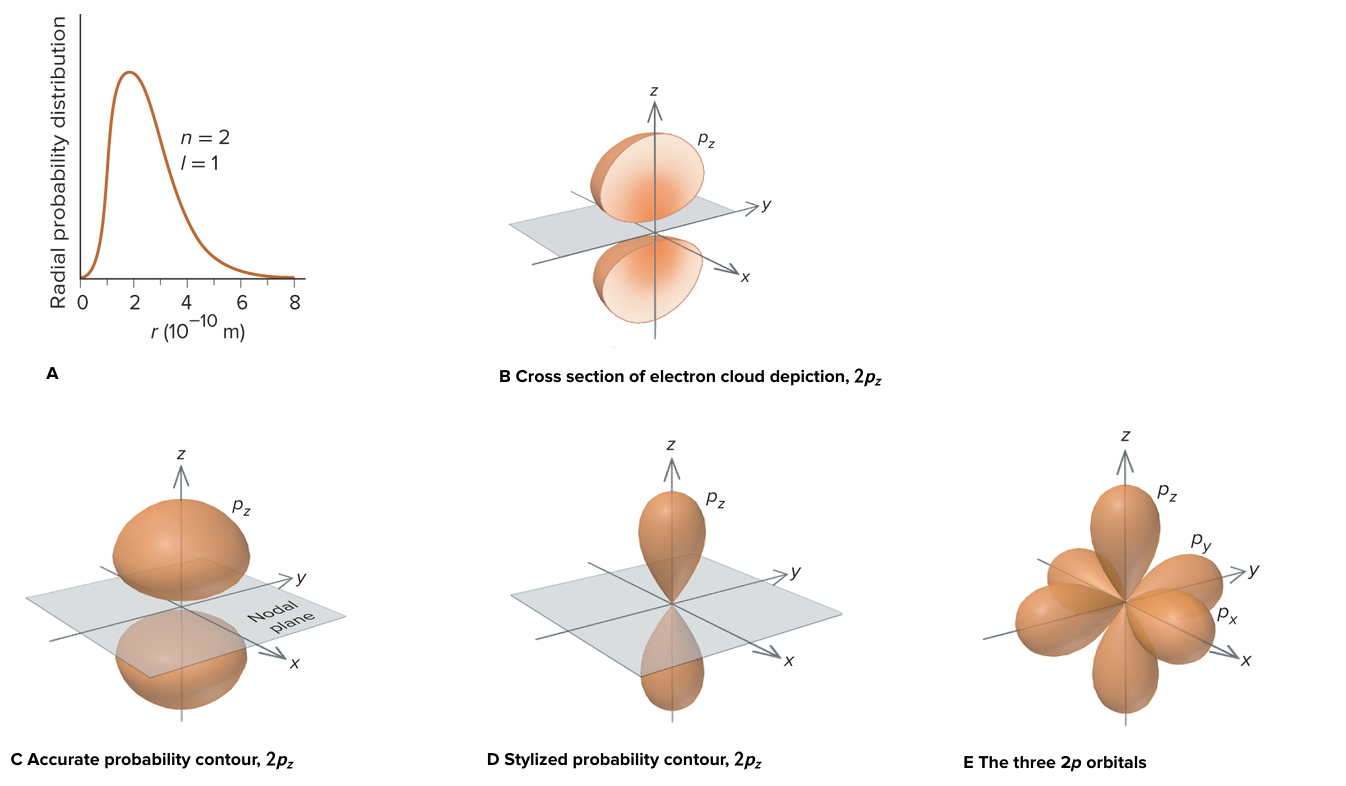
p orbital
An orbital with l = 1 with two regions of high probability on either side of the nucleus, divided by the nodal plane
Electrons spend equal time in both lobes
Differ in orientation across different ml values from ±1

d orbital
An orbital with l = 2 with four regions of high probability and ml values ranging between ±2 for five orientations

f orbital
An orbital with l = 3, n ≥ 4, and ml in the range ±3 for seven orientations