Intro to Marketing Exam 1
 Call Kai
 Learn
Learn Practice Test
 Spaced Repetition
 Match
Match Flashcards
 Knowt Play
1/69

There's no tags or description
Looks like no tags are added yet.
Name | Mastery | Learn | Test | Matching | Spaced | Call with Kai | Chat |
|---|
No analytics yet
Send a link to your students to track their progress
70 Terms
What is marketing and what is its purpose?
Marketing is the activity, set of institutions, and processes for creating, delivering, communicating, and exchanging offerings that have value for customers, clients, partners, and society at large.
The customer is the center of our marketing decisions! And we must discover and satisfy their needs
Its purpose is to create customer relationships and value while satisfying customer needs and organizational goals.
What is the marketing concept? What are the three types of needs?
The marketing concept is a discipline that focuses on customer needs. It emphasizes the idea that the social and economic justification for an organization's existence is the satisfaction of customer needs while meeting organizational goals.
The key differentiating role against other businesses is that: marketing discovers and satisfies customer needs
Customer needs are problems or pain points customers are trying to solve
Functional needs (to achieve specific goals)
Cars, food, etc.
Social needs (belonging/acceptance)
Toyota vs. a Ferrari, a watch vs. a Rolex. Both can drive and tell the time, but one carries status.
Emotional needs (feeling/internal state)
Disneyland brings personal joy/excitement. Insurance products provide peace of mind.
How does marketing discover and satisfy customer needs?
Marketing works through a two-step process
Discovery (Step 1) - Use marketing research methods to discover needs and wants using customer surveys, interviews, observations, and data analysis.
The methods of discovering needs and wants are called 'Marketing Research'. Selecting to satisfy what needs for which groups = segmentation and targeting (Chapter 8).
Satisfaction (Step 2) - Use the Marketing Mix (4Ps) to satisfy those needs: Product, Price, Promotion, Place/Distribution.
What are the 4 P's of the Marketing Mix?
The 4 P's are controllable factors that marketing managers can use to solve marketing problems
Product - A good, service, or idea to satisfy the consumer's needs. Identifying “what is the need?”
Example: In a restaurant—food, services, store decorations, and vibe.
Price - What is exchanged for the product (not necessarily monetary). Identifying how much to charge, discounts, etc.
Example: How much you charge for each item, discounts offered.
Promotion - A means of communication between the seller and the buyer. Identifying what message customers are receiving and if it is clear/through the right channels.
Example: Ads on billboards, student newspapers, social media, word-of-mouth.
Place/Distribution - A means of getting the product to the consumer. Identifying if the customer is effectively getting the product, in-store or online, etc.
Example: Dine-in, delivery, in-store pickup. These are controllable because they are under the control of the marketing department in an organization.

What is the marketing exchange concept?
Exchange is a mutually beneficial trade of things of value between buyer and seller so that each is better off after the trade.
Sellers provide: Product/service;
Customers provide: Payment.
For a valid exchange to occur, both parties must perceive value in what they receive.
Education: students pay tuition; universities provide education
Entertainment: audience provides engagement/attention; media provides entertainment
Politics: politicians promise action; citizens provides their support in votes

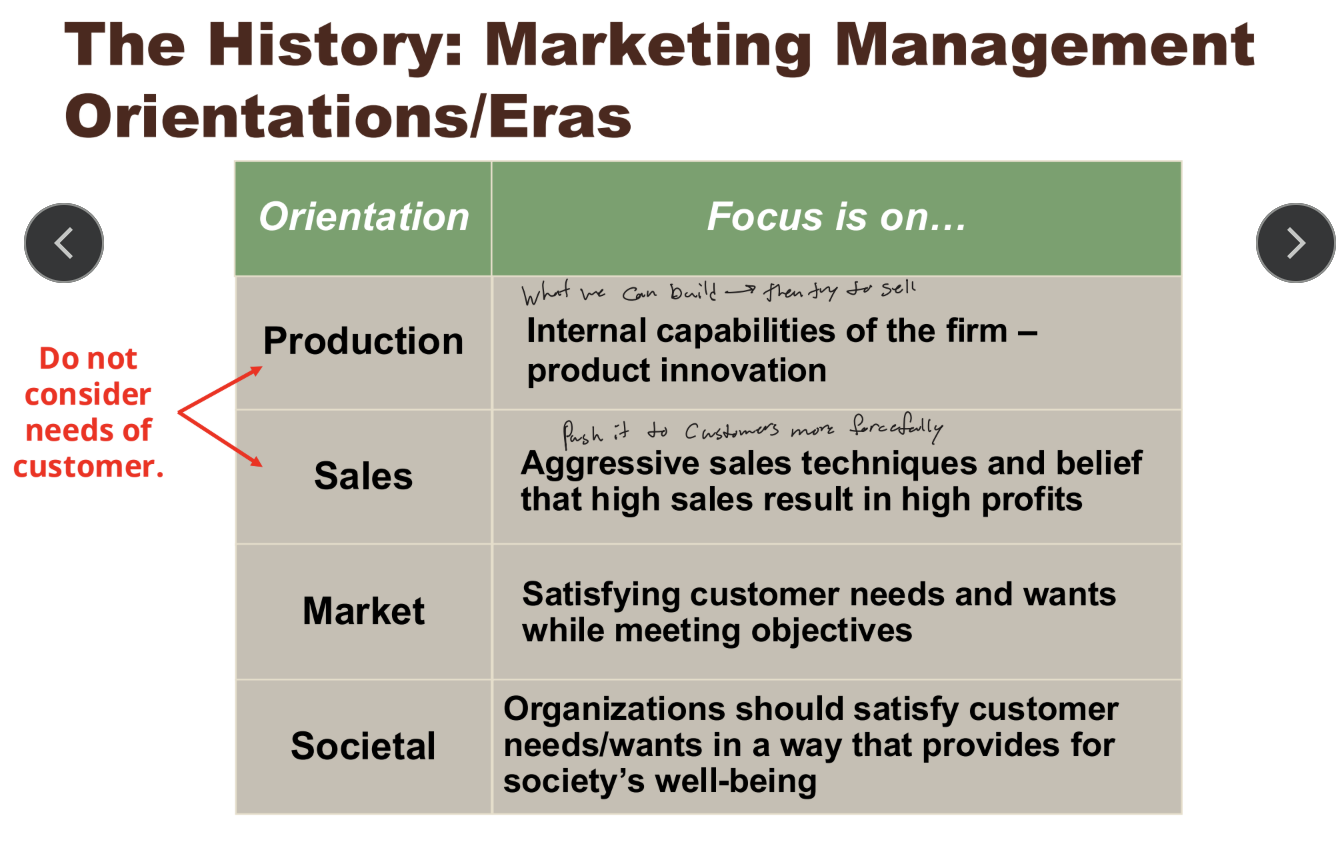
What are the 4 marketing management orientations/eras and their differences?
The evolution of marketing management orientations
Production Era: internal capabilities; what we can build - focus on internal capabilities and making products efficiently, but does not consider customer needs.
Sales Era: aggressive selling - push products to customers with aggressive sales techniques; belief that high sales result in high profits, but customers may not want what's being pushed.
Marketing Era: customer satisfaction - satisfying customer needs and wants while meeting organizational objectives, still may not consider broader society needs.
Societal Era: customer needs + society's well-being - organizations should satisfy customer needs/wants in a way that provides for society's well-being, the most modern approach considering stakeholders beyond just profits.
Who uses marketing and what do they use marketing for?
Marketing is used by
For-Profit Companies - Sponsored advertisements are common (98% of Meta's profits come from advertising).
Not-For-Profit Organizations - Universities use marketing (social media presence, personalized discounts/scholarships); Non-profits market to gain donors and support.
Person Marketing - Politicians and public officials (voters/donors are market); Social media influencers (followers/fans); Entrepreneurs, job seekers (seeking investors/clients/partners/employers).
Place Marketing - Tourist marketing highlighting unique experiences; Cities/regions market themselves to attract tourists and businesses.
END OF CHAPTER 1
END OF CHAPTER 1
What is environmental scanning and what are the environmental elements to consider?
Environmental scanning is the process of continually acquiring information on events occurring outside the organization to identify and interpret potential trends.
Major External Factors (the "Big 5")
Social Factors (demographics, age, gender, race, culture, trends)
Technological Factors (new innovations and tech developments)
Economic Conditions (GDP, unemployment, inflation, consumer income)
Competition (competitors and competitive structure)
Legal & Regulatory Factors (laws protecting competition, consumers, producers, society).
Internal Factors (Controllable): Marketing Mix (Product, Price, Promotion, Place).
These factors affect the target market and marketing decisions. While external factors are uncontrollable, organizations can use environmental management.

What is environmental management?
Environmental management is the attempt to influence factors in the external marketing environment.
While marketers cannot directly control external forces like competition or technology, they can try to influence them.
Examples: Lobbying for favorable regulations; Strategic partnerships to compete better; Innovation to lead technological change.
What are demographics and the various demographic variables?
Demographics are information about the characteristics of human populations and segments, especially those used to identify consumer segments.
Key Demographic Variables
Age - Different generations have different needs/preferences
Gender - Male/Female/Non-binary preferences differ
Income - affects purchasing power
Ethnicity - different groups have different preferences
Larger ethnic markets: Hispanic Americans $2.3 trillion, African Americans $1.8 trillion, Asian Americans $1.5 trillion
Other Key factors
Occupation - affects income and lifestyle
Family Life Cycle - Different stages have different needs
Generational Cohorts: Baby Boomers (1946-1964), Generation X (1965-1976), Millennials/Gen Y (1977-1994), Gen Z (1995-2010).
Explain the differences between gross, disposable, and discretionary income.
Gross income: total
Disposable income: income (after taxes) to use for necessities
On average,13% on food, 33% housing, 3% clothes, 25% on transportation and health care (Department of Labor report)
Discretionary income: what remains after paying taxes and necessities

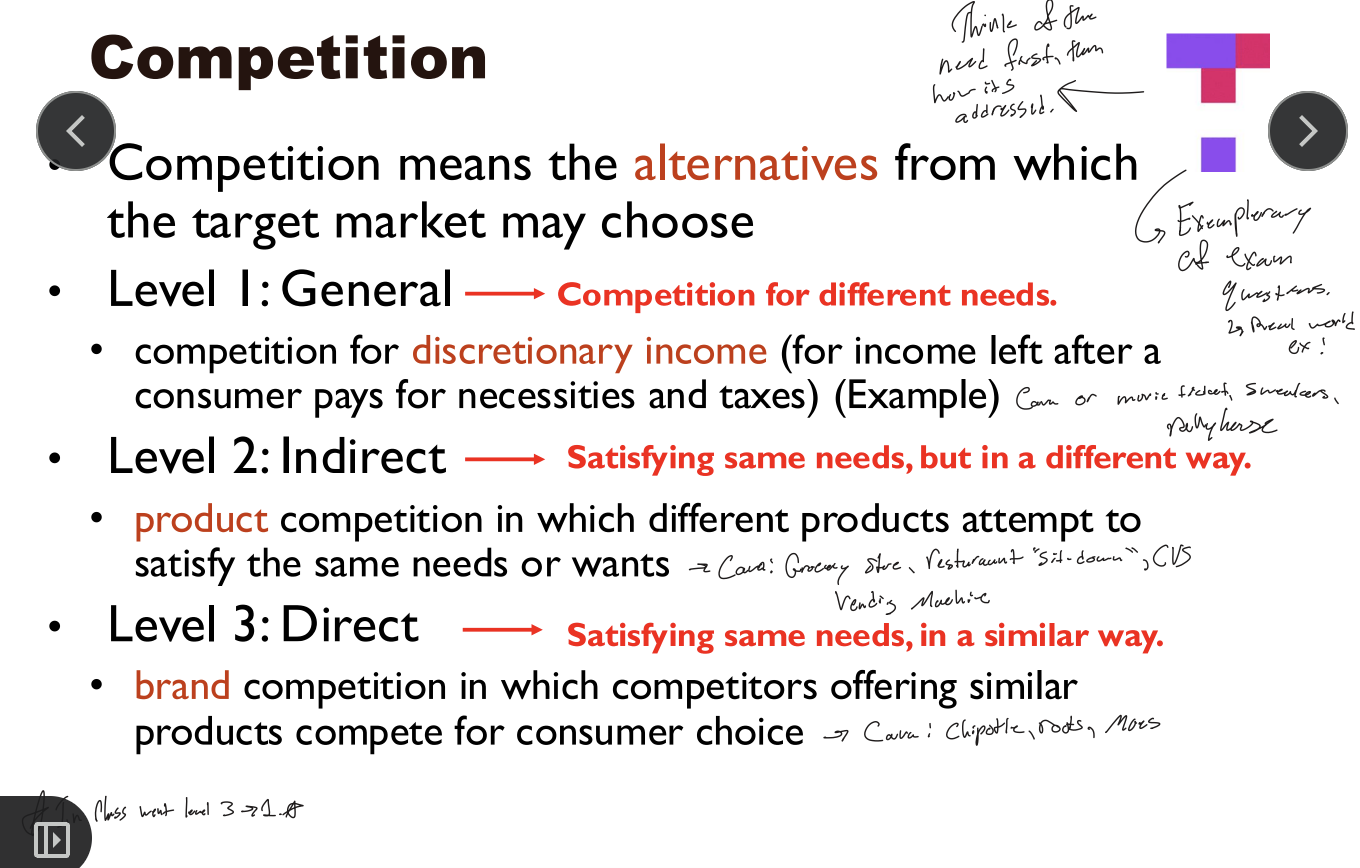
Explain the differences between general, indirect, and direct competition.
Competition means the alternatives from which the target market may choose
Level 1: General - Competition for different needs.
Competition for discretionary income (for income left after a consumer pays for necessities and taxes)
Cava, a movie, or new sneakers
Lottery system - lottery and non-lottery items compete for the consumer’s limited household budget!
1982 - 1988 Money spent on non-gambling items declined by $137/quarter per household
Level 2: Indirect - Satisfying the same needs, but in a different way
Product competition in which different products attempt to satisfy the same needs or wants
Against Cava, there are grocery stores, sit-down restaurants, CVS, vending machines, etc.
Level 3: Direct - satisfying the same needs, in a similar way
Brand competition in which competitors offering similar products compete for consumer choice
Against Cava, there is Chipotle, Roots, Moes
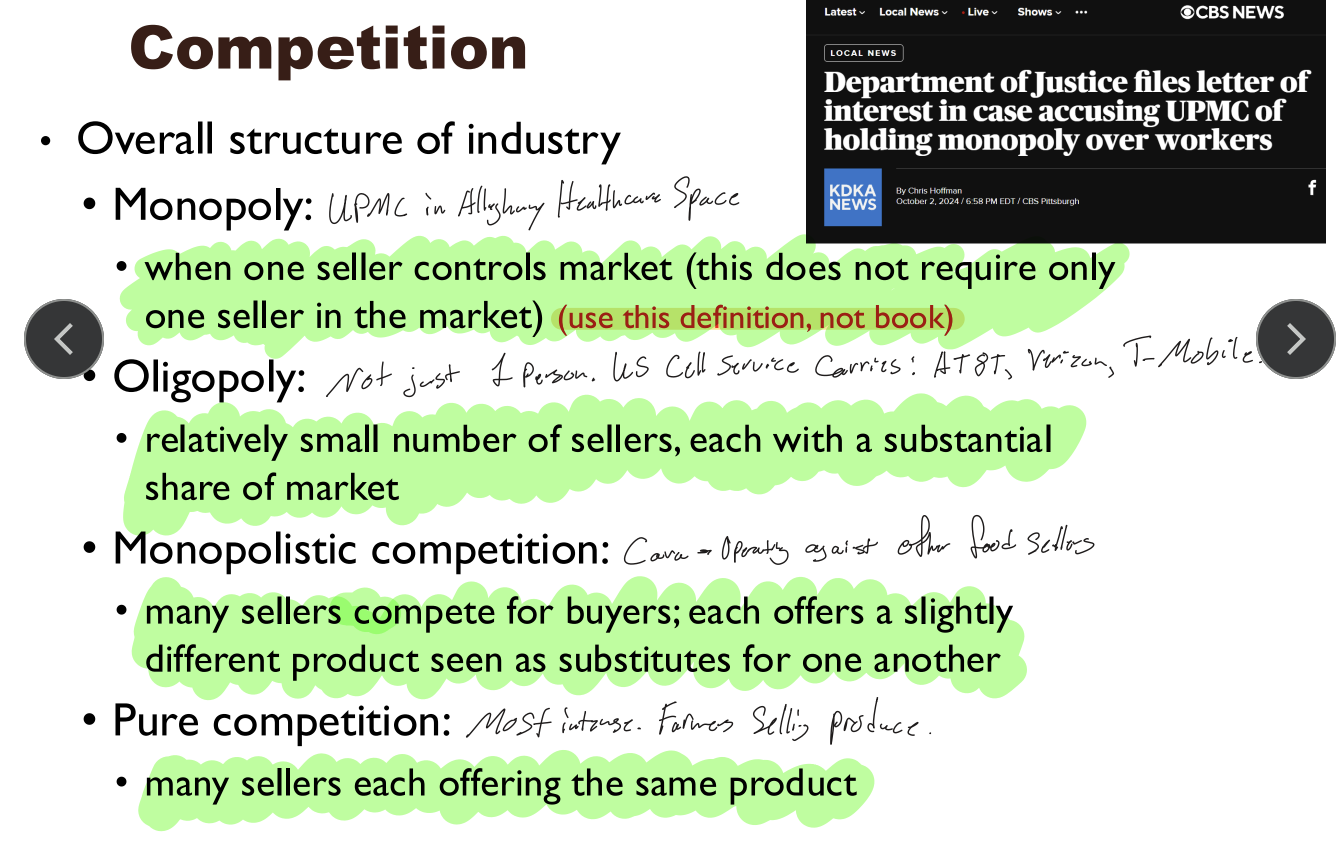
Explain the differences between Monopoly, Oligopoly, Monopolistic competition, and pure competition.
Monopoly
When one seller controls the market (this does not require only one seller in the market)
UPMC in the Alleghany Healthcare Space
Oligopoly
Relatively small number of sellers, each with a substantial share of the market
US Cell carriers like Verizon, AT&T, T-Mobile
Monopolistic competition
Many sellers compete for buyers; each offers a slightly different product seen as substitutes for one another
Cava operating against other food sellers
Pure competition
Many sellers each offering the same product
Most intense, farmers selling produce.
What are social trends that have impacted business?
Social/Cultural trends that influence marketing
Health/Wellness - increasing focus on healthy living
Sustainability/Preserving the Environment - environmental consciousness
Privacy Concerns - data privacy and personal information security
Diversity/Inclusion/Equality - companies emphasizing diverse and inclusive practices
What is corporate social responsibility (CSR) and why is it important?
Corporate Social Responsibility (CSR) is the idea that organizations are part of a larger society and are accountable to that society for their actions.
Why Important? 90% of S&P 500 companies published a CSR report in 2019 (vs. only 20% in 2011).
Consumers care - 77% motivated to purchase from CSR-committed companies; 54% stopped buying from companies due to public position.
Investors care - 73% say CSR efforts affect investment decisions; 41% millennial investors research CSR.
Employees care - 93% believe companies must lead with purpose; 60% would take pay cut for purpose-driven company.
Can help you draw out a more flashy/talented group of applicants. If done correctly, it can drastically benefit your company.
Long-run benefits: Brand image, resilience, long-term profitability—if done correctly, CSR doesn't hurt profit.
What are the three concepts of social responsibility?
Profit Responsibility - Obligation to maximize profits for stockholders
This was Milton Friedman's argument: A business's only social responsibility is to increase profits while staying within the rules of the game (open/free competition without deception/fraud).
Stakeholder Responsibility - Firms are responsible beyond just themselves
Stakeholders include consumers, employees, suppliers, and distributors.
Societal Responsibility - Obligations to preserve the environment and the general public;
Triple-bottom line: Profit, People, Planet
Most comprehensive approach considering broader societal impact.

What is green marketing vs. greenwashing? What is the difference?
Green Marketing - Marketing efforts to produce, promote, and reclaim environmentally sensitive products
Genuine commitment to environmental responsibility
Consumers/employees care about environmental impact.
Greenwashing - Dishonestly marketing products as environmentally friendly
Spending more money promoting being "green" than actually spending on green initiatives
Little substantive environmental action despite green marketing claims. Key
Difference:
Green marketing is authentic environmental commitment.
Greenwashing is deceptive marketing without substantive action.

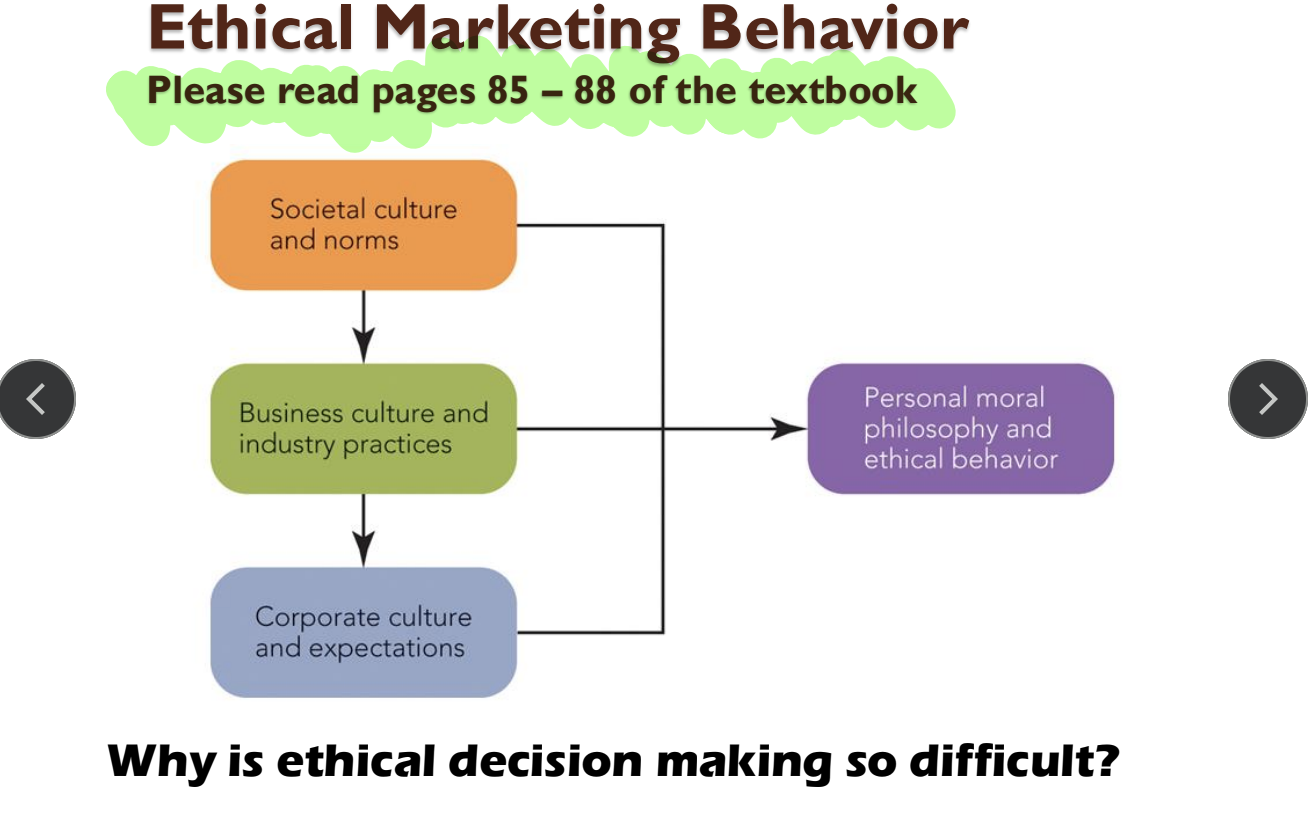
Why is ethical decision-making so difficult?
Ethical decision-making is challenging because…
Multiple stakeholder interests conflict
Profit motives may conflict with ethical concerns
Ambiguous situations without clear right/wrong answers
Pressure to compete and succeed
Personal values vs. organizational expectations
Different societal, business, and corporate cultures may have conflicting standards
Personal moral philosophy may differ from corporate expectations
Observing unethical behavior by peers/top management creates pressure to compromise
Ethical dilemmas can bring personal and professional conflict (such as fear of retaliation or being penalized for reporting unethical behavior).
What are moral idealism and utilitarianism?
Moral Idealism - Personal moral philosophy that considers certain individual rights or duties as universal, regardless of outcome.
Exists in the Consumer Bill of Rights
Favored by moral philosophers and consumer interest groups.
Example: Right to know applies to probable defects in products relating to safety. Also applies to ethical duties such as "do no harm".
3M phased out production of a chemical used in pet food bags, candy wrappers, carpeting, Scotchgard after discovering it accumulated in human/animal tissue worldwide, resulting in $200 million annual sales loss.
Utilitarianism - Personal moral philosophy focusing on greatest good for greatest number by assessing costs and benefits of ethical behavior consequences.
If benefits exceed costs, behavior is ethical. If not, unethical.
Underlies economic tenets of capitalism; embraced by many business executives and students.
Key Difference: Moral idealism emphasizes principles/duties regardless of outcome; utilitarianism emphasizes consequences and overall benefit to majority.
What is the 4-step Framework for Ethical Decision Making? The five ethical tests?
Four-step ethical decision-making framework
Step 1 - Identify the Issues (clearly define the ethical problem/dilemma).
Step 2 - Gather Information and Identify Stakeholders (who are affected, what information is relevant).
Step 3 - Brainstorm and Evaluate Alternatives (generate multiple possible courses of action, consider consequences).
Step 4 - Choose a Course of Action (apply ethical tests).
Five Ethical Tests:
1) Publicity Test - Do I want to see this on the front page?
2) Moral Mentor Test - Would the person I admire most do this?
3) Transparency Test - Can I give a clear explanation with an honest account of my motivations?
4) Person in the Mirror Test - Will I respect myself?
5) Golden Rule Test - Would I want this done to me?

What are the four factors influence ethical behavior in organizations
1) Societal Culture and Norms - moral standards relative to particular societies; reflected in laws/regulations
2) Business Culture and Industry Practices - effective rules of the game, boundaries between competitive and unethical behavior
3) Corporate Culture and Expectations - values/attitudes learned and shared in an organization; formal codes of ethics; ethical actions of top management
4) Personal Moral Philosophy - learned through socialization, family, formal education; influenced by surrounding cultures.
END OF CHAPTER 3
END OF CHAPTER 3
What is consumer behavior?
Consumer behavior is how people make decisions about purchasing and using products and services, including
The actions they take
Mental processes that occur before purchasing (research, evaluation)
Mental processes that occur after purchasing (satisfaction, regret)
Social processes influencing decisions.
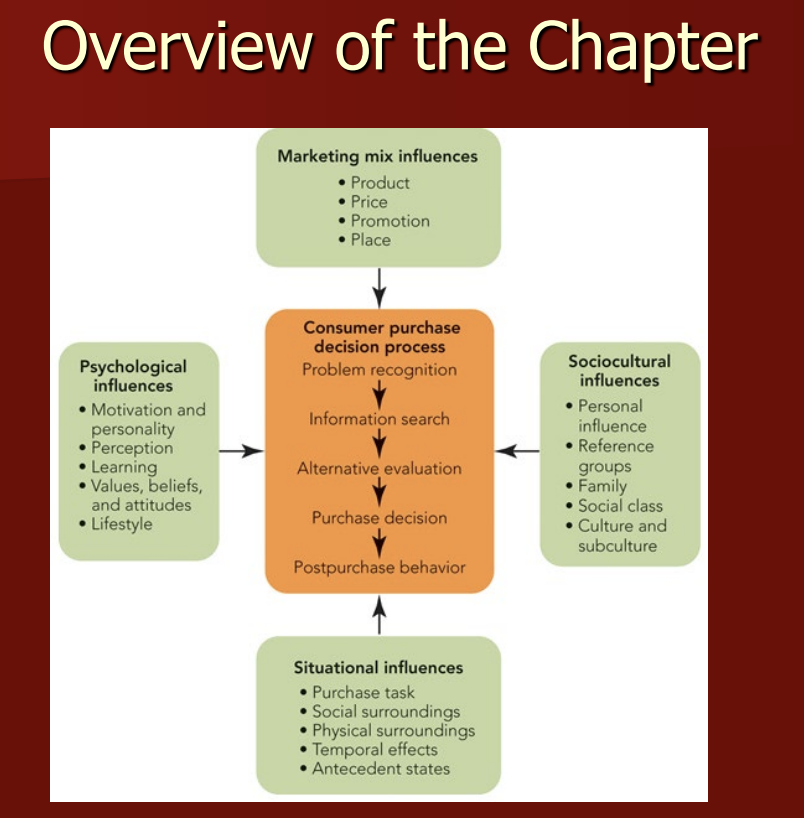
What is the consumer/purchase decision process? (The 5 Steps)
Step 1 - Problem Recognition: The consumer recognizes the difference between the actual state and the ideal/desired state. Recognizes an imbalance that needs solving.
Step 2 - Information Search: Start with an Internal search in your own memory/previous experiences. Then contact external.
Step 3 - Alternative Evaluation: narrow options, compare pros/cons, develop consideration set (subset of awareness set where we know of things that exist), identify salient vs. determinant attributes.
Step 4 - Purchase Decision: whether to buy, where to buy, when to buy; may not purchase due to availability, change mind, or decide to wait.
Step 5 - Post-Purchase Behavior: evaluate satisfaction/dissatisfaction; affects repurchase intentions and word-of-mouth.
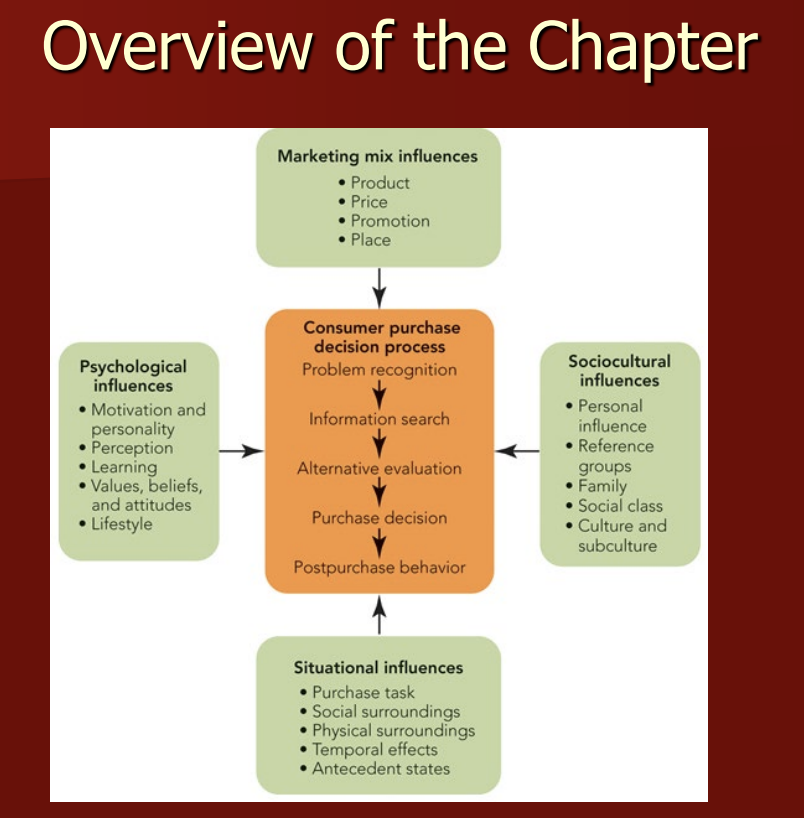
Explain the problem recognition stage with examples. What is the role of marketing?
Step 1 - Problem Recognition: The consumer recognizes the difference between the actual state and the ideal/desired state. Recognizes an imbalance that needs solving.
Example: Customer recognizes they are hungry, so they eat lunch. The actual state can be stable, but the desired state can change. McDonald’s can make you full (actual state) but is not a healthy option (desired state), so your preference for hunger changes.
Marketing role: good marketing helps recognize this imbalance.
Explain the information stage and its 2 main levels.
Step 2 - Information Search
First, one will start with an internal search of their own memory.
This is immediate, convenient, and trustworthy, as it is you pulling from previous experiences.
Next, one will move to external searches
Personal sources: Can include friends, relatives, etc.
Public sources: Can include product rating organizations, consumer reports, government agencies
Marketer-dominated sources: Can include ads, company websites, salespeople, point-of-purchase displays in stores.

Explain the alternative evaluation stage, and what are a consideration set vs. an awareness set.
Step 3 - Alternative Evaluation
First, one must narrow options and compare pros/cons
Awareness Set - All brands the consumer knows exist/broad set of products the consumer is aware of. This includes brands they haven't thought about buying.
All cell phones in the phone example.
Consideration Set - Subgroup of brands from awareness set. Brands the consumer actually considers buying, and much smaller than the awareness set.
Typically 2-5 products in the consideration set with certain brands perceived as acceptable alternatives.
iPhone in the phone example.
Flow: Awareness Set (broad) → Consideration Set (narrow) → Purchase Decision.

What are salient attributes vs. determinant attributes?
The valuation of different attributes differs across consumers
Determinant Attributes: Ones that actually result in the preference of one product over others in the final choice
Important to the buyer and on which competing brands/stores are perceived to differ
Determinant attributes are NOT necessarily the most important attributes for that customer
Salient Attributes - Attributes the consumer thinks are important; Top-of-mind attributes.
Attributes the consumer is aware of and considers. May not actually determine final choice.
Attribute
Salient?
Determinant?
Why?
Camera Quality
✓ YES (everyone cares)
✗ NO (all phones are similar)
No competitive difference
Battery Life
Maybe
✓ YES
Pixel 7 is clearly superior—differentiates it
Audio Quality
Maybe
✓ YES
OnePlus/Samsung differentiate from Pixel's weak audio

Explain the purchase decision stage, what consumers consider, and how this can be measured.
Step 4 - Purchase Decision
After evaluating the alternatives, consumers make a choice, although a purchase decision is not always made.
Consumers will consider:
Whether to buy
Where to buy
Terms of sale, past purchase experience from seller, return policy of seller, etc.
When to buy
Sales, time pressure, financial constraint, etc.
And even after all of this, they may not purchase due to availability, change their minds, or decide to wait.
Can measure actual purchases with Conversion rate(s): Percentage of consumers who buy a product after viewing/considering it

Explain the post-purchase stage and the process of satisfaction vs. Dissatisfaction.
Step 5 - Post-Purchase Behavior
Evaluate satisfaction/dissatisfaction
How good of a choice was it?
What determines satisfaction/dissatisfaction?
Expectations
Outcomes
Influence of others
Satisfaction/dissatisfaction affects
Repurchase intentions
Word-of-mouth communication
During the post-purchase stage, explain what cognitive dissonance is and what consumers will do when they experience it.
Cognitive dissonance is post-purchase psychological tension or anxiety (regret) when uncertain they made right choice.
What Consumers Do to Reduce It?
1) Seek Information that Reinforces Positive Ideas (ask friends, read positive reviews, notice supporting ads).
2) Avoid Information that Contradicts the Decision (stop watching negative reviews, ignore competing ads).
3) Revoke/Return the Product (most extreme response; return item if cognitive dissonance is too great).
How Marketing Can Minimize: Effective communication, Follow-up contact, Guarantees/warranties, encourage consumers to seek confirmatory information.

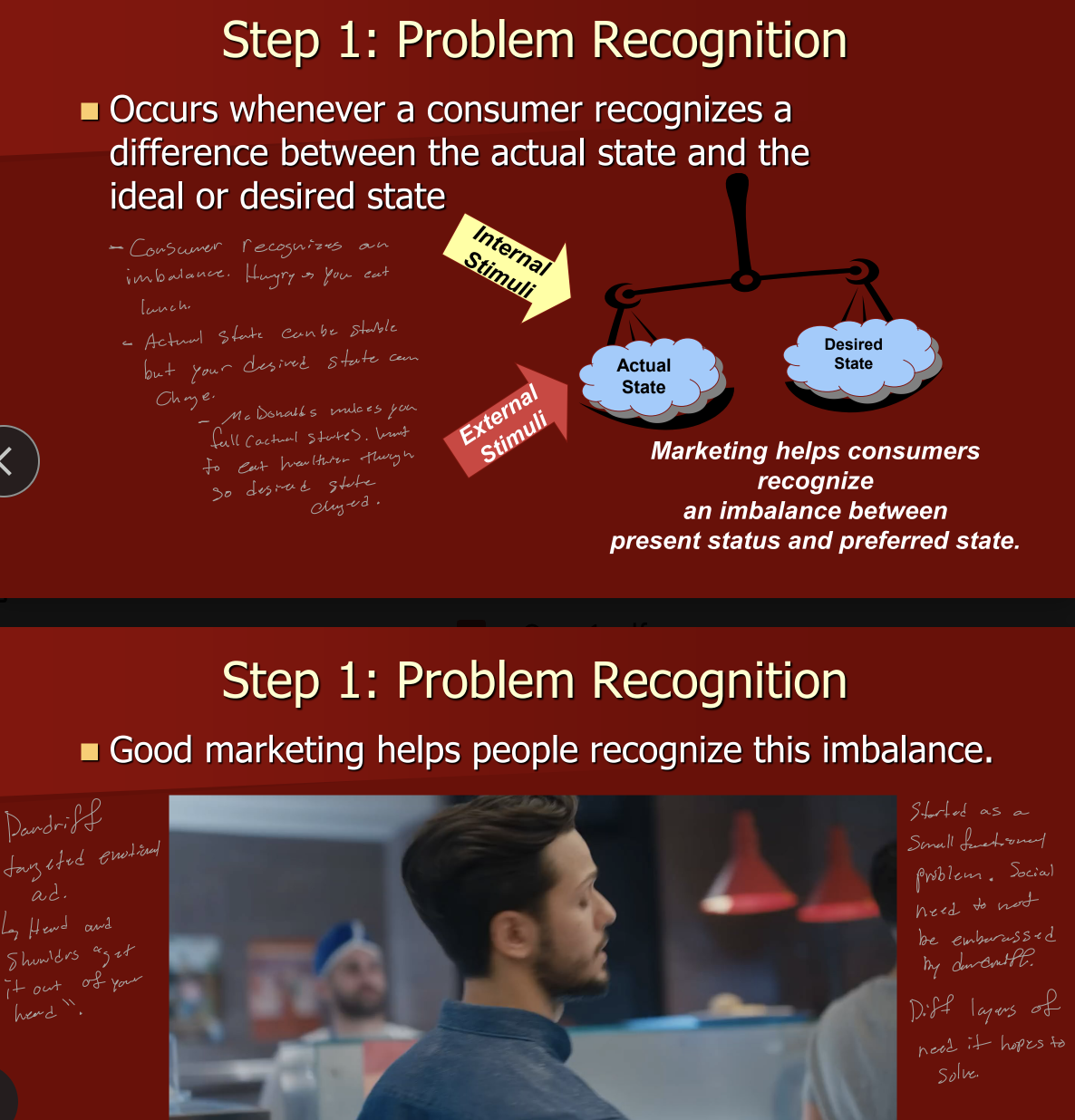
What are the different levels of involvement in consumer decision-making?
High Involvement or Extended Problem Solving - Expensive/important purchases (house, car, college) where the consumer goes through all 5 steps carefully.
Extensive information search and alternative evaluation.
Moderate Involvement or Limited Problem Solving - Mid-level purchases (appliances, furniture) with some research and evaluation
Several alternatives considered.
Low Involvement or Routine Problem Solving - Routine/inexpensive purchases (toilet paper, toothpaste) with minimal information search
Limited alternatives considered; quick decision process.
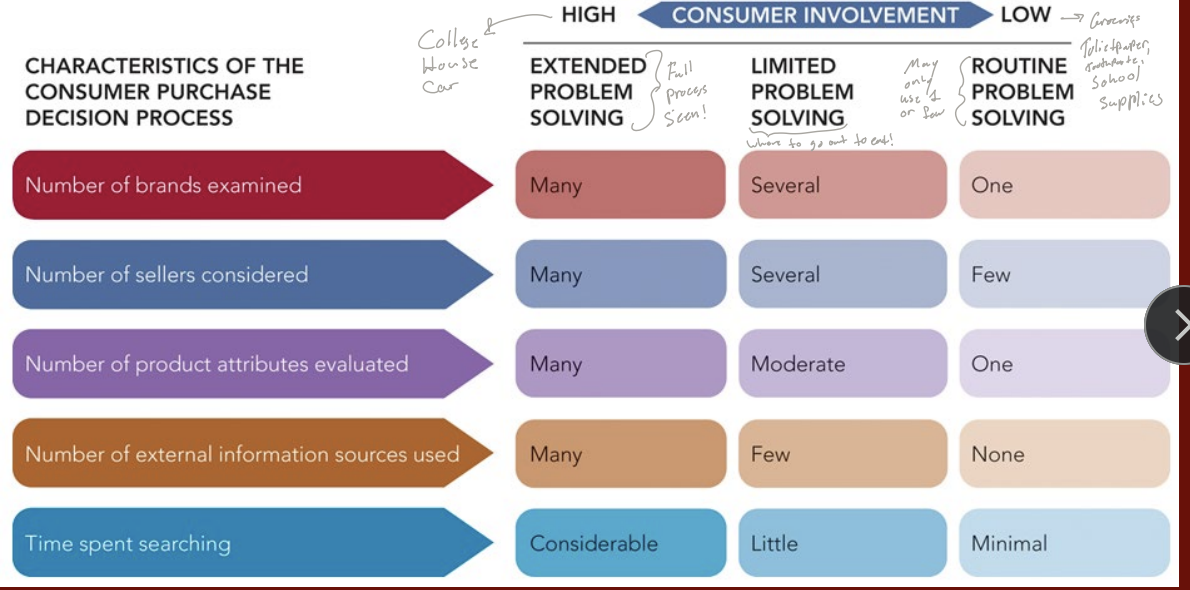
What are the different influences on consumer decision-making? - Psychological (motivation/personality/perception) . (READ THESE SLIDES AGAIN, 80’s, IN STUDY GUIDE)
Motivation/Personality
Motivation
Energizing force that stimulates behavior to satisfy a need
The Maslow hierarchy of needs:
Motivation comes from a need.
If a need is met, it is no longer a motivator; a higher-level need would now become a motivator
Personality
Person’s consistent behaviors or responses to recurring situations
Personality affects purchases:
Research shows that people who are more compliant prefer known brand names and use more mouthwash;
People who are assertive use razors instead of electric shavers, and purchase signature goods such as Gucci and Yves St. Laurent
Perception
Process by which we select, organize, and interpret information to form a meaningful picture of the world
How we see the world around us
May or may not reflect reality
Selective Perception
Ways human brain developed to organize and filter the complex information environment around us
How we (selectively) gather and process information
Three types of selective perception
Selective Exposure (Collect information)
Occurs when people pay attention to message that is consistent their attitudes and beliefs and ignore others
Selective Comprehension/Distortion (Interpret Information)
Interpreting information so that it is consistent with your attitudes and beliefs
Selective Retention (Store/recall Information)
A process whereby a consumer remembers only information that supports their beliefs

What are the different influences on consumer decision-making? - Psychological (learning/lifestyle) . (READ THESE SLIDES AGAIN, 80’s)
Learning
We learn about many things that influence the decision process: how to search, what criteria to consider, which criteria is important, brand preference, who to ask, etc...
Behavioral learning (learning by doing)
The process of developing automatic responses through experience
Cognitive Learning (Learning by observing/thinking)
Learning by thinking, reasoning, and mental problem solving
Brand Loyalty
Developed through behavioral or cognitive learning
Lifestyle
A pattern of living that determines how people choose to spend their time and resources (money, energy, etc...), what they consider important in their environments, and what they think of themselves and the world around them

What are the different influences on consumer decision-making? - Psychological (values/beliefs/attitudes + Pepsi exmaple!) . (READ THESE SLIDES AGAIN, 80’s, IN STUDY GUIDE)
Attitude
Learned predisposition to respond to an object (a product) in a consistently favorable or unfavorable way
How someone feels about it
Beliefs
Perception of how a product or brand performs on different attributes
How someone thinks
Beliefs vs. attitude
Attitude is how someone feels about a brand/product, while a belief is what someone thinks (can be subjective)
Consumers often develop beliefs through learning
Attitudes are shaped by values and beliefs
Attitude change
Change beliefs about how a brand performs on certain attributes
Change perceived importance/value of attributes
Add new attributes
___________________________________________________________
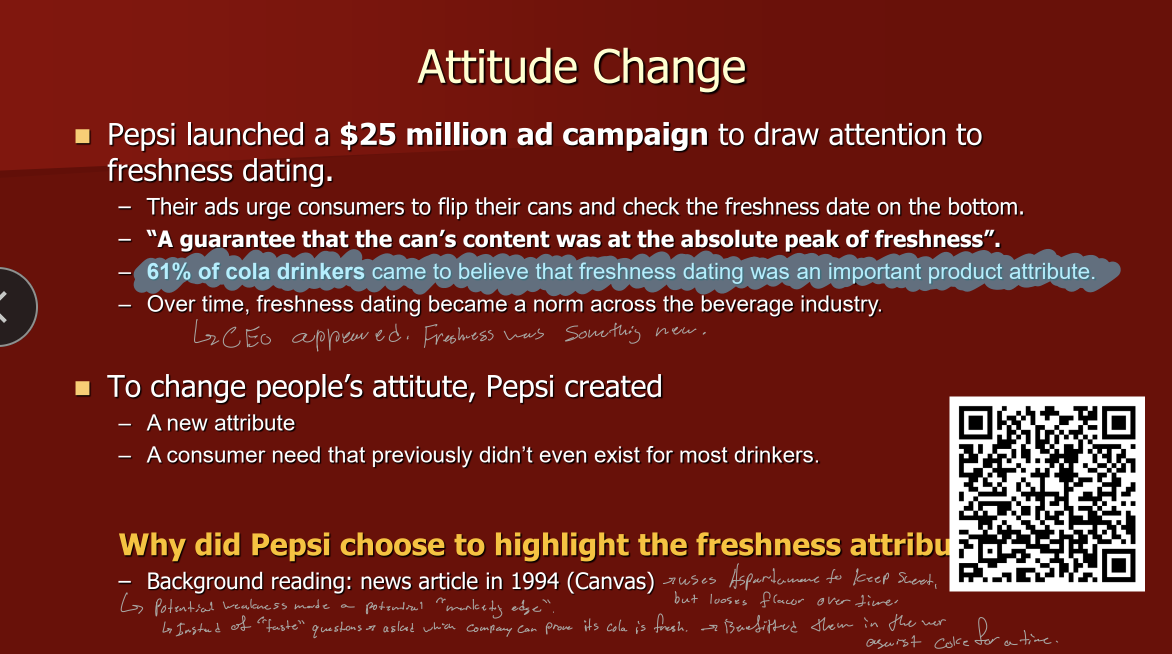
Pepsi launched a $25 million ad campaign to draw attention to freshness dating.
Their ads urge consumers to flip their cans and check the freshness date on the bottom.
“A guarantee that the can’s content was at the absolute peak of freshness”.
61% of cola drinkers came to believe that freshness dating was an important product attribute.
Over time, freshness dating became a norm across the beverage industry.
To change people’s attitude, Pepsi created
A new attribute
A consumer need that previously didn’t even exist for most drinkers.
What are the different influences on consumer decision-making? - Sociocultural influences (Personal, reference groups + 3 types)
Personal Influences
Opinion Leaders
Individuals who have direct or indirect social influence over others
Firms often invite influential community leaders, celebrities, and athletes to try their new products
Word of mouth
The influence of people during conversations, including online reviews
Can be positive or negative
Reference Groups
People that an individual refers to as a source of personal standards
Associative: the group a person belongs to
Aspiration: the group a person wishes to be a member of
Dissociative: the group a person wishes to maintain a distance from
Family
Culture and Subcultures

What are the different influences on consumer decision-making? - Situational influences (Purchase task, Social surroundings, Physical surroundings, Temporal effects, Antecedent States).
Factors specific to the situation can influence the decision process
Purchase Task
Reason for purchase changes behavior
Example: Wine for yourself vs. wine for your boss's dinner party. Casual lunch ≠ romantic anniversary dinner
Social Surroundings
People with you, other people in store, store personnel assistance
Example: Shopping alone vs. with friends changes what you buy
Physical Surroundings
Store atmosphere (lighting, music, temperature), crowding level, store layout/displays
Example: Luxury boutique vs. warehouse store = different spending
Temporal Effects
Time of day, how much time available, time urgency/pressure
Example: Rushed morning ≠ leisurely afternoon shopping
Antecedent State
NOT a permanent personality trait
Temporary mood (happy, sad, stressed, bored), cash vs. credit card, hungry vs. satisfied
Example: Good mood + credit card = impulse buy; same person in different mood = different decision
Key Point: Same person, different situation = different purchase behavior

END OF CHAPTER 4 - For the love of God review that chart!
END OF CHAPTER 4 - For the love of God, review that chart!
What are the different types of global companies and their marketing strategies? (international, multinational, transnational)
Three types:
International Firms - Use a domestic marketing strategy with little/no modification in international markets.
View marketing in different countries as an extension of the home country strategy. Same products, promotions, and positioning globally.
Multinational Firms - Practice a multidomestic marketing strategy and use unique/different strategies in different markets.
Customize product variations, brand names, communications, and pricing. Example: Netflix customizes to each country.
Transnational Firms - Practice a global marketing strategy and view the world as one market.
Standardize marketing when possible due to cultural similarities; adapt when cultures differ; balance between efficiency and customization.

What is protectionism and how does it impact trade? (Tariffs/Quotas)
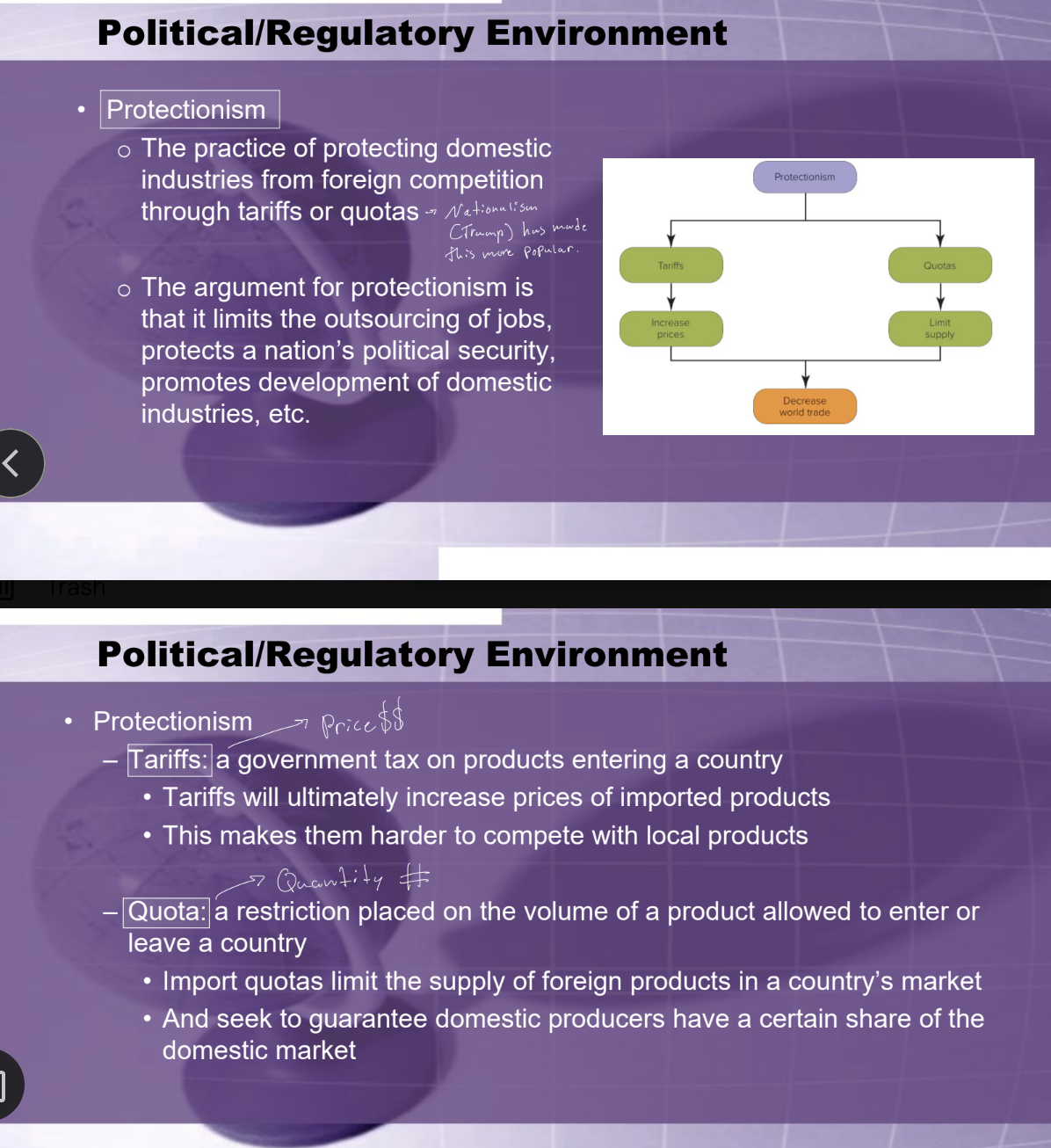
Protectionism is the practice of protecting domestic industries from foreign competition through tariffs or quotas.
Arguments FOR: Limits outsourcing of jobs, protects the nation's political security, and promotes development of domestic industries.
Tariffs - Government tax on products entering the country, which increases the price of imports.
Makes imports harder to compete with local products.
Quotas - Restriction on the volume of product allowed to enter/leave the country, which limits the supply of foreign products.
Guarantees domestic producers a certain market share.
Impact on Global Marketers: Must understand tariff/quota structures, as they may increase product costs and may require different market entry strategies. Affects pricing in different countries.
What are Hofstede's cultural dimensions?
Six dimensions for comparing national cultures
Power Distance - Degree to which less powerful members accept/expect unequal power. High = hierarchical, Low = democratic.
Individualism vs. Collectivism - Self-image "I" vs. "We". Individualist = independence/personal achievement, Collectivist = group harmony.
Masculinity vs. Femininity - Masculine = achievement/assertiveness/competition, Feminine = cooperation/caring/quality of life.
Uncertainty Avoidance - Degree of discomfort with uncertainty. High = prefer rules/structure, Low = flexible/innovative.
Long-Term vs. Short-Term Orientation - Long-term = focus on the future/willing to wait, Short-term = focus on the present/want immediate rewards.
Indulgence vs. Restraint - Indulgent = free gratification/enjoying life, Restraint = suppress gratification/strict social norms.

What cultural aspects affect global marketing? (Values, customs, cultural symbols, language, and ethnocentrism).
Five key cultural elements:
Values - Core principles/standards guiding behavior that vary by culture. Hofstede’s ideas about what consumers believe is important.
Customs - What is considered normal/expected about the way people do things. Important to understand to avoid offending.
Cultural Symbols - Things representing ideas/concepts in a specific country, even though the same symbol means different things in different cultures.
Example: Number 13 in Western countries is unlucky.
Language - Global marketers must know nuances/idioms, as translations can change meaning/offend.
Example: Number 4 in Japan sounds like "death"
Ethnocentrism - Tendency to believe one's own culture is superior.
Consumer ethnocentrism = believe inappropriate to purchase foreign products, which makes global marketing difficult.
Example: McDonald’s in foreign countries does their best to move away from American identity and rather highlight the aspects of local franchising owners.

What are the 4 global market entry strategies and their advantages/disadvantages? (Exporting, licensing, joint venture, and direct investment).
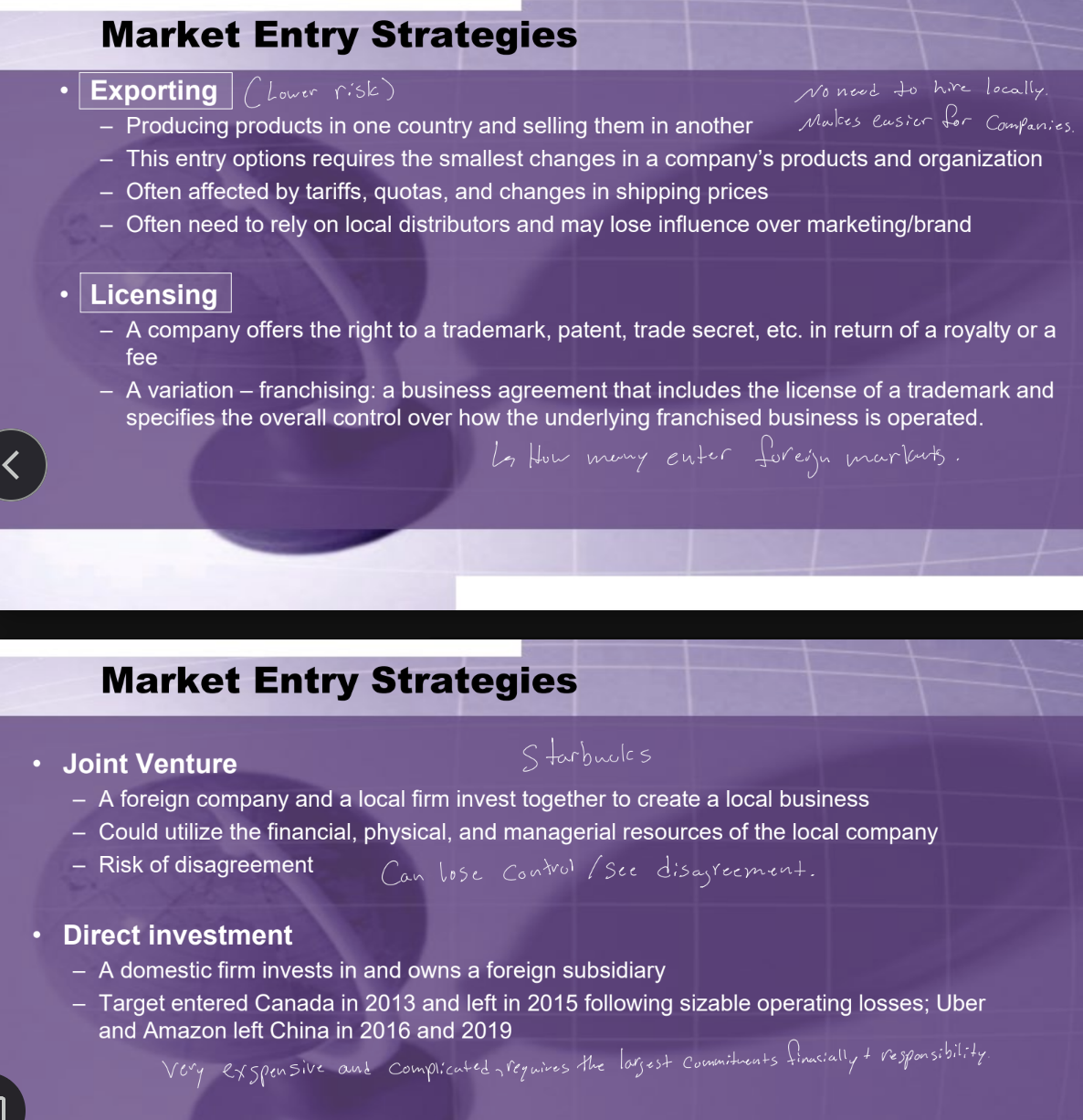
Four strategies ordered by risk/commitment:
Exporting (Lowest Risk) - Producing in the home country, selling in foreign markets, requiring the smallest changes.
Advantages: low risk/investment, simple
Challenges: affected by tariffs/quotas, and relying on local distributors may lose control.
Licensing - Company offers the right to trademark/patent for a royalty/fee.
Can be done with Franchising - Trademark license with specified control)
Advantages: lower investment, access to foreign knowledge;
Challenges: less control, quality concerns.
Joint Venture - Foreign + local firm invest together
Advantages: use local resources, share risk, local expertise;
Challenges: disagreement risk, may lose control.
Direct Investment (Highest Risk) - Domestic firm invests in/owns a foreign subsidiary; Advantages: full control, full ownership of profits; Challenges: very expensive, political/economic risk, complex.
How do you apply the 4 P's in the global marketing environment? (Product and promotion)
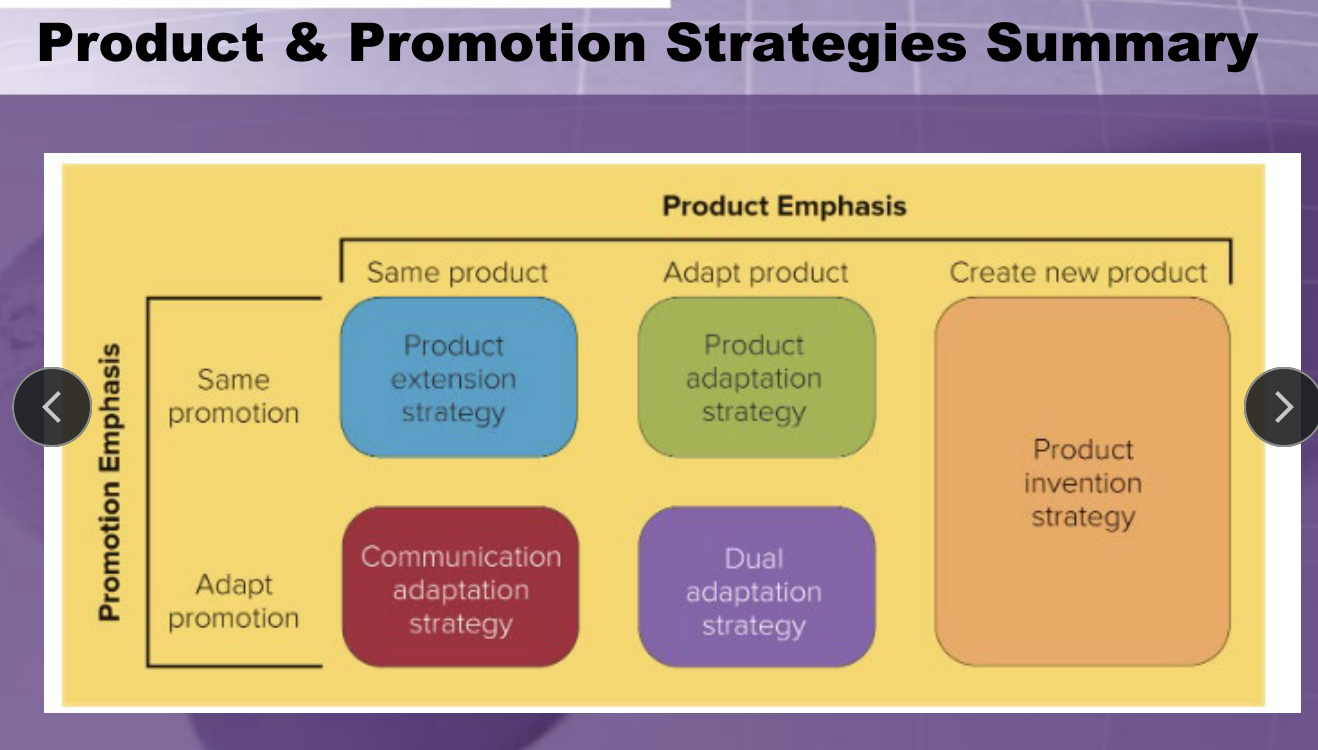
Product Decisions
Extension - sell the same product, no customization.
Examples: Coca-Cola, Nike, Apple
Adaptation - modify for local preferences
Examples: Listerine alcohol-free for Muslim countries, green tea for Asia.
Invention - develop new product for specific market
Example: McDonald's beer internationally.
Promotion Decisions
Use identical message worldwide OR adapt for different countries.
Need to consider language adaptation, cultural references, and wordplay translation
Example: Coca-Cola uses same base idea with customization.
How do you apply the 4 P's in the global marketing environment? (Price and place/distribution)
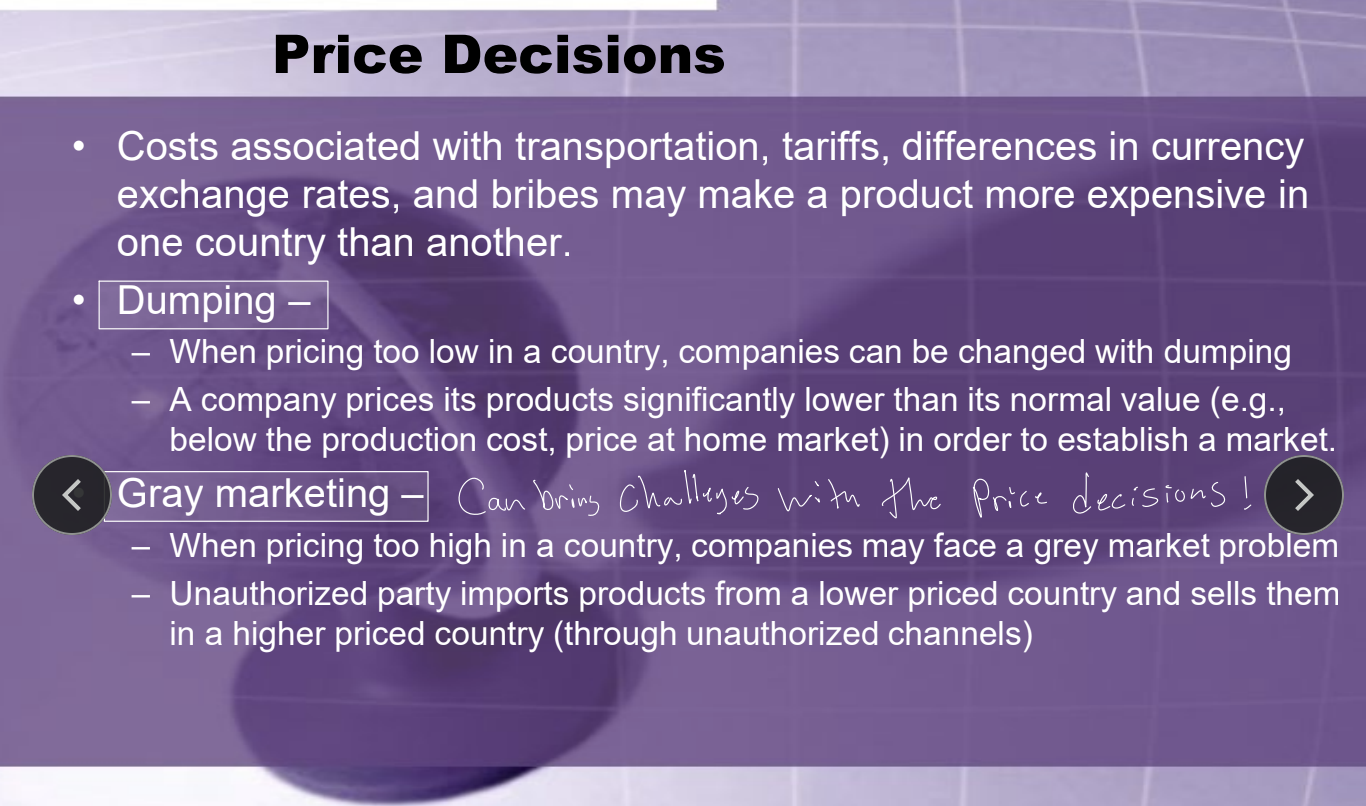
Price Decisions
Account for costs in transportation, tariffs, exchange rates, and bribes that may make their product more expensive.
Dumping - Pricing too low/significantly lower than its normal value in order to establish a market.
Gray marketing - Pricing too high creates parallel unauthorized imports from lower-price countries, then selling in a higher-priced country.
Place/Distribution
Consider infrastructure, channels, retailer relationships, logistics, local regulations.
END OF CHAPTER 6
END OF CHAPTER 6
What is a market? What are the 4 characteristics? (Need, ability, willingness, and authority).
A market is the set of potential customers (people or organizations) with needs or wants and the ability, willingness, and authority to buy.
Four Required Characteristics
1) Must have needs/wants - Recognize a problem to solve and there’s a demand.
2) Must have the ability to buy - Have financial resources/income to pay.
3) Must have willingness to buy (intention to purchase).
4) Must have authority (legal/formal right to make purchase;
Example: child may want a toy, but parent has authority). Vapes or alcohol for those under 21.
5) Must be people or organizations - Not just ideas/products (or Nino the dog).
If all are not present, it's not a market for that product.

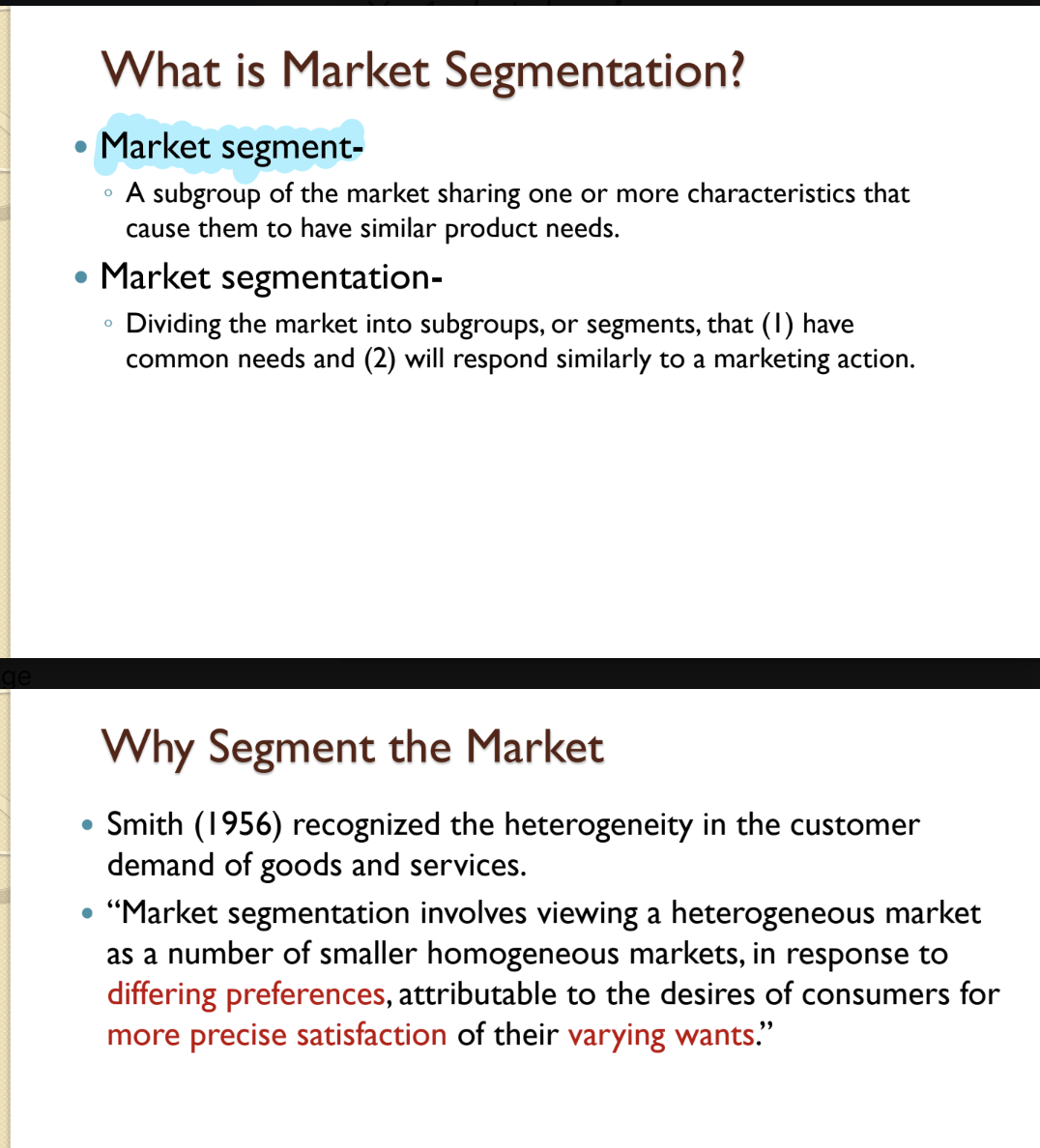
What is a market segment, and what is market segmentation?
Market Segment
A subgroup of the market sharing characteristics causing similar product needs.
Key Concept (Smith, 1956): Recognized heterogeneity in customer demand—markets are not homogeneous but composed of smaller homogeneous groups with differing preferences. Attributable to the desires of consumers for more precise satisfaction of their varying wants.”
Market segmentation
Dividing the market into subgroups, or segments, that….
(1) have common needs
(2) will respond similarly to a marketing action.
Why segment the market? What do marketers need to do?
Fundamental Reason
Consumers are not alike - have different needs/preferences, and hence firms need to serve them differently.
What Marketers Need to Do:
Break the large market into smaller groups, deciding who to serve and how.
Understand unique needs/preferences for each group
Pick groups to serve
Customize marketing strategies for target groups.
Benefit: More efficient marketing that better meet customer needs and can lead to higher profitability.

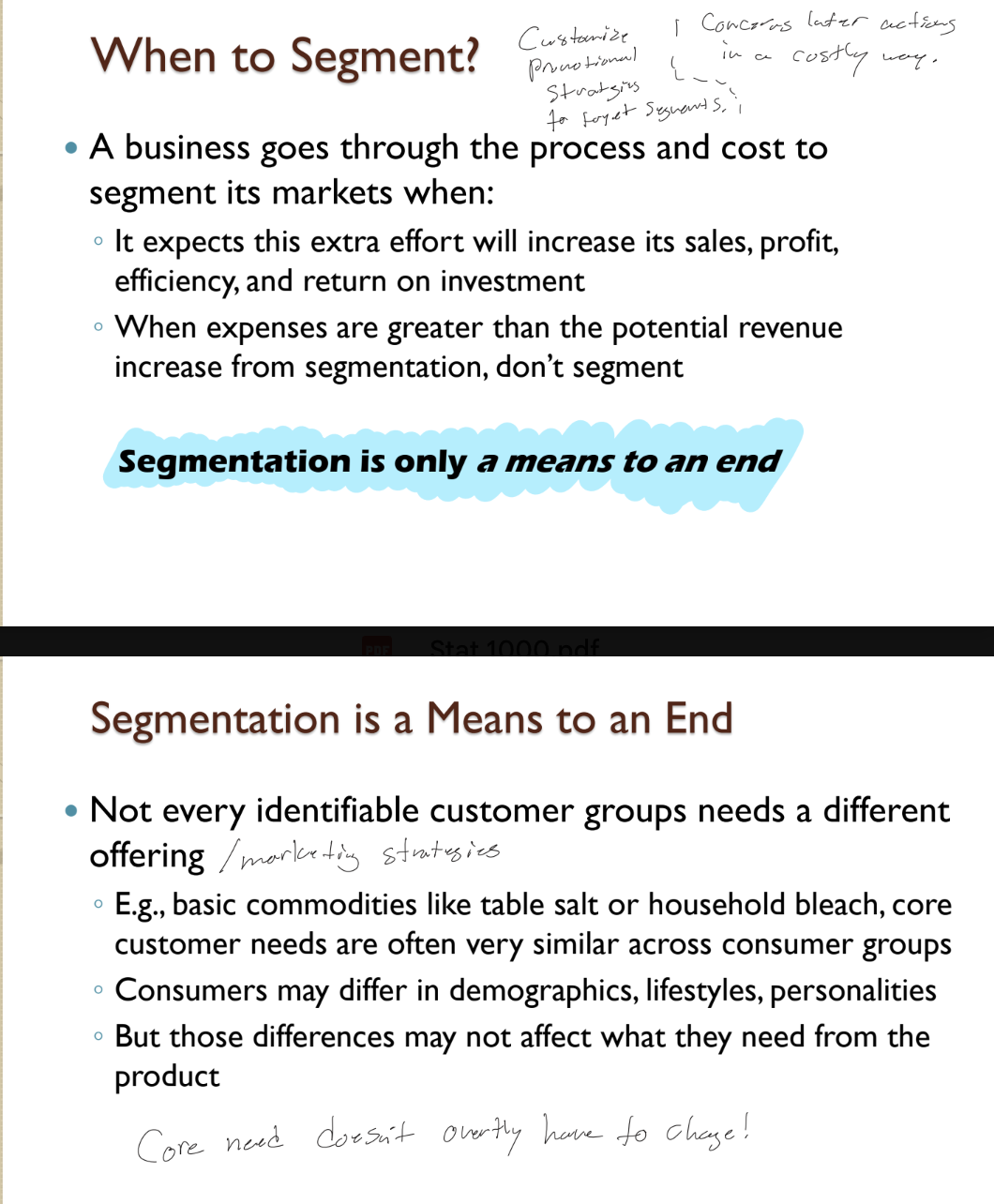
When should you segment the market?
Businesses segment markets when..
Expect extra effort will increase sales, profit, efficiency, and return on investment.
Benefits of segmentation outweigh costs.
When expenses are greater than potential revenue increase → DON'T segment.
Key Point: Segmentation is a means to an end, not an end itself.
When NOT to Segment
Not every identifiable customer group needs a different offering/marketing strategy.
Examples: Basic commodities (salt, bleach) - core customer needs are often very similar across groups; consumers may differ in demographics/lifestyles, but differences don't affect product needs.
What criteria should you use in forming segments?
Three key criteria
Similarity of Buyers' Needs Within Segment - Customers within the segment must have similar needs and must react similarly to the firm's marketing actions, so marketing can effectively reach the segment.
Difference of Needs Among Segments - Members of one segment should have sufficiently different needs, and they must react differently to marketing actions than different segment members of other segments.
If two segments are too similar, group them together.
Profit Considerations -
Simplicity/Cost-Effectiveness: identify segment members and cost-effectively assign customers
Potential of Reaching Segment: members must be reachable with the marketing mix
Profitability: maximize potential profitability and ROI from marketing actions.

What is a segmentation basis, and what are the different bases for segmenting consumer markets? (Geographic, demographic, Psychographic, and Behavioral).
A segmentation basis is a set of variables/characteristics used to assign customers to homogeneous groups.
Geographic - Region, Market size, Market density, Climate.
Example: Home Depot in Florida won't stock snow shovels, but Buffalo will. Plant-based KFC in India and new offerings to replicate traditional Chinese breakfast in China.
Demographic - Age, Gender, Income, Ethnicity, Occupation, Family life cycle.
Advantages: Easy to measure.
Disadvantages: May not relate to product needs.
Example: Age-based segmentation of technology. A cell phone for the elderly will have big buttons and a large LCD, while a smartwatch for kids will have a school mode and location tracking. Razors for men/women.
Psychographic - Lifestyle/habits, Values, Attitudes, Personalities.
Examples: L.L.Bean/Patagonia target outdoorsy people. Interest-specific magazines.
Advantages: More directly related to product needs.
Behavioral - How consumers behave toward a product or brand rather than who they are. Benefits Sought or Usage Rate.
Usage Rate Example: Segmenting based on quantity consumed or patronage. 80/20 Principle (20% of customers generate 80% of demand).
Hotels saving some rooms for loyalty customers.
Benefits Sought Example: Segmenting based on important features/benefits sought from the product
Starbucks customers want speed vs. study space vs. premium experience. Phones.

What are the 5 segmentation and targeting steps?
Step 1
Group Potential Buyers into Segments
Step 2
Group Products to Be Sold into Categories
Step 3
Develop a Market-Product Grid and Estimate the Size of Markets
Step 4
Select Target Markets based on estimation of the market size for each segment of each product grouping.
Step 5
Take Marketing Actions to Reach Target Markets

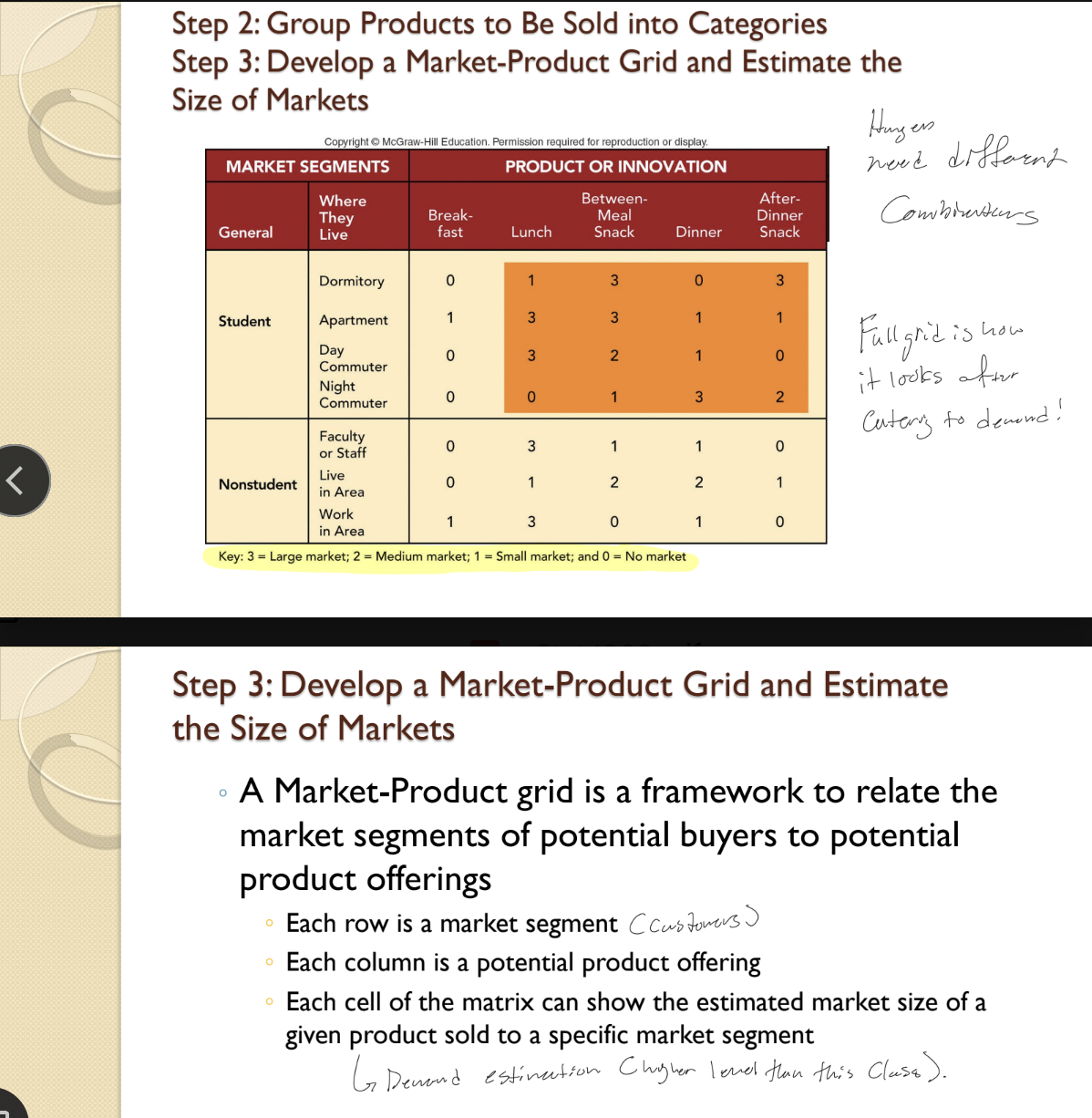
What is a Market-Product grid and how do you use it?
A Market-Product grid is a framework relating market segments of potential buyers to potential product offerings.
Structure
Rows = Market segments
Columns = Product offerings/categories
Cells = Estimated market size for a given product sold to a specific segment.
How to Use
Step 1 - Identify market segments
Step 2 - Identify product categories to sell
Step 3 - Create a grid showing estimated demand in each cell
Step 4 - Identify cells with highest potential (large market size)
Step 5 - Select target markets (which segments/products to pursue).
Example - Wendy's: Segments (college students, families, office workers) × Products (lunch combos, breakfast, salads, kids meals) = grid showing estimated demand for each combination.
What are the four main targeting strategies? (Differentiated, Undifferentiated/Mass, Concentrated/Niche, Micro-marketing).
Four main targeting strategies
1) Undifferentiated Targeting (Mass Marketing) - One product for multiple segments in an attempt to serve multiple segments with a single product.
Advantages: avoids extra development costs, efficient
Challenges: may not satisfy segments well
Examples: Book series, movies, basic cola.
2) Differentiated Targeting - Multiple products for multiple segments and use different products to serve segments with different needs.
Advantages: better meet needs, premium pricing, more market share
Challenges: higher costs, complex.
Examples: Car manufacturers who make different car models based on differing needs, incomes, lifestyles, etc.
3) Concentrated/Niche Marketing - One/few products for small, specific, well-defined segment.
Advantages: useful for smaller firms, deep expertise, loyal customers, profitable at high markups/price
Challenges: limited market size, vulnerable
Examples: Lamborghini, Bombas socks.
4) Micro-Marketing (Segments of One) - Mass customization where we tailor products to individuals and modify basic good/service for individual customer.
Examples: Nike By You, Converse customization, Custom laptops.

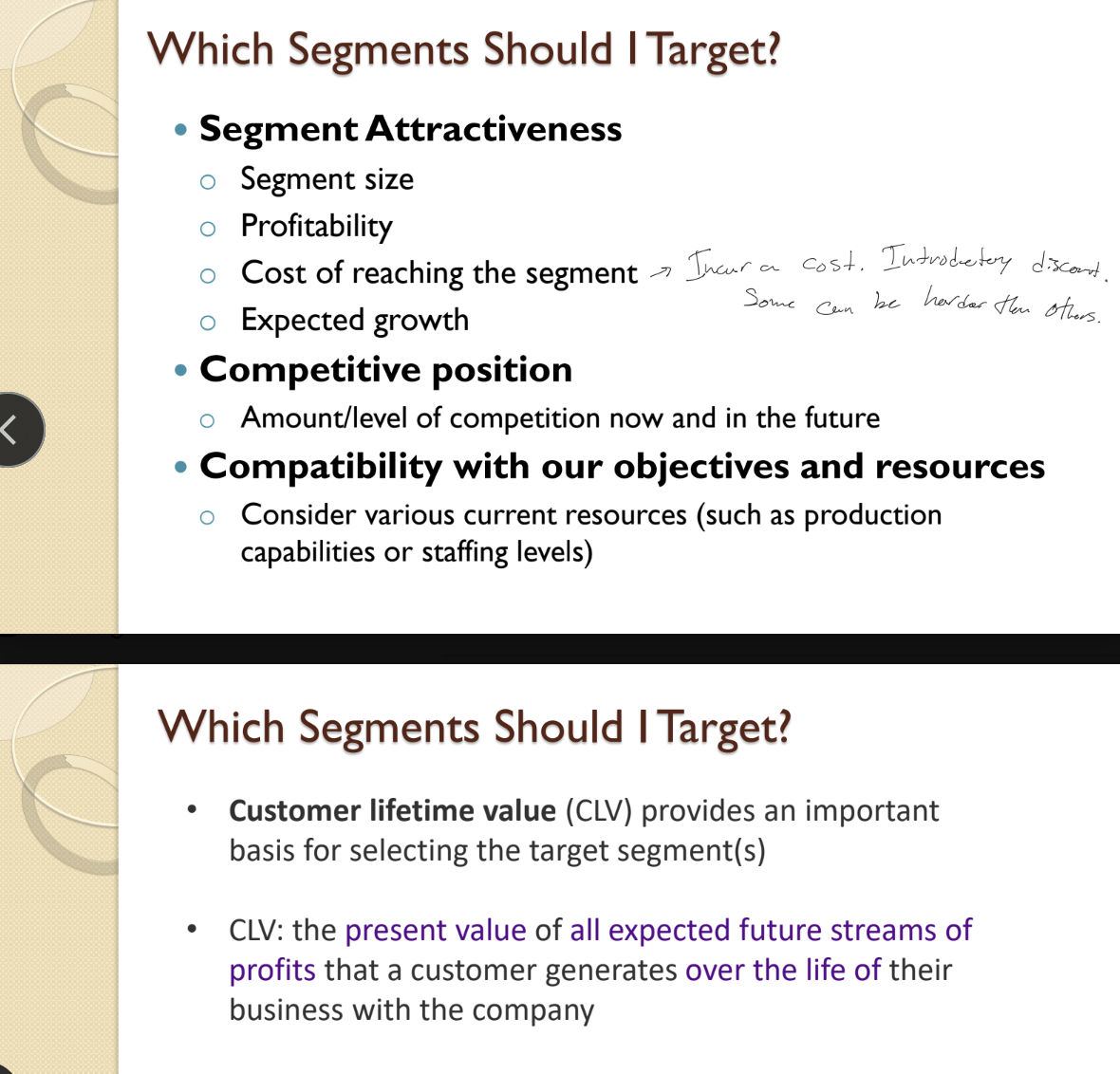
Which segments should you target? How do you evaluate segment attractiveness?
Segment Attractiveness evaluation
Segment Size - Number of potential customers where larger generally more attractive.
Profitability - Expected profit margin; must account for costs vs. the price customers pay.
Cost of reaching segment - Marketing costs to acquire customers; distribution costs; some segments are cheaper to reach.
Growth Potential - Expected segment growth over time; growing segments are more attractive.
Competitive Position
Amount/level of competition, as less competitive segments are more attractive.
Compatibility with Objectives/Resources
Current organizational resources like production capabilities/staffing levels and alignment with company goals.
Key
Evaluate using Customer Lifetime Value (CLV), Cost Per Acquisition (CPA), and segment size.
Formula: Segment Attractiveness = (CLV - CPA) × Segment Size.
What is Customer Lifetime Value (CLV)? Why is it important, and what is its formula?
Customer Lifetime Value (CLV)
The present value of all expected future streams of profits that a customer generates over the life of their business with the company.
Why is this important?
Provides a basis for selecting which target segments to pursue and helps prioritize which customers/segments are worth investing in.
Formula for Limited Lifetime
CLV = (Price – Cost) × Annual Quantity × Retention Rate adjusted for discount rate × Years.
Formula for Infinite Lifetime: CLV = (Price – Cost) × Annual Quantity × Retention Rate / (Discount Rate + (1 – Retention Rate)).
How do you calculate Customer Lifetime Value for a limited lifetime?
Customer Lifetime Value for a limited lifetime is calculated by converting future cash flows to present value and summing across all years.
Formula
CLV=Annual Profit×t=1∑n[1+Discount RateRetention Rate]t
Components
Annual Profit = (Price - Cost) × Annual Quantity
Retention Rate = Probability customer stays/returns each year (between 0-1)
Discount Rate = Time value of money rate (e.g., 0.5)
t = Year number
n = Total years of customer lifetime.
What it means
Each year's profit is multiplied by the retention rate raised to that year's power (accounts for customers leaving), then divided by (1 + discount rate) raised to that year's power (converts future money to present value). Then sum all years to get total CLV.
Example
Year 1: $320 × 0.75 / 1.5 = $160
Year 2: $320 × (0.75)² / (1.5)² = $80
Year 3: $320 × (0.75)³ / (1.5)³ = $40
Year 4: $320 × (0.75)⁴ / (1.5)⁴ = $20.
CLV = $160 + $80 + $40 + $20 = $300.
The discount rate converts future dollars to today's value (e.g., 0.5 means $1 next year = $0.67 today).
![<p>Customer Lifetime Value for a limited lifetime is calculated by converting future cash flows to present value and summing across all years. </p><ul><li><p><strong>Formula</strong></p><ul><li><p> $$CLV = \text{Annual Profit} \times \sum_{t=1}^{n} \left[\frac{\text{Retention Rate}}{1 + \text{Discount Rate}}\right]^t$$</p></li></ul></li><li><p><strong>Components</strong></p><ul><li><p><u>Annual Profit</u> = (Price - Cost) × Annual Quantity</p></li><li><p><u>Retention Rate</u> = Probability customer stays/returns each year (between 0-1)</p></li><li><p><u>Discount Rate</u> = Time value of money rate (e.g., 0.5)</p></li><li><p><u>t </u>= Year number</p></li><li><p><u>n</u> = Total years of customer lifetime. </p></li></ul></li><li><p><strong>What it means</strong></p><ul><li><p>Each year's profit is multiplied by the retention rate raised to that year's power (accounts for customers leaving), then divided by (1 + discount rate) raised to that year's power (converts future money to present value). Then sum all years to get total CLV. </p></li></ul></li><li><p><strong>Example</strong></p><ul><li><p><u>Year 1</u>: $320 × 0.75 / 1.5 = $160</p></li><li><p><u>Year 2</u>: $320 × (0.75)² / (1.5)² = $80</p></li><li><p><u>Year 3</u>: $320 × (0.75)³ / (1.5)³ = $40</p></li><li><p><u>Year 4</u>: $320 × (0.75)⁴ / (1.5)⁴ = $20. </p><ul><li><p><u>CLV</u> = $160 + $80 + $40 + $20 = $300.</p></li></ul></li><li><p>The discount rate converts future dollars to today's value (e.g., 0.5 means $1 next year = $0.67 today).</p></li></ul></li></ul><p></p>](https://assets.knowt.com/user-attachments/da88714b-00f1-49c2-a267-472eddae94b2.png)
How do you calculate Customer Lifetime Value for infinite lifetime customers? What about cost per acquisition?
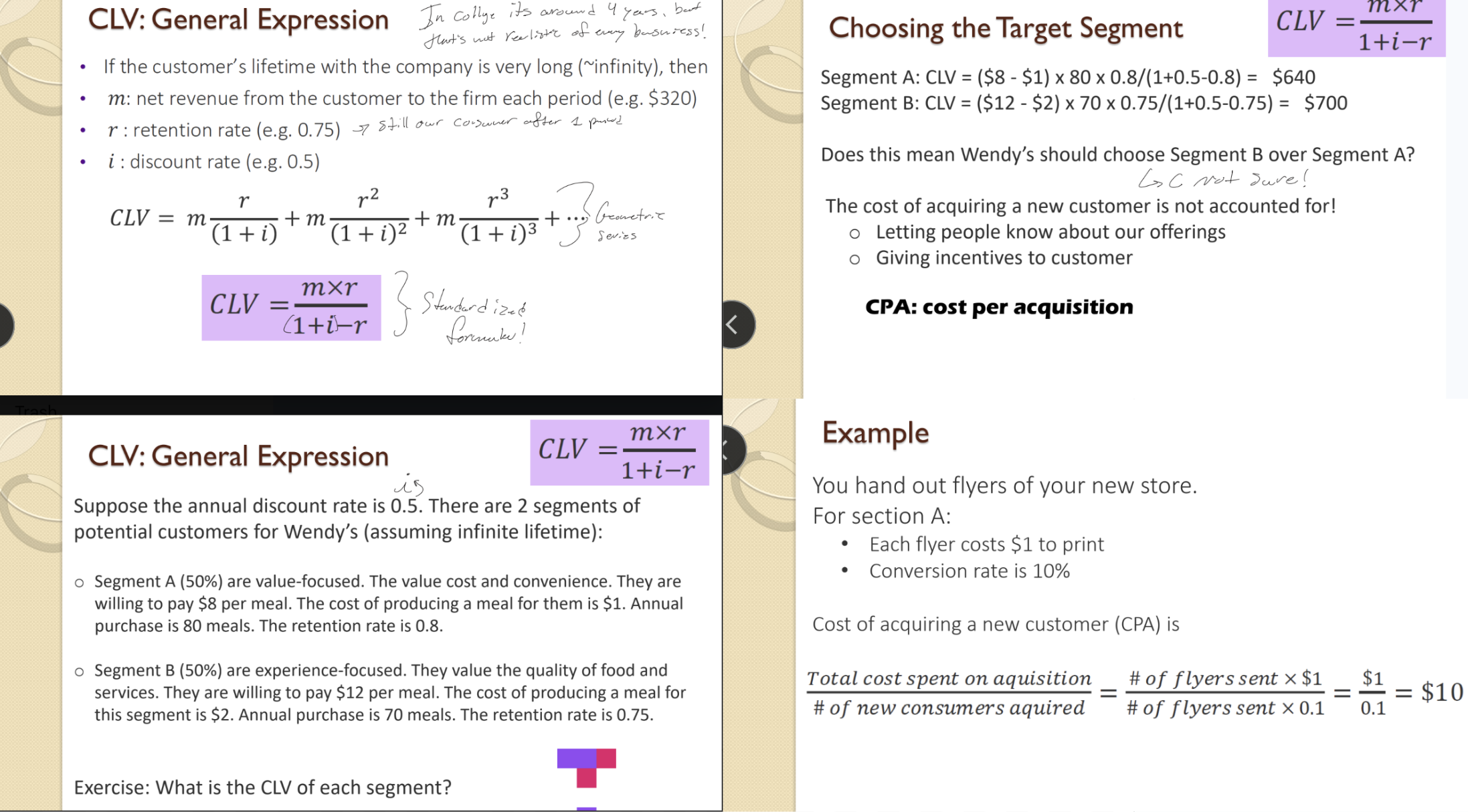
For infinite-lifetime customers, use the standardized formula
CLV=1+i−rm×r
Components
m = net revenue (profit) from customer each period (e.g., ($8-$1) × 80 meals = $560)
r = retention rate, probability customer returns each period (e.g., 0.8 meaning 80% retention)
i = discount rate, time value of money (e.g., 0.5)
This formula assumes customer relationship lasts indefinitely.
Wendy's example (2 segments, 0.5 discount rate)
Segment A (50% Value-focused)
m=$560, r=0.8 → CLV = $560 × 0.8/(1+0.5-0.8) = $448/0.7 = $640.
Segment B (Experience-focused)
m=$700, r=0.75 → CLV = $700 × 0.75/(1+0.5-0.75) = $525/0.75 = $700.
Segment B has higher CLV ($700 > $640) BUT this doesn't automatically mean choose Segment B.
Must also consider Cost Per Acquisition (CPA).
What is the cost of acquiring a new customer (CPA)?
Cost Per Acquisition (CPA) is the average cost to acquire/attract one new customer in a target segment. It includes all marketing and advertising expenses needed to convert a prospect into a customer.
Formula
CPA=Number of Customers AcquiredTotal Acquisition Cost
Or alternatively:
CPA=Conversion RateTotal Marketing Cost
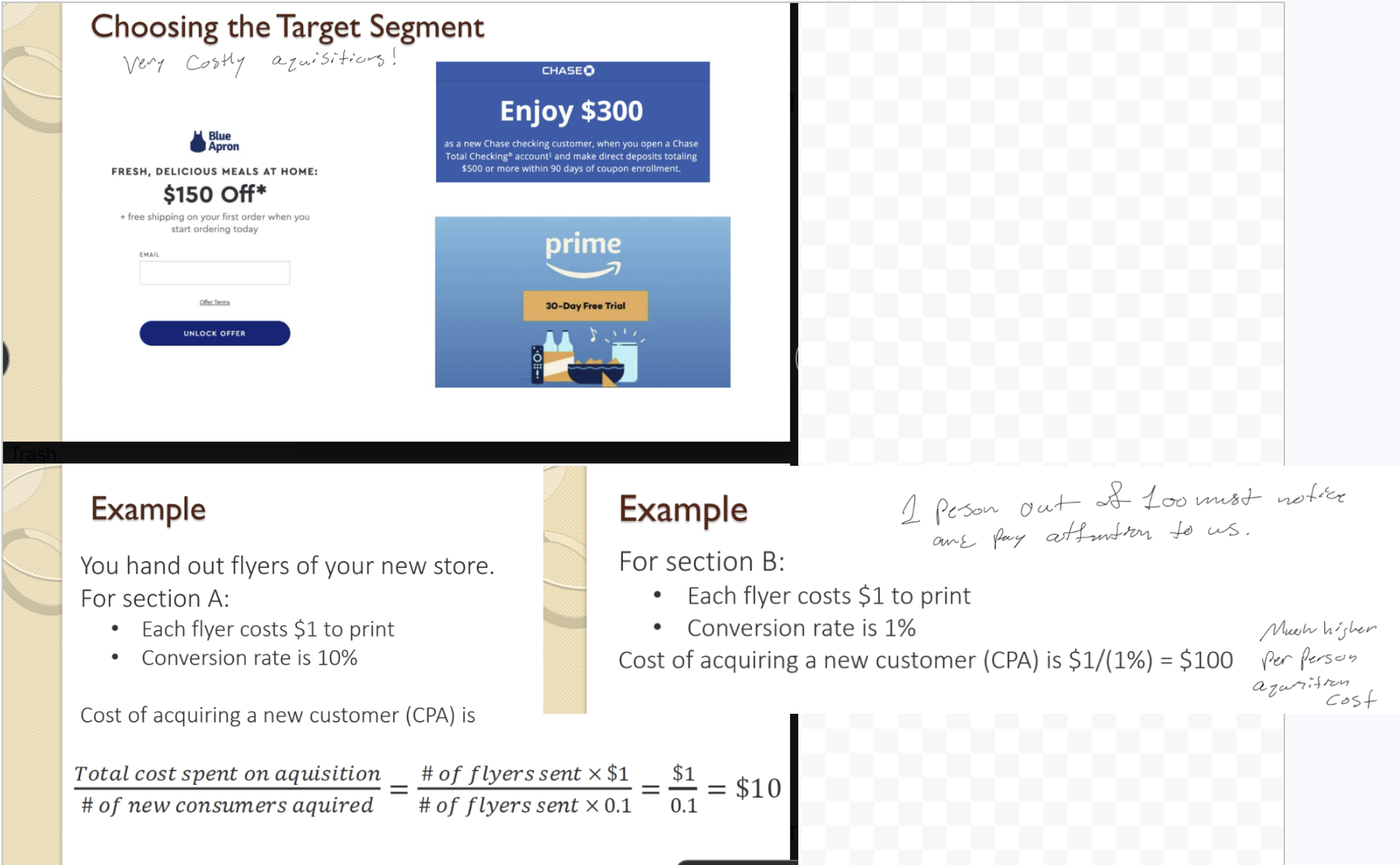
Example from flyer campaign:
Handing out flyers for new store to Section A
Each flyer costs $1 to print and the conversion rate is 10% (1 in 10 people who get flyer become customers).
Handing out flyers for new store to Section B
Each flyer costs $1 to print and the conversion rate is 1% (1 in 100 people who get flyer become customers).
Calculation
CPA = Total flyers sent × $1 / (Total flyers sent × 0.1)
A: $1 / 0.1 = $10 per customer acquired.
This means it costs $10 in marketing to acquire one new customer in Section A.
B: $1 / 0.01 = $100 per customer acquired.
This means it costs $100 in marketing to acquire one new customer in Section B.
Real-world examples
Blue Apron offers $150 off (high CPA)
Chase Bank offers $300 bonus (high CPA)
Amazon Prime offers 30-day free trial (moderate CPA).
Why CPA matters for segment selection
Lower CPA = better segment to target (easier/cheaper to acquire customers).
How do you evaluate segment attractiveness based on CLV, acquisition cost, and segment size?
Formula
Segment Attractiveness = (CLV - CPA) × Segment Size.
CPA = Cost Per Acquisition (cost to acquire a new customer in the segment).
Important
Acquisition costs can change the decision even if one segment has higher CLV.
Example
Segment A (Students)
CLV=$640, CPA=$10, size=50% = ($640-$10)×0.5 = $315.
Students may be easier to serve and squire, but at times harder to pay
Segment B (Faculty)
CLV=$700, CPA=$100, size=50% = ($700-$100)×0.5 = $300.
Faculty might be more costly to serve and acquire, but can effectively pay.
Conclusion
Segment A is more attractive despite lower CLV due to lower acquisition cost.
Key Lessons
Don't only look at CLV as you must consider acquisition costs and segment size.
CLV shows customer value. CPA shows acquisition cost. Net difference determines which segment to target, not CLV alone.
A segment with high CLV but very high CPA may be less attractive than a segment with lower CLV but significantly lower CPA.

What is a fifth step that can be taken in marketing actions to reach target markets? What are 2 stratgies?
Develop and implement your market strategies (a combination of product, price, promotion, and place/distribution) to meet the needs of your selected target markets.
What to offer them?
Example action: promotion strategy
Ads in apartment lobbies and on buses to reach apartment and day commuter students
Example action: price strategy
Offer 10% discount on all purchases between 2–4:30 p.m. to attract students who want afternoon snacks

What is positioning and what is product positioning?
Positioning
The place a product occupies in target consumers' minds on important attributes relative to competitive products.
Key Insight is not about actual product attributes, but rather about HOW CONSUMERS PERCEIVE the product.
Position is relative to competitors in consumers' minds.
Can create position through marketing strategy.
Importance
How consumers perceive the brand/product drives purchase decisions more than actual product features.

What is the process to create effective positioning and different positioning strategies?
Process
Step 1 - Identify Important Attributes (what attributes matter to consumers).
Step 2 - Discover How Target Customers Rate Competitors (market research on competitor perceptions).
Step 3 - Discover Where Your Product Is (what's the current position in consumers’ minds).
Step 4 - Reposition if Needed (change strategy if current position is not ideal).
Positioning Strategies
1) Head-to-Head Positioning - Compete directly on similar attributes, same criteria but better
Advantages: address established needs, competitor comparison
Challenges: direct competition is harder to win.
Examples: CVS and Walgreens
2) Differentiation Positioning - Position away from competitors in a unique/different way
Advantages: less competition, can charge a premium
Challenges: smaller market, must communicate unique benefits.
Examples: Whole Foods (premium/organic) vs. Costco (bulk/value) vs. Kroger (traditional).

What is a perceptual/positioning map?
Perceptual Mapping
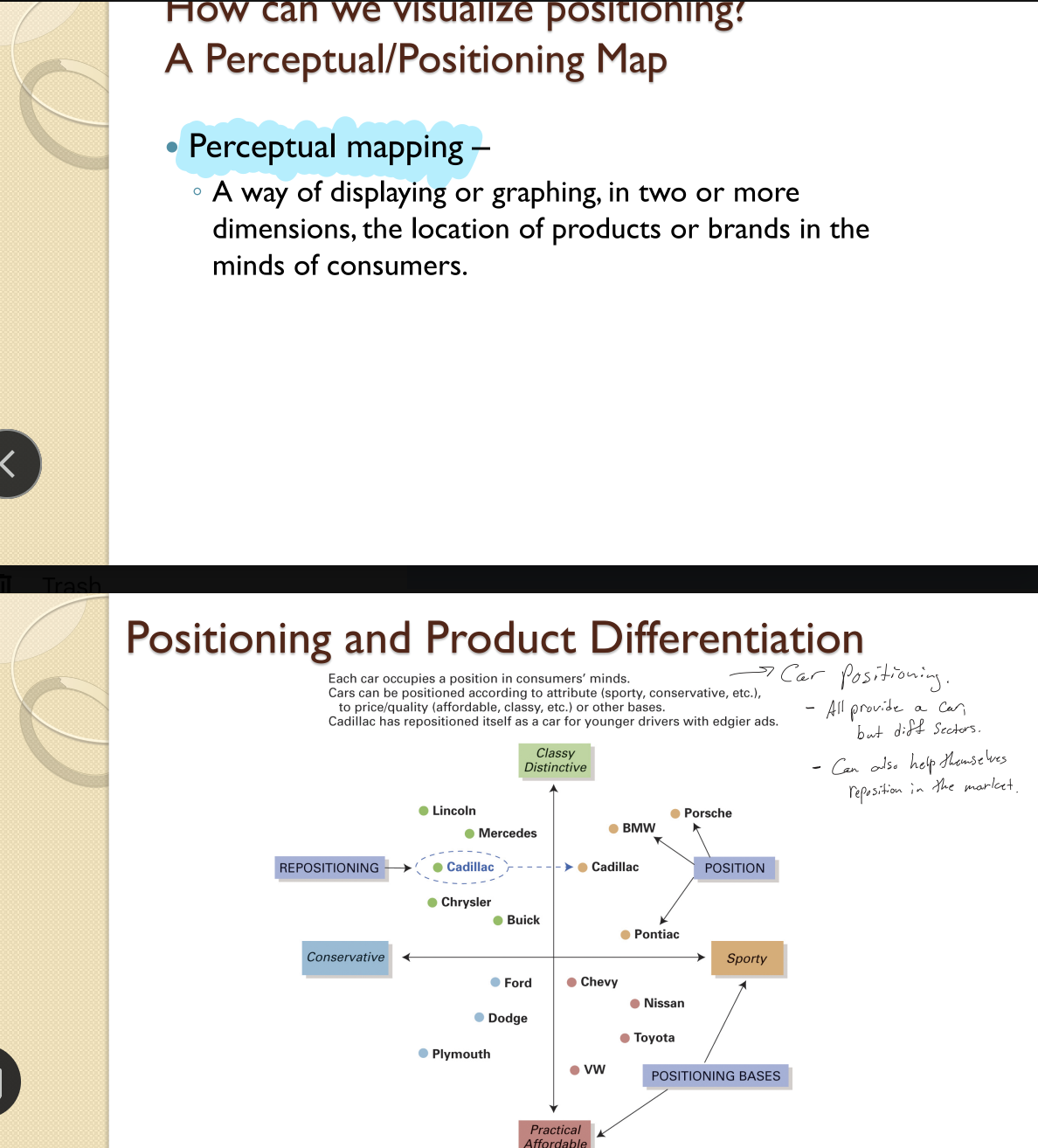
A way of displaying/graphing, in two or more dimensions, the location of products/brands in the minds of consumers.
A visual representation of positioning strategy shows how consumers perceive different brands relative to each other.
How It Works
X-axis = one important attribute (e.g., Price: Cheap to Expensive), Y-axis = another attribute (e.g., Quality: Low to High)
Each brand is plotted based on consumer perceptions
Distance between brands shows competitive relationships.
Example:
Luxury car market - Cadillac in luxury/comfort, Ferrari in luxury/performance, Honda in value/practical.
Strategic Use
Identify gaps in the market (unmet positioning opportunities) and understand the competitive landscape.
What is repositioning? Why would a company want to reposition? What are some methods and challenges that come along with this process?
Repositioning: Changing how consumers perceive a brand/product in their minds and moving the product's position on the perceptual map.
Why Reposition
Current position not resonating, market preferences changing, competitive landscape changing, want to appeal to different/additional segments, and modernize brand perception.
Example
Cadillac
Old Position (conservative, old, traditional luxury for older customers)
New Position (new/hip, sporty, modern for younger customers).
Methods
Change product (new features, design)
Change promotion (different ads, celebrities)
Change price positioning (premium vs. value)
Change distribution
Emphasize different benefits.
Challenges
Changing consumer perceptions is difficult;
Existing customers may resist
Takes time and investment; Must be backed by actual product/service changes.

END OF CHAPTER 8
END OF CHAPTER 8
END OF EXAM 1 - PLEASE PRACTICE
END OF EXAM 1 - PLEASE PRACTICE