Atrial Timing Cycles
 Call Kai
 Learn
 Practice Test
 Spaced Repetition
 Match
 Flashcards
 Knowt Play
1/10

There's no tags or description
Looks like no tags are added yet.
11 Terms
AV Delay
healthy heart has a brief pause between atrial contraction “atrial kick” and ventricular contraction
pacemaker timing cycle designed to simulate the natural pause between atrial and ventricular events, by mimicking the PR interval
benefits when properly timed:
allows optimal time for ventricular filling, which may contribute to improved cardiac output
allows sufficient time for proper mitral valve closure, which can help certain patients avid or minimize mitral regurgitation
enhances hemodynamics
Paced AV Delay
time period between paced atrial event and delivery of a subsequent paced ventricular event, if an intrinsic ventricular event does not come in
pacemaker spike initiates the AV delay timing cycle
programmable value

Sensed AV Delay
time period between a sensed atrial event and the delivery of a subsequent paced ventricular event, if an intrinsic ventricular event does not come in
pacemaker has to sense the atrial event before the timing cycle is initiated; there is usually a slight delay in sensing due to lead position, size of sensing circuit, etc.
most clinicians program this delay to a value slightly shorter than the paced AV delay

Programming AV Delays

AV Delays in a patient who requires ventricular pacing
once the AV delay has started, the ventricular channel is looking to see if the atrial event conducts to the ventricles
if the AV delay times out and no intrinsic R wave is sensed, the device will ventricular pace

AV delays in a patient who has intrinsic conduction
if an R wave is sensed during the AV delay, the ventricular pace is inhibited

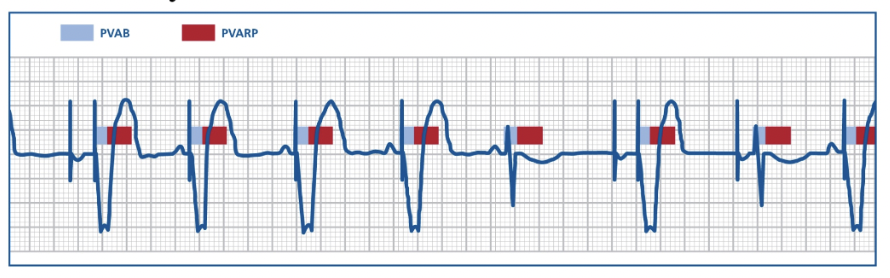
Post-Ventricular Atrial Refractory Period (PVARP)
triggered by a ventricular paced or sensed event; initiates a refractory period in the atrium
programmable from 125-500 ms
benefits:
prevents atrial channel from sensing and responding to, or “tracking” premature atrial contractions and retrograde P-waves
can be programmed to help minimize risk of pacemaker-mediated tachycardias

Importance of PVARP
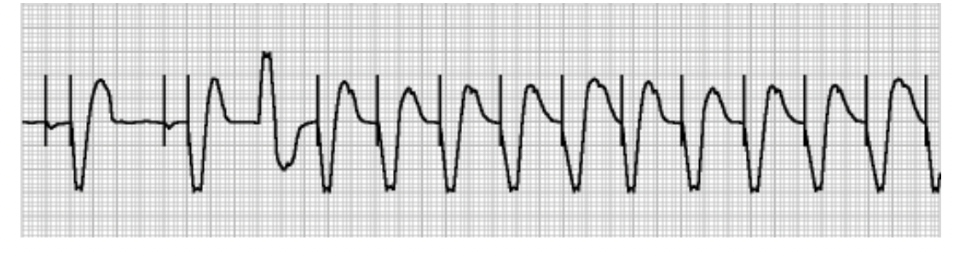
if retrograde conduction exists and the patient experiences a loss of AV synchrony, they are at risk for developing a pacemaker-mediated tachycardia (PMT)
PMTs are prevented by ensuring that PVARP is programmed to a longer value than the retrograde conduction time
Post-Ventricular Atrial Blanking (PVAB)
occurs during first part of PVARP
no signals are sensed by pacemaker’s atrial channel
independently programmable
nominally 150 ms (programmable between 60-250 ms) in pacemakers
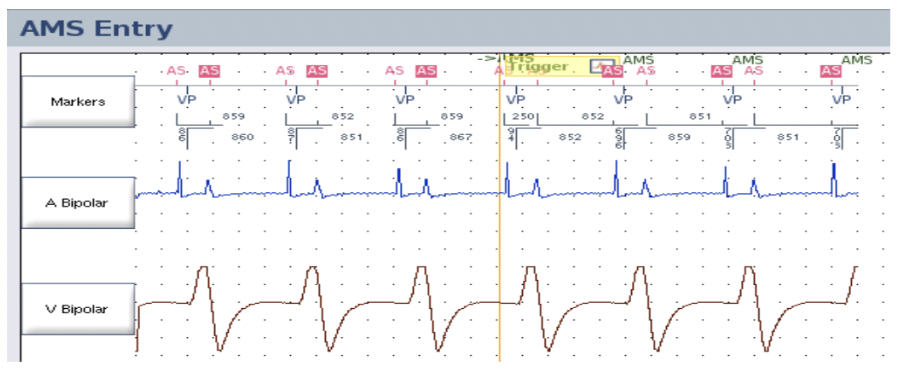
farfield R waves
exists to ensure the device does not sens eor respond to far-field R-waves
occur when the atrial channel senses ventricular impulse
Importance of PVAB
far-field R waves, if sensed, can confuse the device
device sees two atrial events instead of one for each heart beat
if behavior persists, this can result in inappropriate detection of an atrial arrhythmia
PVAB and PVARP
remember that events in PVAB are not sensed at all
events in PVARP are “seen” but do not reset any timing cycles
important to be able to see events in PVARP, in case the patient enters an atrial arrhythmia