Computer Science unit 1 ( Adders, Multiplexors, Counters, Registers, Encoder, Decoder)
 Call Kai
 Learn
 Practice Test
 Spaced Repetition
 Match
 Flashcards
 Knowt Play
1/25

There's no tags or description
Looks like no tags are added yet.
26 Terms
What is a Half Adder (HA)?
A half adder is a combinational logic circuit with two (2) inputs and
two (2) outputs. It is used to ‘add’ two one-bit digits which produces
a sum and carry as outputs from the circuit.
What is a Full Adder (FA)?
The full adder is a three (3) input and two (2) output combinational circuit. Unlike the half adder (HA), the FA facilitates the addition of a carry in from a previous circuit.
What is a Multiplexor (MUX)?
A multiplexor is a combinational circuit which selects one of several analogue or digital signals as input and forwards it into the output line.
What are select lines (MUX) and state the formula that related select lines with input lines.
A select line determines which specific input gets connected to the output.
Formula : A multiplexer with ‘n’ select lines can handle up to ‘2n’ input lines (e.g., 2 select lines support 2² = 4 inputs in a 4:1 multiplexer)
Two uses of Multiplexors?
They are used in the Design of digital components such as CPUs and GPUs
In telecommunication networks they allow a specific amount of information to be passed along a particular communication channel.
What is a Counter?
A counter is a type of sequential circuit made up of flip-flops. It is used to store the number of times a particular process is executed upon a clock pulse.
What is a Asynchronous/ ripple counter?
An Asynchronous Counter, or Ripple Counter, is a counter where only the first flip-flop receives the main clock signal, and each subsequent flip-flop is triggered by the output of the previous one.
What is a Synchronous Counter?
A synchronous Counter is a counter where all flip-flops are triggered simultaneously by a single common clock signal, ensuring synchronized state changes.
What is a register?
A register is a type of high-speed memory that holds data and instructions for immediate processing for the CPU.
What is an Encoder ? ( State its formula)
An encoder is a combinational logic circuit that compresses data for the purpose for translating or transmitting.
Formula: An encoder has ‘2n’ number of input lines and ‘n’ number of output lines.
What is a Decoder ? (state its formula)
A decoder is a combinational circuit that reverses the operation of an encoder, meaning it retrieves the original information.
Formula: It converts ‘n’ input lines to a maximum of 2n unique output lines
What are shift registers?
A shift register is a sequential digital circuit made up of flip-flops that temporarily stores binary data and shifts the data from one flip-flop to another with each clock pulse.
List the 4 types of shift registers and define them?
Serial Input Serial Output (SISO)- A shift register that receives data one bit at a time and outputs data one bit at a time.
Serial Input Parallel Output (SIPO)- A shift register that receives data one bit at a time but outputs all the stored bits simultaneously.
Parallel Input Serial Output (PISO)- A shift register that receives all bits of data simultaneously but outputs them one bit at a time.
Parallel Input Parallel Output (PIPO)- A shift register that receives all bits of data simultaneously and outputs all the bits simultaneously.
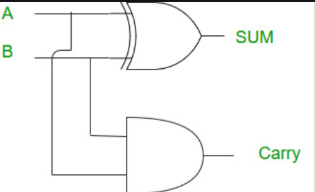
Identify this Diagram
Logic Diagram for a Half adder.

Identify the truth table
Truth table for Half Adders

Identify this image
Circuit diagram for Full Adder

Identify the Image
4:1 Multiplexor

Identify the Image
Block Diagram for 4×1 Multiplexor

Identify the Image above
Asynchronous Counter/ ripple counter

Identify the image above
Synchronous Counter
Sketch or describe the block diagram for the 4-2 line encoder.


Which combinational circuit is this?
This is the circuit diagram for an Encoder
Sketch or describe the block diagram for a 4-2 line encoder

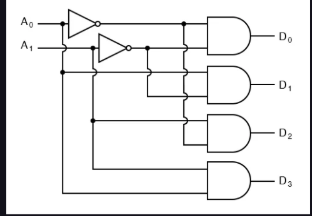
Identify this diagram
Circuit diagram for an encoder.
Sketch the truth table for a 4:1 Multiplexor

Sketch or Draw the truth table for a Full Adder
