Skull bones part 1
 Call Kai
 Learn
Learn Practice Test
 Spaced Repetition
 Match
Match Flashcards
 Knowt Play
1/29

There's no tags or description
Looks like no tags are added yet.
Name | Mastery | Learn | Test | Matching | Spaced | Call with Kai | Chat |
|---|
No analytics yet
Send a link to your students to track their progress
30 Terms
How many cranium bones?
8 Bones
-Frontal
-2 Parietal
-2 Temporal
-Occipital
-Sphenoid
-Ethmoid
Skull Cap
Frontal Bone
Occipital Bone
Right Parietal Bone
Left Parietal Bone
Skull Floor
• Sphenoid Bone
• Ethmoid Bone
• Right Temporal Bone
• Left Temporal Bone

Ethmoid
Frontal
Parietal
Occipital
Temporal
Sphenoid (left greater wing)

Frontal
Ethmoid
Sphenoid
Temporal
Parietal
Occipital

What bone is it?
Label
Frontal bone
Glabella - between eyebrows
Supercilliary ridge(arch) - eyebrows
Supraorbital margin (SOM) - below eyebrow
Frintal tuberosity (eminence)
Supraorbital groove - above eyebrows
Supraorbital notch (foramen) - for blood vessels and nerves, on margin

What bone is it?
Label
Frontal bone - orbital view
Nasal (frontal) spine
Ethmoid notch
Orbital plate

What bone is it?
Label
Parietal bones
Right parietal bone
Parietal tubercle (eminence)
Left parietal bone

What bone is it?
Label
Occipital bone
Lateral condylar portion (occipital condyle) = forms atlanto-occipital joint C1
Foramen magnum
Squamous portion
External occipital protuberance = inion

What bone is it?
Label
Ethmoid bone
Crista galli → goes up through ethmoid notch
Cribriform plate
2 Lateral labyrinth (mass)
Perpendicular plate
Superior nasal concha
Middle nasal concha (turbinate)

What bone is it?
Label
Sphenoid bone - anchors bones
Anterior clinoid process
Foramen rotundum
Foramen ovale
Foramen spinosum
Clivus
Lesser wing
Greater wing
Sella turcica
Dorsum sellae

What bone is it?
Label
Sphenoid bone - oblique view
Superior orbital fissure
Foramen rotundum
Foramen ovale
Lateral pterygoid process (plate)
Pterygoid hamulus
Medial pterygoid process (plate)
Dorsum sellae
Optic foramen
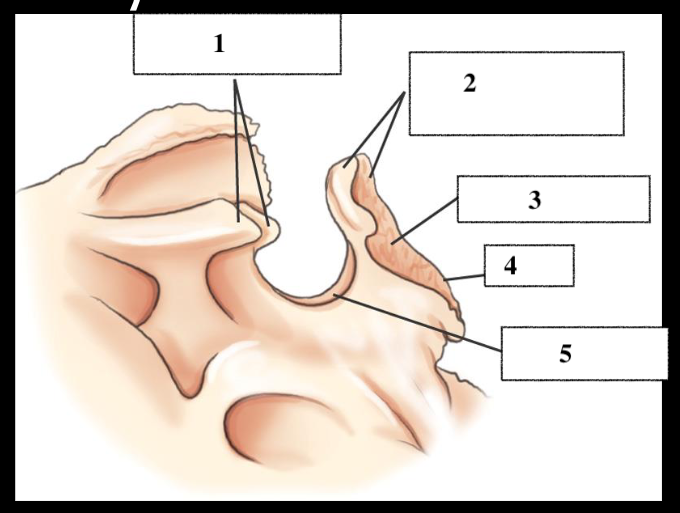
What bone is it?
Label
Sphenoid bone - lateral view
Anterior clinoid processes
Posterior clinoid processes
Dorsum sellae
Clivus
Sella turcica - in profile when lateral

What bone is it?
Label
Temporal bones - Superior view
Petrous ridge
Petroud pyramid
Internal acoustic meatus
EAM
Jugular foramen

What bone is it?
Label
Temporal bones - lateral view
Zygomatic arch
Temporomandibular fossa
Styloid process
EAM
Mastoid process (tip)
Mastoid portion

Label the 3 parts
Squamous portion
Mastoid portion
Petrous portion
Temporal bones
Mesocephalic skull
Average skull
Measurement from frontal - occipital bone= 19 cm = length
Measurement from parietal eminence- parietal eminence = 15 cm = width
Width is 75-85% of length
Petrous pyramids = form a 47 degree angle to MSP
Dolichocephalic
Width is less than 75% of length
Petrous pyramind = form a 40 degree angle to MSP (-7)
Oval skull
Brachycephalic
-Rounded skull
-Width is 80% or more of length
-Petrous pyramids= form a 54 degree angle to MSP (+7)

Glabella
Nasion
Acanthion
Mental point
MSP
Supraorbital groove(SOG)
Superciliary ridge (arch)
Interpupillary line
Angle (gonion)

Glabella
Nasion
Acanthion
Mentum/mental point
Gonion (angle of mandible)
Top of ear attachment(TEA)- petrous ridges

Orbital landmarks
SOM- Supraorbital margin
Midlateral orbital margin
IOM - Infraorbital margin
Outer canthus
Inner canthus

Facial landmarks
-Know in order from highest to lowest
GML - Glabellomental
OML- Orbitomeatal
IOML- Infraorbitomeatal, 7 degrees from OML
AML- Acanthiomeatal
LML-Lipmeatal
MML-Mentomeatal
POSITIONING AND TECHNICAL CONSIDERATIONS
Erect vs. recumbent
• kV range: 70-85
• Minimum 40 inches (102 cm) SID
• Small focal spot
• Shielding of radiosensitive organs
• 10 X 12 IR with collimation
Remove-
Jewelry
False teeth
Hearing aide
Eye Glasses
Hair ties/clips
Wigs
Extentions
PA SKULL
Frontal Bone
OML perpendicular on PA/AP
• Options:
TRUE PA- CR 0° exit at glabella →Petrous pyramids fill the orbits
CALDWELL- CR 15° caudad exit at nasion→Petrous Ridges in lower 1/3 of orbit
TOWNES METHOD
AP AXIAL PROJECTION
Occipital Bone
• Caudal angle- downtown
Preferred OML / CR 30 degrees
Settle for IOML / CR 37 degrees
CR is 2 ½ inches above glabella
Foramen magnum with dorsum sellae in center
HAAS
PA AXIAL PROJECTION
Occipital Bone
Reverse of Townes except:
• Angle 25 degrees cephalic
• Dorsum sellae appears larger within foramen magnum
• Magnification of occipital bone evident
• Exit 1 ½ inch above Nasion
LATERAL SKULL
Need true lateral position of head
• Perform both Right & Left to see temporal and parietal bones
• Three lines:
MSP - parallel
PL –perpendicular to IR
IOML perpendicular to front edge of IR
-CR 2” superior to EAM
• Errors: Rotation, Tilt, Excessive neck flexion, Excessive neck extension
ROTATION
Rotation= Anterior to Posterior separation
• Mandibular rami
• EAM
• Greater wings of sphenoid
TILT AND THE MSP
Inferior to Superior separation
• Orbital plates
• Lesser wings of sphenoid