Tourism
 Call Kai
 Learn
Learn Practice Test
 Spaced Repetition
 Match
Match Flashcards
 Knowt Play
1/30

There's no tags or description
Looks like no tags are added yet.
Name | Mastery | Learn | Test | Matching | Spaced | Call with Kai | Chat |
|---|
No analytics yet
Send a link to your students to track their progress
31 Terms
Definition of tourism
Tourism implies that a person undertakes a journey: The journey may be for less than a day, or it may be a journey within a national boundary, therefore constituting a domestic trip or an international trip.
Sub sectors are identified as being components of tourism activity such as: accommodation, travel agents & tour operators, transport, shopping, etc
“temporary movement to destinations away from the normal home and workplace, the activities undertaken during the stay and the facilities created to meet the needs of tourists” (Mathieson & Wall, 1982)
Tourism Supply
Amount or products/services that will be able to be purchased by the tourist.
Tourism products are highly perishable as they are produced and consumed at the same time.
Movement: travel away from home.
Temporary stay: the visitor intends to return.
Purpose: anything other than earning a living at the destination
Components of the tourism destinations: 5As
Accommodation - Places to stay overnight: hotels, resorts and hostels to campsites, holiday rentals and rural or agro-tourism lodgings. The range, quality & price of accommodation shape what kind of tourist a destination attracts
Accessibility - How easily tourists can reach destination and move around there.
Transport infrastructure such as airports, ports, roads and rail
Transport services such as airlines, trains, buses and car hire
Entry conditions such as visa & physical accessibility for disabled travellers
Attractions/ entertainment - Main reason people visit. Attractions can be:
Natural: beaches, mountains, climate, wildlife, landscapes
Built or man-made: monuments, theme parks, museums, architecture
Cultural: heritage, festivals, gastronomy, traditions, local lifestyle
Event-based: sports events, concerts, conferences
Activities - supporting facilities and services that make a stay comfortable. Eg:
Restaurants, bars and shops
Public toilets, banks and ATMs, and Wi-Fi
Healthcare and safety services
Tourist information centres and signage
Amenities - Things visitors can do at the destination, such as excursions, water sports, hiking, golf, guided tours, nightlife and workshops. Activities add value to the attractions and help extend the length of stay.
Tourism Satellite Accounts (TSA)
Tool to measure the structure and size of tourism in a country and add credibility to the field.
Measures the goods and services purchased by visitors to estimate the size of the tourism economic sector, economic impact, employment.
Tourism Supply and demand
Supply
Supply is the amount of products and services available for tourists to purchase.
Tourism product is highly perishable as it’s produced & consumed at the same time.
A destination’s supply is made up of the 5 As:
Demand
Demand is an individual’s need to consume and experience places.
Consuming destinations is a subjective experience.
Demand is the total number of people taking part in tourism activities.
Tourists demand goods, services and places.
Demand is influenced by the tourist’s budget, their motivations, and changes in the generating area.
Types of tourism
Domestic | People visiting destinations within their own country |
Inbound | International visitors travelling to a country other than their own |
Outbound | Residents travelling to other countries; their home country is the generating market |
Main issues (the complexity of defining tourism)
Difficulty defining tourism because of its diverse and complex nature.
Conceptual weakness: there is no single, agreed concept.
Diverse industrial sectors and academic subjects: UN Tourism lists 12 tourism industries. These include accommodation; food and beverage; rail, road, water and air transport; transport rental; travel agencies; cultural activities; sports and recreation; and retail.
Weak data sources: tourism is hard to measure.
A partial solution: Tourism Satellite Accounts (TSA)
Leisure, recreation and tourism

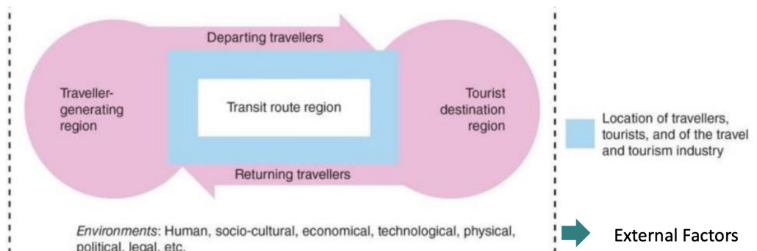
Nature of the tourism system
Human element: tourist.
Geographical element:
TGR (Traveller-Generating Region): where travellers depart from & return to.
TRR (Transit Route Region): area travelled through between home & destination.
TDR (Tourist Destination Region): where tourist goes.
Tourism industry: the businesses serving travellers along the whole route.
International Visitor
Describes a person visiting a country other than that in which they have their usual residence, for a period not exceeding 12 months, and whose main purpose of visit is other than the exercise of remunerated activity.
How does Maslow's hierarchy apply to tourists?

What are the six motivations for travel?
Cultural, status, emotional, physical, personal, personal development
What are the three phases of the tourist experience?
Anticipation → Realization → Recollection
Anticipation = planning and research. Realization = expectations met, new experiences. Recollection = sharing memories, souvenirs
Destination management and planning
Destination Management Organisation: leads, coordinates, stimulates and monitors development and marketing
NTOs- national tourism organisations
DMOs- destination management organisation
CVB- Convention visitors bureaus
Destination competitiveness
Competitiveness is a measure of economic success: achieving long-term profitability above the industry average. It is measured by the Travel & Tourism Competitiveness (TTC) Index.
It is relative: a destination is only more or less competitive compared with others.
Destinations compete on specific quality attributes, location advantages or processes.
Quality advantages include natural, environmental and built features, plus locals’ attitudes towards tourists.
Cost advantage means value for money.
To be competitive, destinations should:
understand changes in the external environment;
be aware of shifting consumer preferences and expectations;
understand their positioning against competitors;
manage their image and reputation;
constantly innovate in their products and marketing.
Conceptual model of destination competitiveness

Tourism Area Life Cycle (Butler, 1980)
1. Exploration | A few visitors come for natural or cultural heritage. Supply is unstructured, and accommodation and services are rare or non-existent. |
2. Involvement | Locals create some tourism facilities, such as accommodation and restaurants. A high season appears and main markets emerge. |
3. Development | Large numbers of tourists arrive and supply becomes industrialised. External companies take control. Impacts grow and conflict with residents may arise. |
4. Consolidation | Visitors keep growing but more slowly, and older facilities start to look second-rate. |
5. Stagnation | Maximum visitor numbers are reached, but the destination is no longer among the most popular. |
6. Decline | Attractiveness falls and visitors move to other destinations. The area depends more on day visitors from nearby, and decline continues without action. |
7. Rejuvenation | The destination reinvents itself by updating facilities and creating new attractions. Tourism remains the main economic activity. |
Role of tourists
visitors who bring demand, money and their own culture, values and behaviour.

Niche tourists are classified by four criteria:
purpose of the trip (leisure or business),
activity done during the stay,
traveller’s individual profile, and
motivation for travel.
Hosts & Encounter
Hosts
They deliver the tourist experience.
They are exposed to tourists by working and living in the destination.
They are affected because their society interacts regularly with tourists.
Their perceptions depend on intrinsic and extrinsic factors.
The encounter is where the two groups meet. Their contrasting behaviour and the social distance between them shape tourists’ attitudes towards hosts.
Relationship between hosts and guest - Doxey’s Irritation Index (Irridex, 1975)
irritation grows as tourist numbers grow.
Euphoria: locals are enthusiastic and tourists are welcomed.
Apathy: tourists are taken for granted.
Irritation: relations become less friendly as numbers rise.
Antagonism: locals blame tourists for everything negative.

Cultural (and social) consequences for host societies
Positive consequences
Preservation and revival: demand from tourists can fund the restoration of heritage and revive crafts, festivals, music and traditions.
Cultural pride & identity: visitor interest can strengthen locals’ pride in their culture.
Intercultural understanding: contact between tourists and hosts can reduce stereotypes and promote tolerance.
Improved facilities: infrastructure and amenities built for tourists also benefit residents.
Negative consequences
Commodification: culture becomes a product made for sale. Eg, religious rituals or dances are shortened and performed on demand for tourists.
Staged authenticity (MacCannell, 1973): hosts present a “front stage” version of their culture to tourists and keep the real “back stage” private. Tourists often consume an inauthentic performance.
Demonstration effect: locals, especially young people, copy tourists’ consumption, dress and behaviour. This can cause dissatisfaction and erode traditional values.
Acculturation: when 2 cultures are in contact, the stronger one, usually tourists’, gradually changes weaker one. Lead to a loss of language, customs and identity.
Cultural drift: temporary changes in hosts’ behaviour while tourists are present can become permanent over time.
Social problems: crime, prostitution, gambling & rising housing costs
What is the tourist product?
Set of goods and services located in a given area which, being able to be marketed directly or indirectly at a set price and under certain quality conditions, motivates travel and generates demand.
Tourism products include both remunerated elements (accommodation, food, activities, etc.) and nonremunerated ones (climate, landscape, nature, culture, etc.). These, despite the fact that their use does not have an established price, strongly influence the consumer's purchasing decision.
Main characteristics of the tourism sector
Demand is seasonal and uneven
Hard to measure

Economic positive consequences of tourism development
1. Job creation (direct, indirect and induced) and income generation;
2. Contribution to government revenue
3. Contribution to national, regional and local development (e.g. rural areas)
4. Business growth
5. Encourages investment ´
6. Foreign currency earnings (inflow of foreign currency)
7. Diversification of the economy
8. Stimulations of other industries (e.g. agriculture, construction)
THE ECONOMIC COSTS OF TOURISM - Economic Vulnerability
Sensitivity to fluctuations: Tourism is susceptible to external factors like economic downturns, political instability, natural disasters, or even pandemics, leading to sudden drops in tourist arrivals and significant economic losses.
Lack of diversification: Overdependence means neglecting other economic sectors, making the overall economy less resilient and adaptable.
Leakage of profits: When foreign companies control tourism businesses, profits may leave the local economy, limiting the benefits for local communities
THE ECONOMIC COSTS OF TOURISM - Inflation
Higher costs push tourists to stay home or choose cheaper destinations.
A higher cost of living leaves less money for travel.
Budget travellers are hit hardest, while luxury tourism is relatively protected.
Measuring tourism is important for two main reasons:
Destinations need to attach economic measures of tourist activities
Destinations can develop economic models that cater to the tourism demand
MEASUREMENT OF TOURISM DEMAND
Volume
• Tourist arrivals
• Nights spent
• Visitor arrivals
Value
• Tourism receipts
• Average spending per person
• Tourism expenditure by category
Visitor profile statistics
• Percentage of population traveling
• Number of trips per person
• Reasons for travel
Historical dimensions of tourism and the environment
Early tourism (17th–19th century). The Grand Tour, spa towns and the first seaside resorts served a small elite. The environment was admired as scenery, and the impact was minimal and local.
Mass tourism (1950s–1970s). Several things made travel cheap and popular: jet aircraft, paid holidays, rising incomes and package tours. Coastal areas such as the Costa del Sol developed rapidly and with little planning. Nature was treated as a free, unlimited resource, and the focus was growth, not protection.
Growing awareness (1980s–1990s). The damage became visible: concrete coastlines, polluted beaches, water shortages and damaged reefs. The Brundtland Report (1987) and the Rio Earth Summit (1992) introduced sustainable development. Ecotourism, responsible tourism and alternative tourism emerged. The deck describes these as products developed “to overcome some negative impacts.”
Sustainability and climate era (2000s–today):
Climate change has become central, and tourism both causes it (transport emissions) and suffers from it (melting glaciers in Chamonix and Greenland, coral bleaching in the Maldives).
Overtourism and carrying capacity have become political issues, for example in Venice and the Balearics.
Travellers now actively seek sustainability. The ecotourism market is forecast to grow from $172.4bn (2022) to $374.2bn (2028), and 41% of travellers who chose sustainable accommodation did so to reduce their environmental impact.
Alternative forms are spreading: slow tourism (Provence), rural tourism (Asturias), agrotourism (Tuscany) and wellness tourism (Bali)