chp. 31: innate immunity
 Call Kai
 Learn
 Practice Test
 Spaced Repetition
 Match
 Flashcards
 Knowt Play
1/113

There's no tags or description
Looks like no tags are added yet.
114 Terms
Nonspecific resistance
innate - always there doing job
Specific immune response
adaptive - takes time to activate
Most pathogens must overcome
Surface barriers (skin) and host resistance (either nonspecific/innate or specific/adaptive)
Neutralize
binds to and then inhibits them from binding to target
Destroy
Bind and lyse
Immunity
Ability to resist a particular disease/infection and attack stuff that r not u. if destroys ur own body → autoimmune
Disease
Present, replicating, causing harm
Infection
Present, replicating
immune system
composed of widely distributed cells, tissues, and organs
recognizes foreign substances or microbes (antigens)
acts to neutralize or destroy them
Nonspecific immune response
Natural
first line of defense
resists all microbes
lacks memory
takes minutes/hours to activate
contains phagocytes, plasma proteins, NK, and dendritic cells

What are the specific things that perform innate immunity?
Epithelial barriers
NK cells
phagocytes
dendritic cells
plasma proteins

Specific immune response
Acquired
resistance to particular foreign agents
has memory
takes days to activate
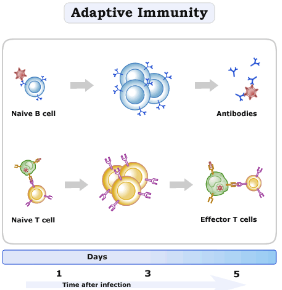
includes B and T cells and antibodies
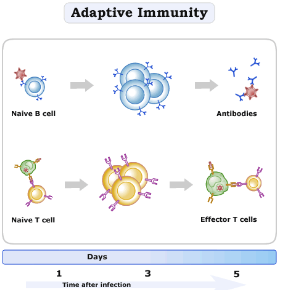
What are the specific things that perform adaptive immunity?
naive B cells → plasma cells → antibodies
naive T cells → effector T cells
What are the physical barriers in innate immunity?
Skin (cannot be broken by microbes!)
mucous membranes
respiratory system - mucociliary escalator
GI tract - gut associated lymphoid tissue (GALT)
genitourinary tract - flushing

mucociliary escalator
in the respiratory system, this is where cilia is constantly moving mucus out of the lungs → throat to get rid of bad stuff
Chemical mediators in innate immunity
Antimicrobial peptides and proteins
most ancient primary defense mechanism
many are positively charged and amphipathic (like cell membrane so can get in and cause harm to microbes)
ex: lysozyme (break peptidoglycan), lactoferrin (take iron away), granzyme (make holes)
What are the most ancient primary defense mechanism?
antimicrobial peptides and proteins that r positively charged and amphipathic
Many antimicrobial peptides and proteins are (charge and thing)
positively charged and amphipathic
Examples of antimicrobial peptides and proteins
lysozyme (break B-1,4 bond in peptidoglycan), lactoferrin (take iron away), granzyme (make holes)
Lysozyme
Breaks b-1,4 glycosidic bond between NAM-NAG to break peptidoglycan (cell wall)
an example of a antimicrobial peptide and protein
Lactoferrin
takes away iron
an example of a antimicrobial peptide and protein
granzyme
makes holes
an example of a antimicrobial peptide and protein
what are the 2 major types of antimicrobial peptides?
cationic antimicrobial peptides (CAMPS)
made by us the host
bacteriocins
good bacteria make this to protect us
Which type of antimicrobial peptide is found in and made by humans?
Cationic antimicrobial peptides (CAMPs)
First class cationic peptides (CAMPs)
Cathelicidins (causes disruption in membrane of pathogens)
secreted as inactive proteins (preproteins)
broad spectrum, produced by a variety of cells
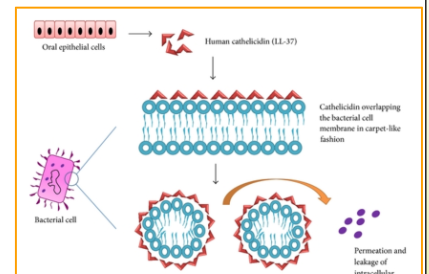
Cathelicidins are secreted as
inactive proteins (preproteins)
Are cathelicidins broad or narrow spectrum?
Broad
Second class cationic peptides (CAMPs)
a and b defensins (make holes in membrane of pathogens)
released as a precursor/preprotein, broad spectrum
found in neutrophils, intestinal Paneth cells, intestinal and respiratory epithelial cells (made by more specific cells than 1st class)

a and b defensins are released as
Precursor protein
are a and b defensins broad or narrow spectrum?
Broad but found in more specific cells like intestinal and respiratory epithelial cells and neutrophils
Third class cationic peptides (CAMPs)
Histatin (kill yeast and replicate via budding)
wont work against bacteria cuz targets mitochondria
has anti-fungal activity
to make sure it only harms fungi and not humans, fungi membrane is diff (has ergosterols) so it can cross fungi membrane only
large peptides found in human saliva
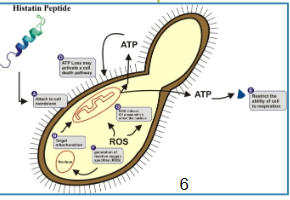
Histatin is the large peptide found in
human saliva
What is the target of histatin - what activity does this cause?
mitochondria of yeast, anti-fungal activity
What antimicrobial peptide is produced by our normal bacteria?
Bacteriocins
Bacteriocins are
lethal to related species
produced by gram (+) and (-)
E. coli makes colicins
Steptococcus, Bacillus, Staphylococcus and Lactococcus (gram +s) make lantibiotics
Colicins, a type of bacteriocin, are produced by?
E. coli (gram -)
Lantibiotics, a type of bacteriocin, are produced by?
Streptococcus, Bacillus Staphylococcus, and Lactococcus spp. (gram +)
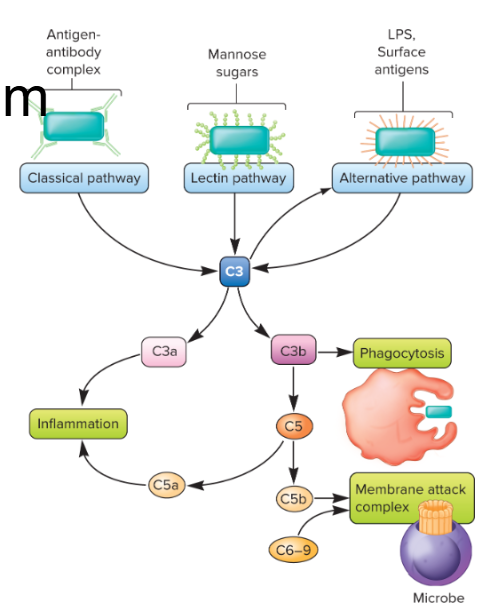
The Complement System
Supports the immune system
Composed of > 30 serum proteins that are usually floating around turned off until needed
composed of 3 major pathways:
Classical
Lectin
Alternative pathway
They will either stimulate inflammatory response, cell lysis, or opsonization

What 3 major activities does the complement system do?
Stimulate inflammatory response (calling for backup so have alot of cells in one area doing their job)
cell lysis (activation of MAP causes hole)
opsonization (C3b or antibodies make pathogen easier to recognize and eat -phagocytosis)
MAC
Membrane attack complex - makes hole in membrane of cell to lyse
activated by C5b in Complement System

How is MAC activated in the Complement system?
C3 activates C3b → C5 → C5b → C5b activates it
can also be activated by C6-9
Opsonization
Makes cell easier to recognize, so phagocytosis can occur (eats + destroys cells)
Done by C3b or antibody binding to the pathogen

what activates opsonization to make phagocytosis easier?
C3 activates Cb3 who binds to the pathogen
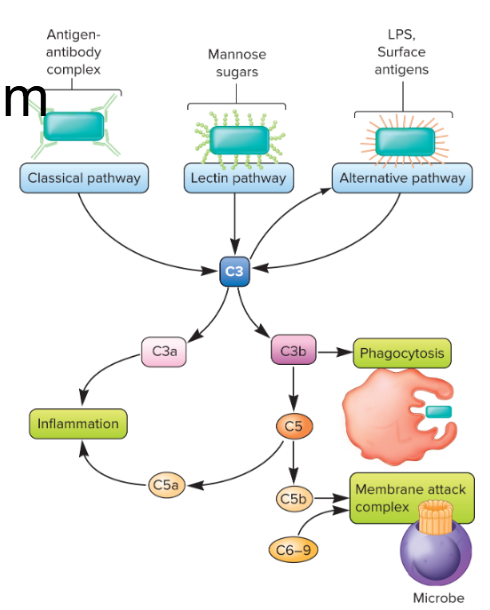
what do all 3 of the pathways (classical, lectin, alternative) in the complement system make?
C3 which then goes on to make either C3a or C3b
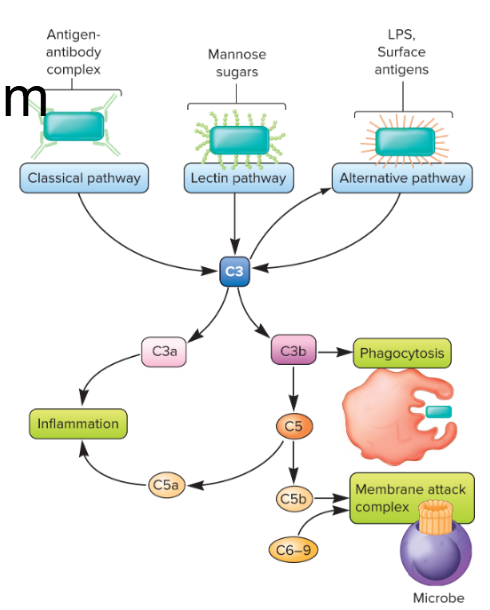
how is the inflammatory response activated in the complement system?
C3 → C3a → inflammation
or
C3 → C3b → C5 → C5a → inflammation

classical pathway
help in ADAPTIVE immunity
antigen-antibody complex
depends on antibodies which are only made during adaptive immunity!
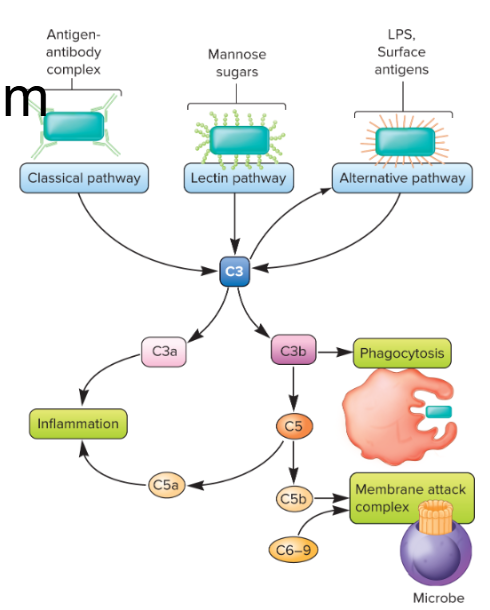
lectin pathway
help in innate immunity!
needs help to respond
includes mannose sugars
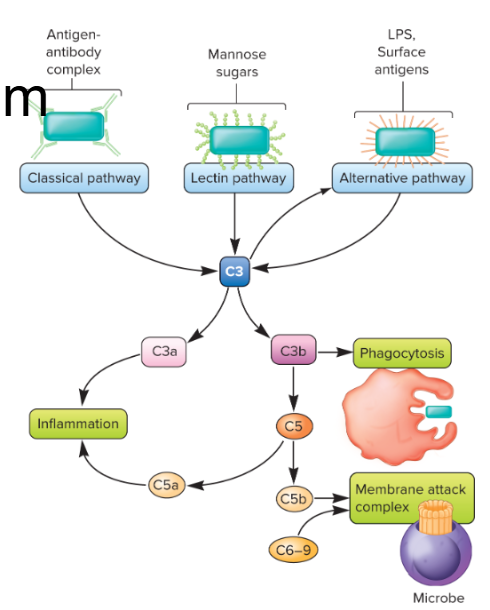
alternative pathway
helps in innate immunity!
turns on 1st cuz only needs one protein (but called this cuz it was the last to be identified)
includes LPS, surface antigens
which pathway in the complement system gets activated 1st?
the alternative pathway which helps in innate immunity
C3
a preprotein produced in the complement system that gets cleaved into A and B

what r the cells of the immune system?
leukocytes which all arise from pluripotent stem cells and then differentiate
mast cells, granulocytes, monocytes and macrophages, dendritic cells, lymphocytes

Leukocytes
White blood cells involved in both specific and nonspecific immunity
all arise from pluripotent stem cells and differentiate into:
mast cells, granulocytes, monocytes and macrophages, dendritic cells, lymphocytes
Leukocytes are involved in both
specific and nonspecific immunity
Leukocytes arise from
Pluripotent stem cells (one cell —> all different cells). All of the cells have the same DNA and gene regulation differentiates them
what r the types of cells leukocytes differentiate into?
mast cells
granulocytes (eosinophils, basophils, neutrophils)
monocytes and macrophages
dendritic cells
lymphocytes
Erythrocytes
Red blood cells
All ___ are ___, not all ___ are ___
All lymphocytes are leukocytes, not all leukocytes are lymphocytes
mast cells
NOT in circulation! They originate in bone marrow and when they mature they r in connective tissue
deal w bigger entities than tiny bacteria
have granules (includes vasoactive mediators)
NOT phagocytic!
have high affinity receptors for IgE (which activates granulation → histamine release → hay fever, eczema, asthma)

Mast Cells respond to
Large pathogens

Mast cells have
granules (not granulocytes) that include vasoactive mediators (such as histamines, which are vasodilators)
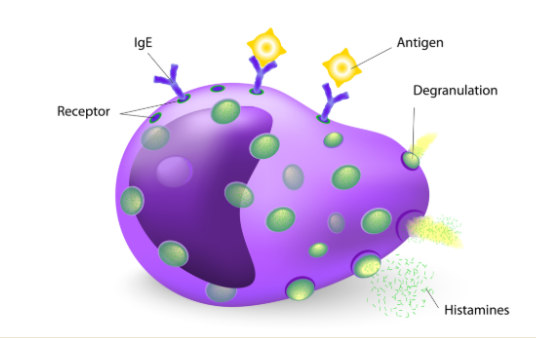
How do mast cells push pathogen out of the body?
release contents and push out, they are NOT phagocytic cuz they dont eat, they just release granules which help get rid of pathogens.
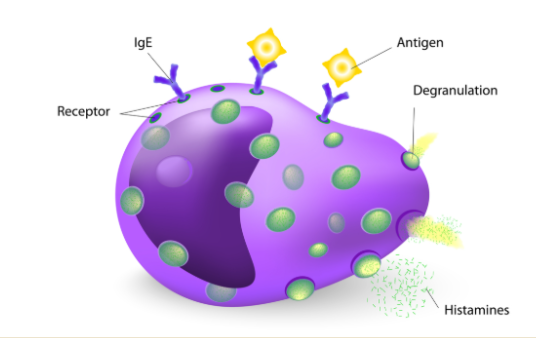
Mast cells have high affinity receptors for what on the cell surface?
IgE
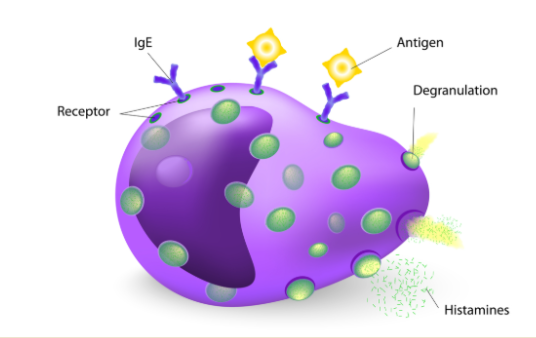
What does IgE cause when there are no large pathogens to deal with and it gets bored?
Starts responding to innocuous things causing hay fever, eczema, and asthma
What are the granulocytes?
BEN (basophils, eosinophils, and neutrophils)

Basophils
Stain the darkest (bluish-black) with basic dyes
release vasoactive mediators (histamine)
play a role in the development of allergies and hypersensitivities
found mostly in tissues (v. few in circulation)
a type of granulocyte
Eosinophils
Stain red with acidic dyes (eosin red)
defend against protozoan and helminth parasites
release cationic proteins and reactive oxygen metabolites to kill
involved in allergic reactions (Type I hypersensitivity)
circulate in low numbers in blood
a type of granulocyte
Neutrophils
Stain at neutral pH
highly phagocytic!
circulate in blood then migrate to sites of tissue damage. 1st line of defense so found in circulation in high
kill ingested microbes using lytic enzymes and ROS contained in granules
pyogenic (form pus). When they eat, they die and release pus
a type of granulocyte
Which granulocyte is the least found in circulation?
Basophil
Which granulocyte is the most found in circulation and acts as the 1st line of defense cuz theyre highly phagocytic?
Neutrophils
which granulocyte is pyogenic and dies after it eats?
neutrophils
Which granulocyte stains the darkest?
Basophil (found in tissues mostly)
Which granulocyte stains the lightest?
Neutrophils
which granulocyte releases vasoactive mediators (histamine)
basophils (has role in dvpt of allergies and hypersensitivities)
which granulocyte stains at a neutral pH?
neutrophils
which granulocyte stains w acidic dye?
eosinophils (red)
which granulocyte defends against protozoan and helminth parasites and has a role in type 1 hypersensitivity allergies?
eosinophils
Monocytes and macrophages
Highly phagocytic cells ( a type of leukocyte)

Monocytes
Circulate in blood until exit to tissue and become macrophages
mononuclear phagocytic leukocytes
Macrophages
Larger than monocytes, stuck in specific tissues (dont move), see problem and call neutrophils for help
variety of surface receptors
called this when they move out of blood → tissue
how to differentiate btwn monocytes and macrophages?
when theyre smaller and circulating in blood theyre called monocytes. When they become larger and get stuck in specific tissues and dont move from their theyre macrophages

Professional Phagocyte Process
Macrophages encounter microbe and do phagocytosis or call for help from neutrophils —→ neutrophils do phagocytosis and then die.
If neither of these work dendritic cells sample the microbe and take information to secondary lymphoid tissue (LT - lymph nodes) to activate adaptive immune system (sound alarm)
Professional phagocytes
1) Macrophages will 1st encounter microbe
constantly checking for problems and trying to defend, 1st line ‘wall’
2) Neutrophils are recruited to site of infection
phagocytose → die → secrete pus
most in circulation and come to help
3) Dendritic cells (DC) samples the microbes but do not destroy them
take the info to secondary lymphoid tissue (LT)
leukocytes that look like hands use their hands to move from infection site to activate B + T cells (swat team)
Dendritic cells link
innate and adaptive immunity
dendritic cells
NOT DENDRITES! only look like dendrites cuz they have hands like dendrites
leukocytes that use their hands to move from site of infection to activate secondary lymphoid tissue (B + T cells)
hands give them extra SA to present problem to activate immunity
Lymphocytes
Major cells of the immune system. Includes:
T cells, B cells, and innate lymphoid cells (ILC)
Natural killer (NK) cells r part of ILC
B and T lymphocytes differentiate in the bone marrow from stem cells
memory cells
natural killer cells
go around and touch cells to check if theyre okay, will kill the weird cells. Dont increase in # unless theres infection or cancer
Part of the ILC (innate lymphoid cells)
DONT have memory
which lymphocytes have memory?
T cells and B cells do, innate lymphoid cells (ILC) do not (includes NK)
innate lymphoid cells (ILC)
a type of lymphocyte that includes natural killer (NK cells)
dont have memory
Stem cells
Unspecialized pluripotent - become something else
Where do B and T lymphocytes differentiate from stem cells?
In bone marrow (B) and thymus (T)
B and T cells are
memory cells
Thymus
Functional as a kid, fat as an adult - stop making new T cells once turns into fat
primary organs and tissues
where cells are made
where lymphocytes mature and differentiate
thymus (T cells born) and bone marrow (B cells born)
overtime thymus becomes fatty tissue and stops functioning which is why we dont have infinte T cells!
secondary organs and tissues
where cells can meet
lymphocytes may encounter and bind antigen
spleen (only one where only blood exits/enters), lymph nodes (blood and lymph enter/exit), and associated lymphoid tissue (ALT)
mucosal (MALT), salivary (SALT), gut (GALT)
M cells
Mucosal-associated lymphoid tissues (MALT).
Includes:
GALT - gut associated
BALT - bronchial associated
found at the top of Peyer’s patches in vilis and crypts (GALT) and are the gatekeepers that alow things to enter

What does MALT include?
GALT (gut associated lymphoid tissue)
BALT (bronchial-associated lymphoid tissue)
M cells are at the top of
Peyer’s patches (GALT) to be a gatekeeper so toxins don’t go through to intestines

If you have more M cells, you are more likely to have
Prion disease (Scrapie)
What are the phagocytic cells?
Macrophages, neutrophils, Dendritic cells
What die after doing phagocytosis?
Neutrophils