Red Blood Cell Overview
 Call Kai
 Learn
Learn Practice Test
 Spaced Repetition
 Match
Match Flashcards
 Knowt Play
1/153

There's no tags or description
Looks like no tags are added yet.
Name | Mastery | Learn | Test | Matching | Spaced | Call with Kai | Chat |
|---|
No analytics yet
Send a link to your students to track their progress
154 Terms
Erythropoietin
regulates production RBCs
Created in kidneys
works on bone marrow
EPO has ___ sugars
4
EPO utilizes Glycoprotein hormone with ____ glycosylation sites
4
for EPO, the ends of carbohydrate chains are
variably sialylated
sialic acid moieties in epo
serum half life
as O2 drops, EPO ____
increases
in a healthy person, EPO is in a _________ with _____ levels of EPO.
steady state; low
EPO in a hypoxic patient
2 hypoxia-inducible factors (HIF-1alpha and HIF-1beta) will dimerize and bind to hypoxia-responsive elements in EPO gene promoter, which causes increase EPO production.
HIF-1alpha and HIF-1beta are produced under _______ conditions.
all
healthy people always have a little EPO production but it is dramatized when in ______.
oxidative stress
Ubiquitin tag
added under normal conditions
tags proteins for cellular destruction when the protein is not necessary
EPO effect on bone marrow
promotes proliferation, differentiation and survival
EPO stimulates differentiation of
progenitors → precursors → reticulocytes → erythrocytes
EPO pushes _____ out earlier than normal
reticulocytes
increased EPO shields _________ from apoptosis.
erythroid precursors
definition of proliferation during increase EPO in bone marrow
increasing number of different precursor cells while allowing products to differentiate.
allows quicker differentiation.
hemoglobin
globular protein made of 2 different pairs of polypeptide chains and 4 heme groups.
alpha-like globin family consists of genes:
HBZ
HBA2
HBA1
alpha-like globin family is found on chromosome(s)
16
alpha-like globin family produces chains:
zeta. alpha
main developmental stage in which alpha globin is used
embryonic, fetal→ adult
beta-like globin family is found on genes:
HBE1
HBG2
HBG1
HBD
HBB
beta-like globin family is found on chromosome:
11
beta-like globin family produces these chains:
epsilon, gamma, delta, beta
epsilon chain of beta-like globin is used
embryonic stage
gamma chain of beta-like globulin is used
feta
delta chain of beta-like globulin is used
adult, minor
beta chain of beta-like globulin is used
adult, major
zeta chain of alpha like globulin is used
embryonic stage
HBE1 gene produces __ chain
epsilon
HBG1 and 2 gene produces __ chain
gamma
HBD gene produces __ chain
delta
HBB gene produces __ chain
beta
alpha-globin gene cluster

beta globulin gene cluster

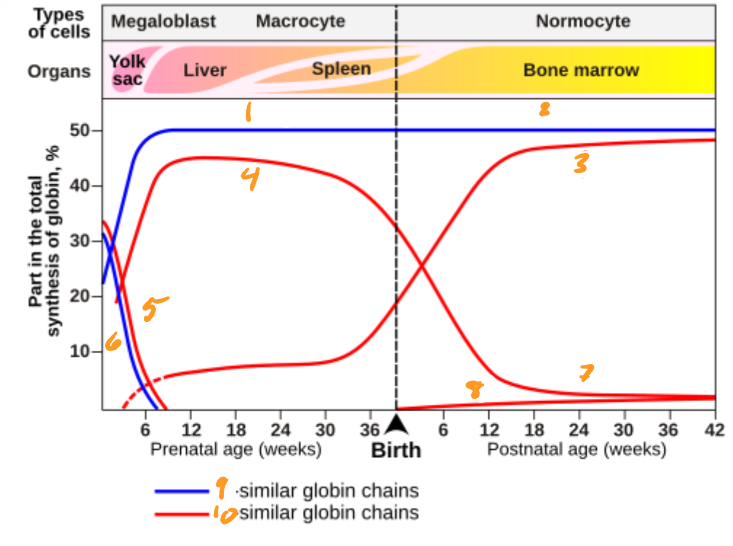
1
alpha

2
alpha

4
beta

5
epsilon

6
zeta

7
gamma

8
delta

9
alpha

10
beta
during yolk sac phase ____ are produced
hemoglobin gower 1
hemoglobin gower 2
hemoglobin portland
hemoglobin gower 1
2 zeta; 2 epsilon
hemoglobin gower 2
2 alpha, 2 epsilon
hemoglobin portland
2 zeta; 2 gamma
hemoglobin f
fetal hemoglobin
2 alpha; 2 gamma
dominates during late pregnancy and declines just before birth
hemoglobin at birth
hemoglobin f
hemoglobin a
hemoglobin a
2 alpha; 2 beta
10-40% of total hemoglobin
hemoglobin f
2 alpha; 2 gamma
60-90%
adult hemoglobin
hemoglobin a
hemoglobin a2
hemoglobin f
hemoglobin a2
2 alpha; 2 delta
minor component (3.5%)
alpha chains of hemoglobin contains ~ ____ amino acids
141
Beta chains of hemoglobin contain ~_____ amino acids
146
steps to heme biosynthesis
mitochondria creates amino levulinic acid
moves to cytoplasm and is converted to porphobilinogen
enzymes convert porphobilinogen to coproporphyrinogen
transported back to mitochondria to continue converting to protoporphyrin IX
combines with Fe2+ to make heme
protoporphyrin IX/Fe moved to cytoplasm to combine with globulin
iron is one of the _______ metals in the human body
most essential
iron in the metabolic processes
plays a critical role, important for oxygen transport and cellular respiration
body cannot excrete excess iron
iron balance is maintained through controlled absorption in GI tract
we lose small amounts of iron each day through
shedding of skin, hair or sloughing of intestinal epithelial cells
adult person typically eats ____ mg iron /day
10-20
the _____ absorbs 1-2 mg iron/ day
duodenum
body iron losses _____ mg/day
1-2
Heme
ferrous (Fe2+)
comes from animal sources
ionic/non-heme
ferric (Fe3+)
comes from mostly vegetable sources and must be reduced to Fe2+ before use
Hephaestin
oxidizes Fe2+ to Fe3+ to allow transport of iron to Apotransferin
Apotransferin
transferrin without iron bound
plasma protein
holotransferrin/ transferrin
transferrin molecule with 2 iron molecules bound.
allows for safe travel through the body/ storage of iron
once transported, cells will endocytose iron to transport across the cell membrane and it can either
convert to Fe2+ form for immediate cellular function
store in Fe3_ form using Ferritin or Hemosiderin
Ferritin
cytosolic protein used to store iron to be readily-accessible for release when needed
goes to bone marrow and muscles or liver
hemosiderin
cytosolic protein used to store iron for longer term storage (less accessible)
liver (Fe3+)
iron distribution in red blood cells
~70% iron is incorporated into hemoglobin in circulating RBC and developing erythroid precursors
iron distribution in storage
~20%
stored in ferritin or hemosiderin forms
stored in hepatocytes, macrophages of spleen and bone marrow
“other components” in distribution of iron
myoglobin within muscle
cytochromes
iron-containing enzymes (everywhere in the body)
plasma (bound to transferrin molecules)
pronormoblast
12-20 micrometers
oval nucleus
N:C ratio 8:1
dark blue cytoplasm
can divide and create two daughter cells
function: gathering compounds to start hemoglobin production

Basophilic normoblast
10-15 micrometers
more condensed nucleus; N:C ration 6:1
extremely dark cytoplasm
can divide into 2 daughter cells that can mature
function: hemoglobin synthesis occurs

polychromatic normoblast/ rubricyte
10-12 micrometers
super condensed nucleus with N:C 4:1
cytoplasm start to get lighter due to increased hemoglobin concentrations
last stage that can divide into two daughter cells that can mature
function: hemoglobin synthesis is ramping up

orthochromatic normoblast
8-10 micrometers
completely condensed nucleus N:C 1:1
cytoplasm is almost fully pink due to increase Hb concentrations
function: hemoglobin synthesis fully underway; cell will eventually eject nucleus entirely

an erythrocyte cannot create new hemoglobin after
nucleus ejection
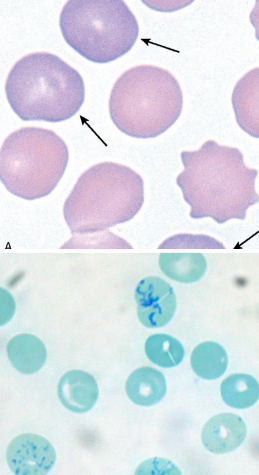
polychromatic erythrocyte
8-8.5 micrometers
no nucleus present
cytoplasm is pinker but has blue/purple tint due to remnants of RNA and ribosomes
called “reticulocyte” when stained with supravital stain
can be released into the bloodstream and visualized on a blood smear
Erythrocytes
7-8 micrometers
cytoplasm is fully pink with clear central pallor
most mature stage and most predominant cell type in peripheral blood
function: hemoglobin is working full time to transport oxygen throughout the body

full maturation sequence in order
pronormoblast → basophilic normoblast → polychromatic normoblast → orthochromatic normoblast → polychromatic erythrocyte → erythrocyte
purpose of fully mature and loaded hemoglobin cell
to transport oxygen from the lungs, and through the blood stream to other tissue cells
oxygen transport function of hemoglobin
binds oxygen in the lungs to drop it off in the tissues
can carry up to 4 O2 molecules
CO2 transport hemoglobin function
diffuses into RBC and mixes with water to create carbonic acid (H2CO3)
breaks down to release H+ and bicarbonate (HCO3)
Nitric Oxide Transport hemoglobin function
secreted by vascular endothelial cells and triggers relaxation and vasodilation of capillaries and veins
hemoglobin has an ______ binding capacity
allosteric
increased hemoglobin-O2 affinity (left shift) results in
decreased CO2
decreased temperature
decreased [H+]
decreased DPG
increased pH
decreased hemoglobin-O2 affinity (right shift) results in
increased CO2
increased temperature
increased [H+]
increased DPG
decreased pH
RBC membrane is made of
50% proteins, 40% phospholipids, 10% cholesterol
phospholipid function in RBC membrane
provides fluidity
cholesterol in rbc membrane
provides rigidity
protein complement in rbc membrane
provides functionality
composed of integral membrane proteins and peripheral membrane proteins
integral membrane proteins
pass completely through the membrane
transport molecules across the membrane
peripheral membrane proteins
internal layer of bilayer
signals inside layers
deformability
ability of RBC to squeeze through narrow capillaries and splenic slits without rupturing
phospholipid outer layer
phosphatidylcholine and sphingomyelin
inner layer of phospholipid bilayer
phosphatidylethanolamine and phosphatidylserine
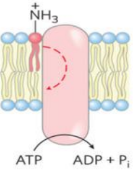
flippases and floppases
maintain the composition/structure of the phospholipid asymmetry by facilitating the movement of phospholipids between the inner and outer leaflets.
flippase
moves phospholipids from the outer layer to the inner layer
requires ATP