SURGERY TEST #2 REVIEW
 Call Kai
 Learn
Learn Practice Test
 Spaced Repetition
 Match
Match Flashcards
 Knowt Play
1/45

There's no tags or description
Looks like no tags are added yet.
Name | Mastery | Learn | Test | Matching | Spaced | Call with Kai | Chat |
|---|
No analytics yet
Send a link to your students to track their progress
46 Terms
What are the main diff btw absorbable and non absorbable suture materials?
→ absorbable
slowly degraded in body via hydrolysis (water breaking it down) or macrophages (WBCs)
takes a variable period of time to break down
usually used internally
examples: dexon, vicryl, PDS, catgut and monocryl
→ non absorbable
may change but are NOT eliminated from the body
usually used externally
removed 7-14 days post op
examples: nylon, stainless steel and prolene
Why is monofilament suture preferred in infected areas?
→ less drag/friction on tissue
→ lower % of infection bc it is cylindrical and smooth
→ prolene is a good choice for infectious spots
what is capillary action in suture materials?
→ only exhibited by catgut
→ catgut absorbs water and swells
→ may wick bacteria into the wound
→ should NOT be used in infected areas
Which types of suture material are most affected by capillary action?
catgut only
How can suture reaction be prevented?
→ use suture materials less likely to cause tissue rxn
prolene: less % of tissue rxn
PDS: little tissue rxn
monofilament: lower % of rxn
→ avoid nylon and catgut
What are the advantages of swaged on needles compared to reusable needles?
→ a swaged on needle has the suture material attached directly to the needle
→ more convenient
→ main advantage: less traumatic to skin
bc no knot or doubled over suture material to pull through tissues
Describe the USP sizing system for suture materials
→ 12-0 smallest and thinnest
→ 4 largest and thickest
→ there is NO 1-0 it is just written as 0 (ought)
→ smallest to largest
12-0, 11-0, 10-0, 9-0, 8-0, 7-0, 6-0, 5-0, 4-0, 3-0, 2-0, 0, 1, 2, 3, 4
→ ought to 3-0 is most common in sm animal practice
What does “3-0” suture mean? (unfinished)
→ a suture size in the USP
→ can also be written as 000
→ has smaller diameter and is thinner than 2-0
→ commonly used in cats and internal sx
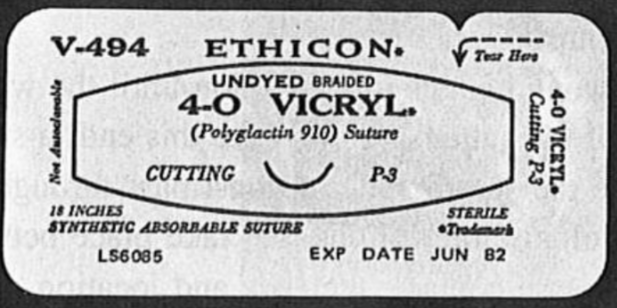
What info can be found on a suture package?
→ colour of suture
→ suture constriction (braided, monofilament, twisted)
→ manufactures name and parent company/address
→ needle description, manufactures needle #, length, cutting pattern and silhouette
→ meets USP standards
→ absorbability and guaranteed sterility
→ length of suture material
→ generic name and trade name
→ gauge (size)
→ product #
What are the common problems associated with sutures?
→ sutures too tight
may rip out and irritate the animal, causing it to chew @ em
skin sutures need 2b left quite loose to avoid this
→ suture rxns
foreign body rxn most common in cats
most likely w nylon or catgut
may cause lrg swelling over the incision (possibly resembling a hernia)
usually resolves once sutures are removed or dissolve
→ animal removes sutures
may cause total dehiscence
irritation may be due to razor burn or sutures being too tight
→ prevention
e-collar, T-shirts, bad-tasting ointments or bite-not collars
What are the steps for removing skin sutures safely?
→ life up suture
→ cut suture to one side of knot
→ pull suture out
NOTE: do not cut through the knot or leave any suture material in animal as fistula mat form
When is tissue glue appropriate for use in sx?
→ used to appose skin to skin if area is DRY (no bleeding) and there is little tension
→ used during canine castration and or feline declaw
What are the differences btw taper and cutting needles?
→ taper point
least traumatic option
completely circular w no cutting edge other than its tip
used on delicate internal tissues
e.g. smooth muscle and hollow organs such as the stomach and intestines
→ reverse cutting
most common
used to get through tough skin w minimal trauma
pointed tip penetrates easily, while the flat edges help prevent tissue damage compared w a cutting-edge needle tip
Name four common suture patterns
Simple interrupted
Simple continuous
Ford interlocking / lock stitch
Subcuticular
When is simple interrupted suture pattern used?
can be used on any layer
basic building-block suture pattern.
When is simple continuous suture pattern used?
faster than simple interrupted
uses less suture material, leaving less foreign material behind and causing less rxns
if the knot unravels or the suture breaks, the incision can dehisce
would not use near an infected area
When is ford interlocking/lock stitch used?
used mainly in lrg animals on skin
may finish with several simple interrupted sutures at the bottom due to gravity
allows fluid drainage w out the whole closure coming undone
When is subcuticular stitch used?
closes skin w out visible external sutures
often used in dog castrations
must use absorbable suture material
When is horizontal mattress stitch used?
faster and uses less suture material: 2 bites, 1 knot
can cause the edges to evert rather than bringing them together properly
When is cruciate stitch used?
similar to horizontal mattress but creates a criss cross/X pattern
2 bites, 1 knot
holds the edges down rather than everting them
What is the correct spacing for sutures on skin?
→ sutures should be ½ inch apart and ½ inch from the edge of the tissue
NOTE: do NOT place them too close to edge of tissue or they will tear through
What are the basic principles of steam sterilization?
→ steam under pressure produces heat that coagulates proteins in bacteria and spores
→ steam must contact ALL surfaces of the materials being sterilized
→ leave adequate space for steam circulation; do not pack the chamber tightly
→ autoclave instruments open (closed if sharp)
→ place trays/pans w solid bottoms on their edges
→ place packs on their edges to allow steam to flow downward
→ smaller packs re penetrated by steam more easily and sterilize faster
Why must surgical instruments be cleaned before autoclaving?
→ autoclaving will NOT be effective if instruments are covered w blood or other foreign material
What is the purpose of ultrasonic cleaning?
→ removes sm debris and microorganisms using mechanical energy caused by the formation, expansion and collapse of air bubbles
→ 16 times more effective than manual cleaning
What is “instrument milk” and why is it used?
→ a solution used to lubricate instruments, inhibits rust, and makes them easier to handle
→ instruments cleaned by ultrasound must be placed in fresh instrument milk for 5 mins
→ do NOT rinse it off
→ may also be used in a spray format
How can you detect damage in surgical scissors?
→ tissue scissors may become dull or damaged when used on inanimate objects
→ damaged if cannot cut through 4 layers of gauze at the tips
→ damaged if they can’t cut along the entire length of the blade
→ check for burrs or grooves
What are the correct methods for passing instruments to a surgeon?
→ sharp instruments
passed CLOSED
→ non sharp instruments
passed OPEN
→ all instruments
pass w handle forward and curve/tip up using a flick of wrist to firmly place instrument into surgeons palm
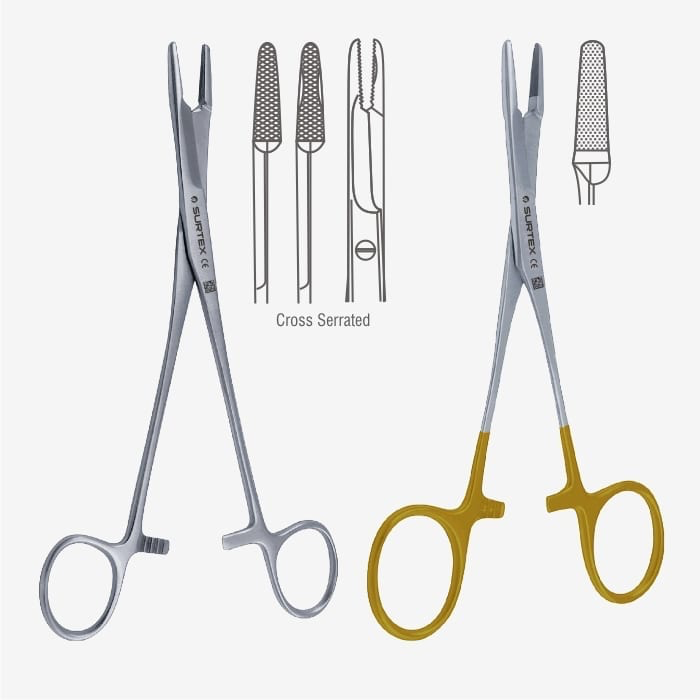
What are the diff btw Mayo-Hegar and Hegar-Olsen needle
holders?
→ mayo hegar (has no scissors)
holds needles using crisscross grooves
→ hegar olsen (has scissors)
holds needles using crisscross grooves
has built in scissors to cut sutures w out needing separate scissors
What is the function of the flow meter on an anesthetic machine?
→ reduces o2 pressure from 50 PSI to 15 PSI
→ controls the rate of o2 delivery to patient
→ flow rate is measured in L/min
→ minimum flow rate = 30 mL/kg
→ read the flow @ the center of the ball or the top of the float (cylinder)
How does a vaporizer work in delivering anesthetic gas?
→ holds the ax agent in liquid form
→ a specific vaporizer is required for each ax
→ oxygen picks up the ax agent to create fresh gas
→ controls the % of ax added to o2
→ the patient breathes the ax gas into lungs
What is the diff btw rebreathing and non-rebreathing
circuits?
→ rebreathing
used for patients > 7 kg
exhaled gas passes through the soda lime canister to absorb CO2
mixes w fresh gas and is recirculated
uses unidirectional flutter valves and less ax bc some is reused
types: F circuit or Y/circle circuit
→ non rebreathing
used for patients < 7kg but can be used for any patient
bypasses the flutter valves and soda lime canister
gas starts @ vaporizer travels to the patient and exits scavenger
does not reuse exhaled gas therefore uses more fresh gas
bains is the most commonly used design
Why are non-rebreathing systems preferred for patients under 7 kg?
→ smaller patients do not have the lung strength to pull gas through the soda lime canister in the rebreathing system
What is the role of the soda lime canister in a rebreathing system?
→ contains soda lime crystals that absorb CO2 from expired gas
→ once CO2 is removed, expired gas mixes w fresh gas and is recirculated to patient
→ used only in rebreathing systems
→ change when…
crystals become hard and brittle
crystals turn slighting off white or show purple colour change in approximately 1/3-1/2 of granules
after 6-8hrs of use
How do you calculate the correct size of a rebreathing bag?
→ Example: 25kg patient
bag size = 60 x body wt / 1000
= 100 x body wt / 1000
(60x25)/1000 = 1.5L
(100×25)/1000 = 2.5L
Therefore you’d pick a 2 L bag
NOTE: if no bag falls w in the range choose the closest bag to the high end of the range
What is the maximum safe pressure when bagging a cat or dog?
→ dog: 20 cm H2O
→ cat 15 cm H2O
Describe the steps of a leak test on an anesthetic machine.
close off pop off valve
seal the patients end of circuit w hand
use flow meter to increase pressure to 20-30 cm H2O
turn off the o2 flow
maintain pressure for 15 secs
a MAX of 2-3 (10% reduction) = pass
a reduction >10% = fail
if machine fails check likely sources of leaks and repeat test until it passes
if leak cannot be found spray soapy solution over machine bubbles will point to leak
NOTE: perform test q Time Machine is set up for patient
What are common causes of leaks in an anesthetic system?
→ holes in reservoir bag, patient circuit or silicon tubing
→ circuit end not fully sealed by hand
→ pop off valve not closed
→ CO2 absorber canister not seated or sealed properly
→ worn or incorrectly positioned seals (O-rings, washers)
→ broken bain circuit seal around the nipple
→ loose unidirectional valve cover
What is the function of the pop-off valve?
→ controls path of expired gas returning from patient
→ closed: gas enters rebreathing bag allowing IPPV (bagging(
→ open: gas is expelled through scavenger
→ partially open: ideal setting; allows waste gas to leave while enough has remains to fill the rebreathing bag for N breaths
→ after bagging return valve to its previous settings
What are the advantages of cuffed ET tubes?
→ airtight cuffs prevent gas leakage
→ safer for personnel bc less ax gas escapes into rm
→ keeps gas flow btw patient and machine
→ reduces aspiration
→ allows better control of resp
→ ensures ax is delivered w out atmospheric dilution
How do you confirm correct placement of an endotracheal tube?
→ feel breath coming from the tube or hold sm piece of hair in front of it and watch it move
breaths must be n do NOT push chest
→ connect ax machine and observe movement of the rebreathing bag and inspiratory/expiratory flutter valves (rebreathing system ONLY(
→ palpate the throat for one tube
if two tubes are felt ET tube may be in esophagus
→. visualize the tube passing through the glottis
→ look for condensation inside the tube when patient breathes n
What are the risks of overinflating the ET tube cuff?
→ may damage the lining of trachea
→ use a manometer or digital cuff inflator
pressure must NOT exceed 20-30 cmH2O
→ if unavailable use the minimum occlusive vol technique
inflate only enough to prevent gas escaping around the tube
→ stop inflating as soon as the leak disappears
→ high vol, low pressure cuffs are safest and have the least chance of tracheal damage
What is the correct procedure for extubating a cat?
turn off ax and keep patient on pure o2 for @ < 5 mins or until extubation is required
untie the tube and deflate the cuff when ax is turned off
evacuate remaining ax gas from the system
extubate @ the first purposeful movement (ear twitch) no when reflex movement occurs
pull the tube out fully and swiftly to minimize stimulation of larynx
NOTE: cats have a higher risk of laryngospasm
Why is it important to evacuate residual anesthetic gas before extubation? How is it done
→ to remove as much access ax gas as possible from the system (avoids prolonged recovery/re inducing patient)
→ process
fill breathing bag w pure o2
increase o2 flow if needed to fill it faster
open pop off valve
fully evacuate the gas through the scavenger
repeat @ < 3 times
return the o2 flow and pop off valve to their original settings


