A&P (Bone Development, Repair, and Disorder Notes)
 Call Kai
 Learn
Learn Practice Test
 Spaced Repetition
 Match
Match Flashcards
 Knowt Play
1/81

There's no tags or description
Looks like no tags are added yet.
Name | Mastery | Learn | Test | Matching | Spaced | Call with Kai | Chat |
|---|
No analytics yet
Send a link to your students to track their progress
82 Terms
ossification
the process by which bone forms
embryonic period, childhood, remodeling, repair
Bone formation occurs in four situations:
intramembranous, endochondral
bone formation follows one of two patterns: ____ or ____
skull, mandible
Flat bones of the _____ and _____ are formed via intramembranous ossification
soft spots
____ ____ that help the fetal skull pass through the birth canal later become ossified, forming the skull
endochondral ossification
the replacement of cartilage by bone
most bones
Which bones are formed via endochondral ossification?
6th Week
Cartilage formation and ossification occurs during the ______ of embryonic development
Step 1 of Intramembranous Ossification
Ossification centers appear in the fibrous connective tissue membrane
ossification center
cluster of mesenchymal cells that differentiate into osteoblasts
mesenchymal cells
stem cells that respond to injury or infection
Step 2 of Intramembranous Ossification
osteoid is secreted within the fibrous membrane and calcifies, osteoblasts continue to secrete osteoid, which calcifies in a few days
osteoid
unmineralized bone matrix
osteocytes
During Step 2 of intramembranous ossification, trapped osteoblasts become _______
Step 3 of Intramembranous Ossification
woven bone and periosteum form
woven bone
accumulating osteoid is laid down between embrnic blood vessels that result in a network of trabeculae called ________
periosteum
During step 3 of intramembranous ossification, vascularized mesenchyme condenses on the external face of the woven bone and becomes the ___________
Step 4 of Intramembranous Ossification
lamellar bone replaces woven bone, just deep to the periosteum. Red marrow appears
periosteal bone collar
During endochondral ossification, osteoblasts secrete osteoid against the hyaline cartilage diaphysis, encasing it in a collar of bone called the ___ ___ ___
Step 1 of Endochondral Ossification
During endochondral ossification, osteoblasts secrete osteoid against the hyaline cartilage diaphysis, encasing it in a collar of bone called the periosteal bone collar.
Step 2 of Endochondral Ossification
Calcified cartilage matrix is impermeable to nutrients, which causes it to deteriorate and develop cavities
Step 3 of Endochondral Ossification
Periosteal bud invades the internal cavities and spongy bone forms.
nutrient artery, nutrient vein, nerve fibers, red marrow elements, osteogenic cells, osteoclasts
What does the periosteal bud contain?
Step 4 of Endochondral Ossification
Osteoclasts open up medullary cavity, and secondary ossification centers appear
secondary ossification centers
this develops in the epiphyses of bone during endochondral ossification
25
By age __ nearly all bones are completely ossified and bones stop growign in plate
outer surface
bones grow in thickness at the ____ _____
thick, heavy
If too much new tissue is formed, the bones become abnormally ____ and ____
exceeds
In children and adolescents, bone formation ______ bone resorption
equals
In young adults, bone formation _____ bone resorption
dominates
During old age, rate of resorption _______
genetics
largest factor that determines how bone density changes overtime
bone mass, blood supply
Starting at age 40, ____ ____ and ____ ____ begin to decrease
males
skeletal mass in generally greater in _____
estrogen
the presence of ______ prevents bone resorption
fracture
break in a bone
comminuted fracture
a bone that is broken, splintered, or crushed into several pieces

Causes of Comminuted Fracture
Severe impacts, such as a car accident
greenstick fracture
incomplete break in a bone, one side of the shaft breaks while the other bends
greenstick fracture
fracture that is common in children, most often caused by a fall

compound fracture
bone sticks through the skin
Causes of Compound Fracture
severe impacts such as a car accident or falling

simple fracture
most common type of fracture
causes of simple fracture
exerting more force on a bone than what it can handle

spiral fracture
bone is broken at an angle
causes of spiral fracture
twisting motion in the bone when one part of the body is in motion while the other is planted
compression fracture
fracture that generally occurs in vertebrae as a result of osteoporosis
Step 1 of Bone Repair
bone breaks and a hematoma forms
Step 2 of Bone Repair
Fibrocartilage forms between the broken bones, called a callus
Step 3 of Bone Repair
Fibrocartilage is replaced with the bone. The combination of fibrocartilage and bone is called a bony callus
Step 4 of Bone Repair
osteoclasts remove and remodel the bone by removing any excess bone tissue, restoring its original structure
osteoporosis
bone reabsorption occurs faster than bone deposition. Bone beocme lighter and fracture easier. Common in elderly women.
causes of osteoporosis
decrease in estrogen/testosterone, improper amount of exercise, insufficient calcium consumption, insufficient Vitamin D.
Calcium, Vitamin D
Supplements to take to treat osteoporosis: ____ and ____
Paget's Disease
abnormal thickening and enlargement of bone caused by excessive and abnormal bone remodeling. Causes bones to be very brittle in areas.
Causes of Paget's Disease
unknown, possibly genetic factors
treatments of Paget's Disease
drug therapy to control bone remodeling rate, tylenol for pain
osteogenesis imperfecta
brittle bone disease
osteogenesis imperfecta
bones are very brittle and as a result can break from the slightest touch or movement
causes of osteogenesis imperfecta
genetic disorder in which body doesn't produce enough collagen (hardening protein)
treatment of osteogenesis imperfecta
possible surgeries to help with painful walking, environmental awareness
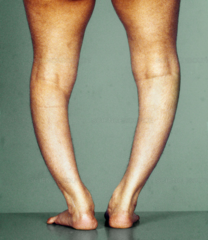
rickets
weak and brittle bones that fracture easily (more common in less developed countries)
rickets
preventable with a proper diet, common in young children
causes of rickets
lack of vitamin D

treatment of rickets
proper nutrient, vitamin D supplements
osteomalacia
rickets in adults, weak and brittle bones that fracture easily
causes of osteomalacia
lack of vitamin D
acromegaly
overgrown bones generally in face, hands, and feet
causes of acromegaly
benign tumor on the pituitary gland that causes abnormal amounts of growth hormone to be released
treatment of acromegaly
remove tumor
perthes' disease
femoral head flattens due to lack of blood supply, causing pain and inability to walk
causes of perthes' disease
unknown
treatments of perthes' disease
pain management, reshaping of the femoral head
fibrous dysplasia
excessive growth or swelling of bone due to abnormal cell development, causes bones to be brittle
causes of fibrous dysplasia
genetic mutation
treatment of fibrous dysplasia
surgery to alleviate troublesome or painful bone
osteomyelitis
bacterial infection in the bone, common in diabetics and those with HIV
causes of osteomyelitis
staph bacteria invading bone tissue
treatments of osteomyelitis
antibiotics, surgery to remove infected bone
leukemia
blood cancer, abnormal production of white blood cells that don't function properly
causes of leukemia
unknown
treatments of leukemia
chemotherapy, radiation, bone marrow transplant