THEA 120 - Part 1: Electricity
 Call Kai
 Learn
 Practice Test
 Spaced Repetition
 Match
 Flashcards
 Knowt Play
1/27

There's no tags or description
Looks like no tags are added yet.
28 Terms
Electricity vs. Electronics
Electricity: The use of electromotive forces to do work.
Electronics: Low voltage circuits and devices used to control the flow of electricity.
Electromotive force (EMF)
Like charges repel and opposite charges attract.
Valence / Free electrons
Electrons in the outer shell.
Elements with these electrons are considered conductors.
The movement of these electrons in large groups is what creates electricity.
The flow of electricity
Free electrons pass from one atom to the next moving toward the positive charge.
Terms, units, and symbols
V - volts - voltage - The potential energy or force to do work
A - amps - current - The rate of flow of the current
W - watts - power - How much work an appliance can do
Ω - ohms - resistance - The resistance of the current
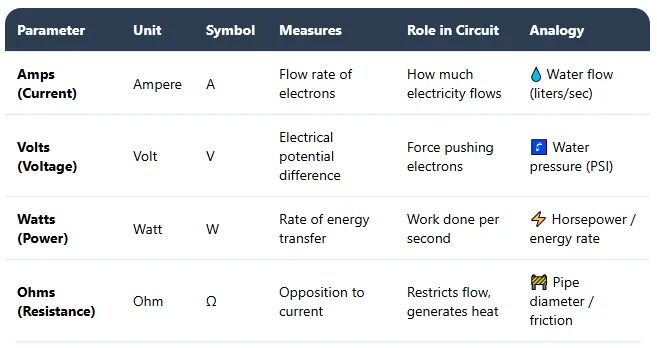
The Power Formula
W = V x A
W is watts
V is volts
A is amperes
Ohm’s Law
V = I x R
V is voltage
I is current
R is resistance
Conductors
Any material that allows electric current to pass through it
Ex: water, copper, aluminum, steel, etc
Insulators
Any material that does not allow electric current to pass through it
Ex: ceramic/porcelain, plastic, rubber, glass, cloth, wood
Series circuit
Electricity passes through one resistance before going to the next one.
If one light burns out, they all go out.
Less efficient since the current slows down going through each filament.

Switches are always wired…
…always wired in series.
Parallel circuit
Electricity goes to each resistance at the same time, and then returns.
If one light burns out, the rest keep working.
More efficient since they are using maximum power they can get.

Circuit breaker
A switch at the panel which creates an open circuit when too much current runs through (“trips”)
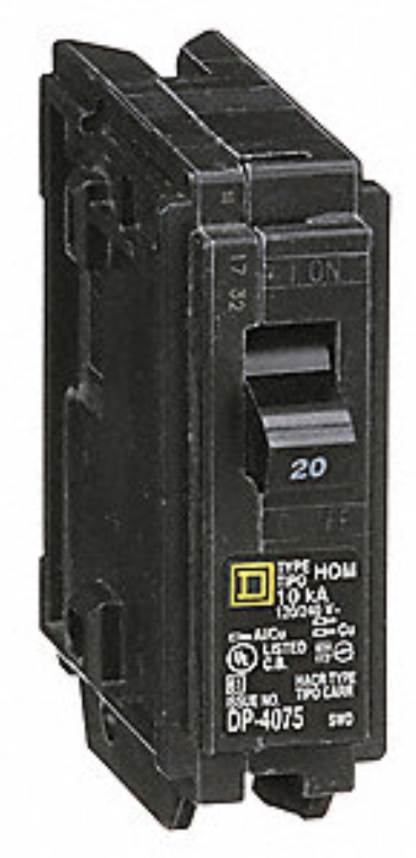
Fuse
Screws into the panel and has a metal wire inside it which burns out when too much current runs through (“blows”)

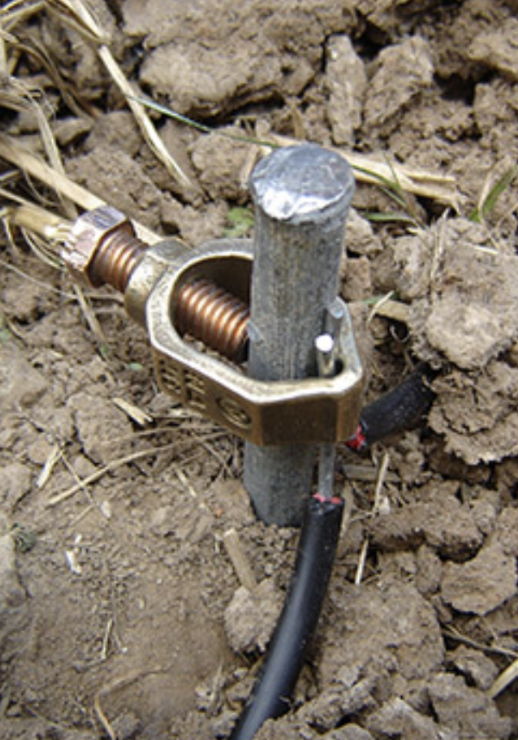
Ground wire
Routes the overload current to the ground pole in the earth
Overload
When too many appliances are placed on the circuit causing the circuit to try to draw too much amperage from the voltage pool.
Short
When there is a broken part of the circuit (perhaps physical damage to a wire casing creating a bare wire) allowing the electricity to leave the otherwise closed circuit.
Usually create sparks, smoke, and sometimes flames.
Electrical safety
If you don’t know what it is or how to handle it, DON’T!!!!
Turn off circuit breaker before fixing any architectural wiring.
Unplug appliance before trying to fix it.
If you need to work live, (which is never recommended), keep one hand in your pocket and be sure you are well insulated from the ground.
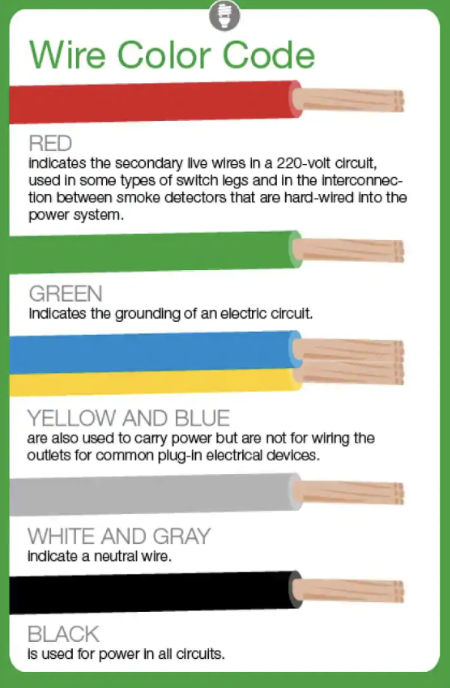
Standardization: Wire Colors
National Electric Code (NEC)
Green —> ground
White (formerly black) —> neutral/return
Black (formerly red) —> hot/live
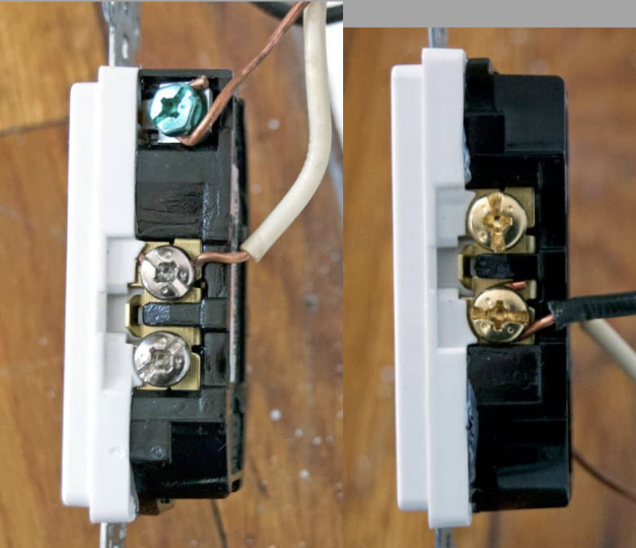
Standardization: Screw Terminal Colors
Green - ground
Silver - neutral
Brass - hot
BX cable
Seen in industrial applications today.
Has metal sheath used to ground the wire.
Hard to tell which wire is which.
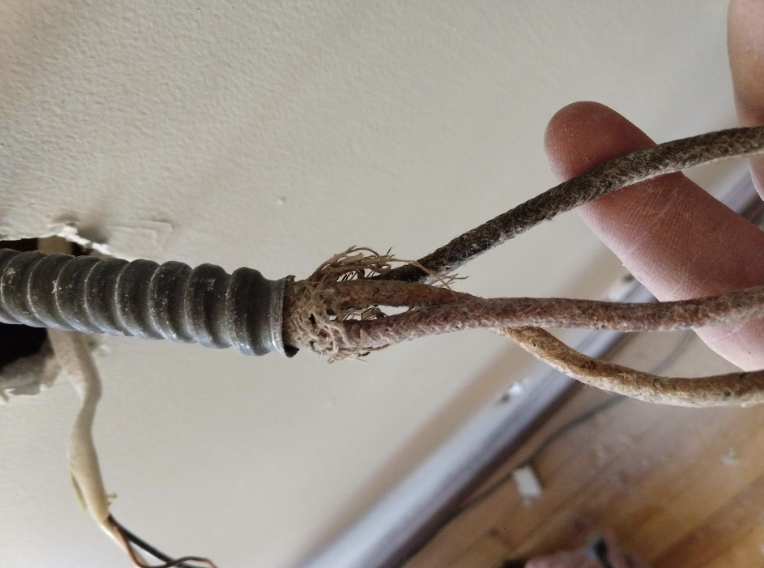
Knob and tube wiring
In some buildings from around 1880-1940 in the US
Each wire is a single insulated wire
One is hot, other is neutral/return. No ground wire.

DC - direct current
Flows directly in one direction.
Loses power over long distances.
AC - alternating current
Flows back and forth, allowing it to be delivered further.
Wire gauges
Smaller number = bigger gauge
Smaller gauge = more resistance
Wire ratings for service wire
S = Standard; rated at 600 VAC
SJ = Junior; rated at 300 VAC
E = Elastomer; (thermoplastic rubber)
T = Thermoplastic insulation
O = Oil-resistant outer jacket
OO = Oil-resistant insulation and outer jacket
P = Parallel construction (flat)
W = Approved for outdoor use (water resistant)
V = Lightweight, round vacuum cleaner cord
Incandescent light bulb
Glass sheath with inert gas vacuum sealed inside
Electricity travels through wire to filament (tungsten) which has a high electrical resistance
Filament gets very hot causing metal to glow brightly
Doesn’t burn up because of inert gas
LED light bulb (Light Emitting Diode)
Made by putting two semi-conductors together (aluminum-gallium-arsenide) which when enough voltage passes through it, it creates light by a process called electroluminescence
Basically the electrons pass from one semi-conductor to the
next and the excitement of the electrons causes the metal
material to glow.
It is more efficient and you get a lot more light from a tiny
device.