Lecture 10: AFO Design Principles
 Call Kai
 Learn
 Practice Test
 Spaced Repetition
 Match
 Flashcards
 Knowt Play
1/44

There's no tags or description
Looks like no tags are added yet.
45 Terms
Patient data collected during patient evaluation
MMT (UE and LE)
ROM
Contractures
Ligamentous laxity
With fracture -No ROM unless directed by physician
Tone (Can it be broken or utilized?)
Ambulatory Requirements
Balance
Proprioception
Foot Placement
Shoes (heel height important with joint stops
Levels of Ambulation Goals
Transfers
Assisted Ambulation
Human
Walker
Cane
Terrain
Indoors, smooth, flat, watch for carpets
Outdoors, uneven terrain, cracks, barriers
AFO Biomechanics
M/L – Coronal
A/P – Sagittal
Rotation – Transverse
Gait

When to Accommodate vs. Correct
Rigid deformity → Accommodate
Flexible deformity → Correct
AFO Footplate Trim Lines Options
Proximal to metatarsal heads (3/4 length)
To toe sulcus
Full length

When is Proximal to metatarsal head trimline appropriate?
Low Tone
No need to control forefoot
Easier to don into shoes
Not dysvascular / Has protective sensation

When is toe sulcus trimline appropriate?
Moderate to high tone, no toe clawing

When is full length trimline appropriate?
High tone with toe clawing
Better choice for dysvascular and insensate patients
Control all foot segments
More difficult to fit in shoe

AA-AFO
Angle of the Ankle in the Ankle Foot Orthosis
angle between the line of the shank relative to the line of the foot
The line of the foot is defined as the line between the base of the heel and the most inferior point of the foot under the fifth metatarsal head. It is described in degrees of plantarflexion, dorsiflexion or as plantigrade
The physiologic angle at which the AFO holds the ankle in the sagittal plane with no forces applied.

SVA
Shank-to-Vertical Angle
the angle between the shank and the foot that is formed when the AFO is loaded while the patient is standing

Optimal SVA for Normal Gait
An SVA of 10–12 degrees inclined is considered the optimum position of the shank in midstance for normal gait, with a range of 7-15 degrees considered normal.

Casting considerations
Traditional tibial angle to floor is equal to about half proper SVA.
If SVA goal is 10-12 degrees, then roughly 5-7 degrees tibial inclination should be the casting goal
Clinically, a vertical tibia during casting is usually closer to 7+ degrees of tibial inclination/SVA
Bent knee position/crouch gait
Strong quads
Plantar flexors too weak
Too much tibia advancement
Too much dorsiflexion
Test mmt single leg heel raise
Trans met amputee…low grade, missing leverage
Number they have to hit varies (6 to 20)
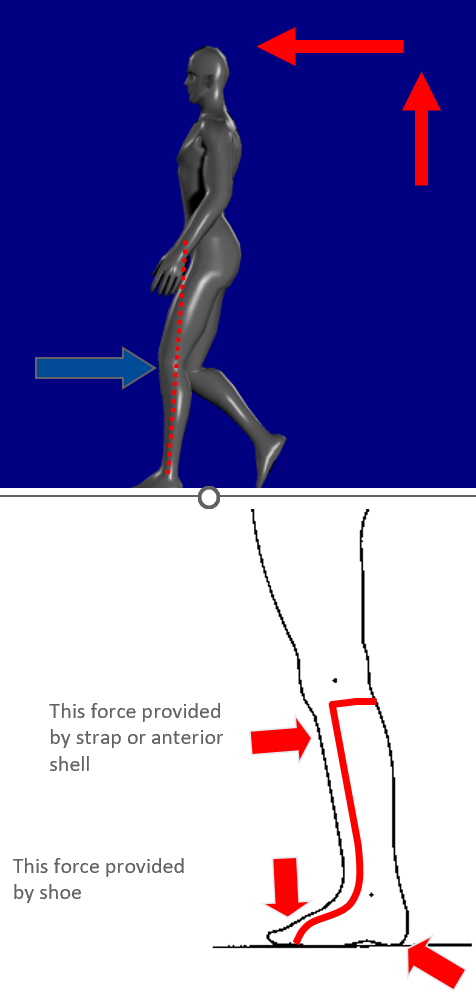
3 Point Force to Create Knee Extension / Resist Knee Flexion
AFO must stop dorsiflexion at late stance to create knee extension moment
posterior force by strap or anterior shell
downward force by shoe
GRF upward into heel

3 Point Force to Create Knee Flexion / Resist Knee Extension
AFO must stop plantarflexion at loading response to create knee flexion moment
AFO only effective until midstance
Must have adequate quadriceps strength
A tall posterior trimline is crucial
Cant go into popliteal but can get close
Mainly at IC, loading response
Need good quads to control
Doesn’t work once GRL ant to knee
Weak plantarflexors, resist tibia falling by locking out knee keeping GRL ant
anterior force at back of knee
posterior force at ankle
upward force at metheads

Indications for Conventional AFO
Unusually Large or Heavy Individual
Minimal Contact of the Leg is Desired
Fluctuating Edema
Heat Sensitive Individual
Change of Size Anticipated

Conventional AFO Metal Components
Sidebars
Joints
Stirrup
Pins/Springs

Types of Stirrups
Standard
permanently mounted to the shoe
Long Tongue
permanently mounted to the shoe
Split Stirrup with Caliper Plate
caliper plate needs to be permanently attached below the sole of each shoe the patient wishes to wear with the AFO
Stirrup then inserted into caliper plate
Insert Stirrup
a rigid foot insert will be used as the base of the AFO
attached to the lateral and medial borders of the foot insert
no shoe modifications

Conventional Ankle Joints
Free motion
Klenzak
Single Action/Single Channel
Double Action/Double Channel

Pins vs. Springs (where you put them, what they do)
Springs
In Posterior Channel
Plantarflexion resist (Pf. Res.)
Dorsiflexion assist (Df. Asst.)
Pins
In Posterior Channel
Plantarflexion stop (Pf. Stop)
In Anterior Channel
Dorsiflexion stop (Df. Stop)

Ankle Joint Selection
Free Motion
Dorsiflexion Assist
Plantarflexion Stop
Dorsiflexion Stop
Rigid Ankle

Thermoplastic AFO Indications
Accommodates Anomalies
Maximum Contact for Control of the Leg/Foot is Desired
Lightweight
Allows Patient to Easily Use Multiple Shoes
Aesthetically More Acceptable Than Conventional AFO
Solid Ankle AFO
Ankle rigid in sagittal plane
Ankle will not plantarflex during swing phase or loading response (Generates moderate knee flexion moment)
Will not dorsiflex under loading from mid to late stance phase (Generates knee extension moment, depending on the length of the foot plate.)
Good coronal stability
Solid Ankle Indications
high tone
Trimline to sulcus or full toe extension
Solid Ankle Analogous to what pin and spring configuration
to pins in anterior and posterior channels of conventional double action ankle joints
AFO – PLS
Dorsiflexion-Assist
Ankle flexible in the sagittal plane
Rigid enough prevent plantarflexion during swing phase (Prevent foot drop)
Flexible enough to plantarflex at loading response (Generates minimal knee flexion moment)
Flexible enough to dorsiflex under loading from mid to late stance phase (Smoother gait)
AFO – PLS Indications
dropfoot
Not indicated for high tone
Minimal coronal stability
PLS Analogous to what pin and spring configuration
spring in posterior channel of conventional double action ankle joints
AFO Articulated (with posterior stop)
Ankle freely dorsiflexes
Ankle will not plantarflex during swing phase or loading response (Generates knee flexion moment)
Maintains neutral ankle position during swing phase
Good coronal stability
Will freely dorsiflex during late stance phase (Generates no knee extension moment)
Increases ease of standing from sitting
AFO Articulated (with posterior stop) Indications
High tone
AFO Articulated (with posterior stop) PLS Analogous to what pin and spring configuration
to nothing in anterior channel and pin in posterior channel of conventional double action ankle joint
Thermoplastic AFO Joints
Oklahoma
Tamarack (Straight or Dorsi Assist)
Gillette (Straight or Dorsi Assist)
Gaffney - Steel
Thermoplastic Motion Stops
Adjustable plantar flexion stop
Combination dorsiflexion and plantar flexion stop
Polypropylene plantar flexion stop
Posterior strap limits dorsiflexion
Ground Reaction AFO
Resists forward progression of the tibia over the foot through ground reaction forces.
typically used to substitute for weak plantarflexors and provide a knee extension moment at late stance by stopping dorsiflexion
The rigid anterior shell and tall anterior trimlines provide more resistance to knee flexion and a more comfortable distribution of forces on the anterior of the leg as compared to a strap
Ground Reaction AFO 3 Point System
patient bears weight on the footplate of the GRAFO, the GRAFO resists rolling forward
As the patient moves past midstance, the AFO resists the forward progression of the tibia over the foot and the knee extension moment is created
The effectiveness of the GRAFO’s knee extension moment will be affected by the length of the footplate – a longer footplate will increase the knee extension moment.
Ground Reaction AFO - Indications
Mild Knee instability (Minimum Muscle Grade of 4)
Weakness of Plantar Flexors
Stops tibial progression at late stance
Weakness of Dorsi and Plantar Flexors
Stops tibial progression at late stance
Resists plantar flexion (assists dorsiflexion) during swing to clear foot
Holds ankle in neutral for heel first initial contact
Axial Resist AFO
is designed to reduce weightbearing on the plantar surface
to achieve this reduction, a constrictive calf section or Patella Tendon Bearing (PTB) modification is incorporated to suspend some of the patient’s weight
The PTB design is borrowed from the PTB prosthetic socket design

Axial Resist AFO Indications
Instability of the Ankle in all Planes
Axial Unloading??
Fracture Management
Charcot Joint
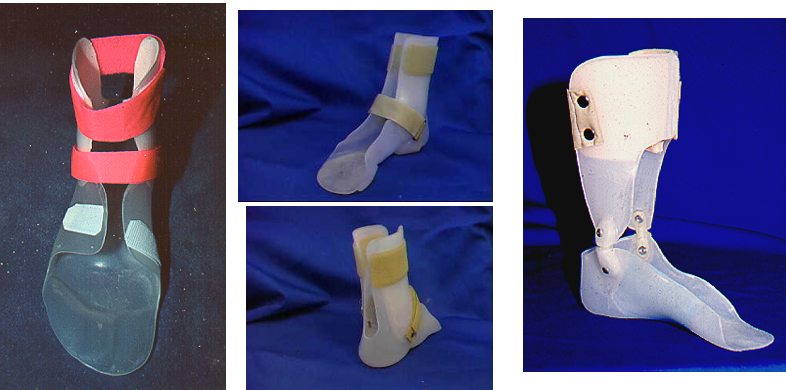
Supramalleolar AFO
variety of different AFOs that have a reduced height calf section
may or may not have ankle joints, and can be fabricated for various levels of rigidity
often indicated for patients with pes planusI
children - often due to neuromuscular disorders
adults - often a result of posterior tibial dysfunction or rupture
They are best at controlling coronal motion and are not an effective lever arm for sagittal control of the ankle
For medial lateral not sagittal plane
Varus / Valgus Control Additions
Trim lines
Ex: Sabolich trim line
Straps
T-straps (conventional)
Pads

Neurological Foot Plates
tone-reducing, tone-inhibiting AFOs
Characteristics
Full length footplate
Elevated toe bed
Metatarsal relief
Loading of transverse arch (shafts of metatarsals)
Calcaneal relief

Composite AFOs
can be custom fit (off the shelf) or custom fabricated
involve a varying layup of carbon, fiberglass, and other fibers to achieve a strong and lightweight orthosis
Some include a posterior strut that can be changed based on patient presentation to be more flexible or more stiff, such as the PDE strut or Coyote Dynamic Strut.

Custom Fit
typically are useful when attempting to provide a lightweight device to assist with weak dorsiflexors
Most manufacturers have varying sizes (ie: small, medium, large) and provide either posterior or anterior calf section
Some manufacturers provide the strut on the medial side of the foot or lateral side of the foot
These orthoses are limited in the modifications that can be made to them, and are typically limited to trimming the footplate to the proper length.

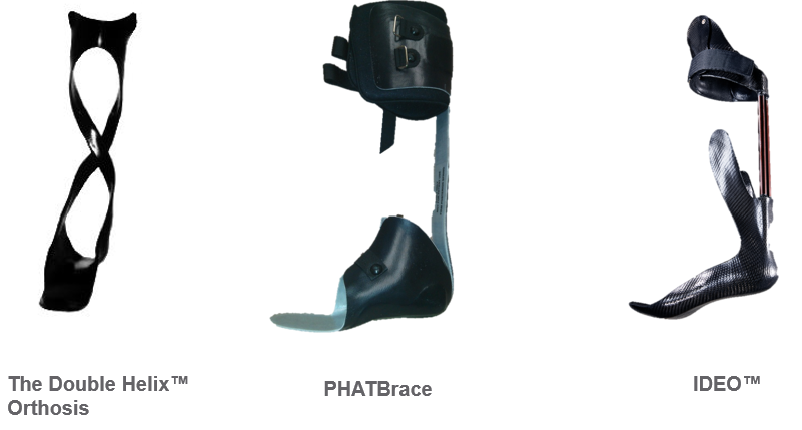
Custom Carbon AFOs
sometimes called dynamic AFOs at times
‘‘dynamic’ can = AFOs with tone-reducing modifications, AFOs with articulated motion, and is often used in the naming of prefabricated AFOs
The designs depicted above are custom fabricated and require specialized casting, modification, and fabrication techniques
These AFOs are based on the same concepts as prosthetic dynamic response feet and are intended to provide a dynamic push off and energy return
These orthoses provide added stability during stance phase, as well as, during swing phase.
AFO Clearance Guidelines
Proximal trimline
20 mm below distal border of head of fibula
25 mm distal to apex of fib head
Ankle joint – conventional skin to metal
Medial: 6 mm
Lateral: 5 mm
Thermo plastic buildup not a textbook answer
3mm minimum