CAPE Chem - Mass Spectometry
 Call Kai
 Learn
 Practice Test
 Spaced Repetition
 Match
 Flashcards
 Knowt Play
1/10

There's no tags or description
Looks like no tags are added yet.
11 Terms
What is the mass spectrometer?
instrument used for measuring the masses of atoms and molecules. It can also be used to measure the relative abundance of different isotopes and to predict the structure of more complex molecules.

What happens at each section of the mass spectrometer?
this that and the next
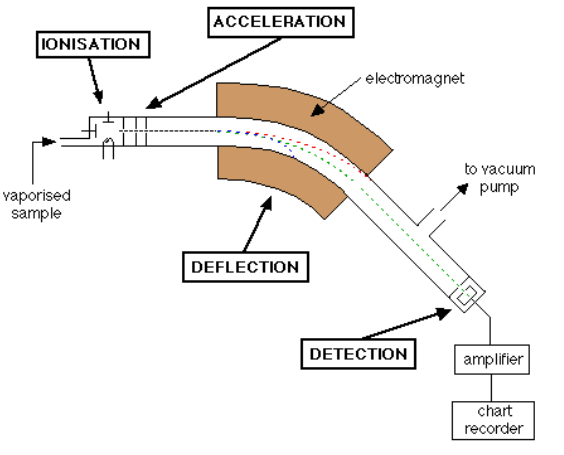
Summarize the workings of the mass spectrometer in the first 3 stages
Gaseous material released into ionization chamber
Particles bombarded with electrons and ionized, mostly to +1 ions (IONISATION)
high energy stream from an electron gun
Ions accelerated to uniform speed by electric field (ACCELERATION)
The positive ions are attracted to the negative plate and accelerate towards it
Summarize the workings of the mass spectrometer stages 4-5
Ions deflected by magnetic field; deflection depends on m/z ratio (DEFLECTION)
The heavier the particle, the less the deflection
Electric current measured as ions land on plate (DETECTION)
The greater the abundance of the isotope, the larger the current
What does the degree of deflection depend on IN ESSENCE?
the mass and the charge
the greater the mass, the less the deflection
the greater the charge, the greater the deflection.
deflection is inversely proportional to the m/z ratio.
What does the degree of deflection depend on IN MOST CASES?
essentially on the relative mass of the species in the mass spectrometer.
If the spectrometer is calibrated, the masses of all the species can be directly measured.
What do we derive the relative abundance of different isotopes from in the mass spectrometer?
the number of particles landing at a single point on the detector, which influences the electric current and the peak.
What does the magnitude of the peak tell us?
the relative abundance of the isotope.
Since the position at which an ion appears on the detector depends on its mass, different isotopes appear at different points on the detector.
What is fragmentation
when molecules break up into smaller pieces within the extreme conditions of the mass spectrometer
Why is it necessary for atoms of a sample to be ionised?
allows ions to be accelerated by an electric field
allows ions to be deflected by a magnetic field
How does adjusting the magnetic field strength enable isotopes to be separated
Ions are separated according to their mass-to-charge (m/z) ratios. Adjusting the magnetic field strength changes the extent of their deflection, allowing ions with different m/z ratios to follow different paths and reach the detector selectively.