Unit III Western Civ
 Call Kai
 Learn
 Practice Test
 Spaced Repetition
 Match
 Flashcards
 Knowt Play
1/117

There's no tags or description
Looks like no tags are added yet.
118 Terms
Is the following story of the origins of Rome mythological, or true? —— Rhea Silvia, the daughter of King Numitor, has twin sons, Romulus and Remus. A prophecy declares they will overthrow their uncle who took the throne. They are ordered to be drowned in a river but a she-wolf rescues and raises them. When the two become adults they fulfill the prophecy. The two then argue over which hill to build Rome upon and Romulus kills Remus.
mythological
Which of the following is the actual origin of Rome?
The Etruscans, settlers from Asia Minor, settled in Etruria c. 1200 BCE. Around 1000 BCE, Indo-European people settled in the Latium region in Italy and became influenced by the Etruscans. In c. 750 BCE, Rome emerged near the Tiber River.
Who is Rhea Silvia?
the daughter of the overthrown King Numitor. She birthed the two twin sons Romulus and Remus who fulfilled the prophecy of overthrowing their uncle which led to Romulus founding Rome.
Who are Romulus and Remus?
the twin sons of Rhea Silvia, the daughter of the overthrown King Numitor, who fulfilled the prophecy of overthrowing their uncle. They were raised by a she-wolf. One of the twins was killed by the other over an argument of where to found Rome and the remaining twin is credited with founding it.
What is the Story of Lucretia?
in the late 500s BCE, a Roman noblewoman was raped by the son of the abusive King Tarquinius Superbus. After her rape, she committed suicide and became a model of virtue for Roman women. This led to the overthrowing of the monarchy and the formation of the Roman Republic.
When did the Roman Republic begin?
after the overthrowing of the monarchy in 509 BCE
an urban convenience in Rome supplying fresh, clean water for baths, fountains, and drinking water for ordinary citizens.
as Rome is a patrilineal society, fathers and husbands headed households. The women had more rights than Athenian women, but were still limited. They could own land, businesses, and attend public events but they could not engage in political life. They were married into monogamous marriages.
One of the two main socio-economic categories in the Roman republic consisting of the commoners and majority of the army.
One of the two main socio-economic categories in the Roman republic consisting of the wealthier upper class that are socially and legally protected.
a conflict against opposing socio-economic groups Patricians and Plebeians relating to how patricians hold all governing power and plebeians are excluded from the government and subject to laws the don’t create. Plebeians demanded political protections and direct roles in government. In 494 BCE plebeians refuse to fight in the army and begin to organize leading to concessions made by the patricians. This is the early republic trying to figure out how to accurately reflect the people of Rome.
264 BCE
218 BCE
149 BCE
Who was Scipio Africanus?
The Roman General during the second Punic war who brought war to Carthage. He forces Hannibal to withdraw from Italy and leads to the Battle of Zama resulting in Roman Victory.
149 BCE
When were the Macedonian Wars?
214 BCE
The Roman victory expanded Roman territory further into Asia Minor. The wars also exposed Rome to Hellenistic culture and influence.
Who was Tiberius Gracchus?
One of the Gracchi brothers. He was a plebeian tribune from a wealthy family who tried to help Rome with a series of reforms. He was elected tribune in 133 BCE when he then tried to revitalize agricultural production and proposed a plan to distribute public land to landless Romans. Later that same year, he and his followers were killed in a riot during an Assembly meeting as his proposals were too radical.
Who was Gaius Gracchus?
One of the Gracchi brothers. He was a plebeian tribune from a wealthy family who tried to help Rome with a series of reforms. He was elected tribune in 123 BCE when he attempted to continue his brother’s reforms. He improved infrastructure, attempted to stabilize the price of grain to insure its affordability, and tried to cut down on corruption in government by creating new courts. The upper classes felt threatened by the proposals and the shifting power and so, in 122 BCE, he and his supporters were killed and the reforms were undone.
Who is Gaius Marius?
a Roman military general who becomes consul and redefines the role of the Roman military. He eliminates land-ownership requirements for soldiers, creates a professional army, promises soldiers land after service, and requires an oath of loyalty to the general, no longer the Roman state. This starts a problematic trend of military power in politics.
a three-person rule in ancient Rome consisting of Pompey, Julius Caesar, and Crassus. By 54 BCE, conflict and differences weakened the Triumvirate and a sequence of events involving the members led to the Great Roman Civil War.
49 BCE
Rome
c. 750 BCE, it was founded near the Tiber River. Initially governed by a monarchy with the first king being Romulus who was advised by a Senate of elite citizens.
What is the Roman Republic?
begins in 509 BCE and ends in 27 BCE. It was established after the overthrow of the monarchy and a Roman constitution was developed. Major governing bodies and magistrates are conceived. There are consuls, the senate, and assemblies of people consisting of dictators and praetors. Women, non
When did the Roman Republic end?
in 27 BCE with the reign of Octavian Augustus.
What are Consuls?
two individuals that are elected for a one year term under the Roman Republic
What is the Senate?
a body of elder statesmen who advised consuls under the Roman Republic
What did the Twelve Tablets do?
they served as a basis for Roman law and reflected the interests of both patricians and plebeians as a part of the Struggle of the Orders.
What is the Second Punic War fought over?
Spain
Which of the following is a battle of the Second Punic War?
Battle of Zama
Which of the following is a battle of the Third Punic War?
Siege of Carthage
Which of the following is the correct order of events of the Second Punic War?
Interests in Spain are split between Rome & Carthage; Hannibal Barca attacks Saguntum; Hannibal invades Italian Peninsula with war elephants; Battle of Cannae; Roman army secures control of Spain from Carthage; Scipio Africanus brings war to Carthage; Hannibal withdraws from Italy; Battle of Zama; Spain becomes Roman province; Carthage agrees not to wage war without Rome’s permission
Which of the following is the correct order of events of the Third Punic War?
Carthage threatened a Roman ally; Cato the Elder spurs Rome to renew war against Carthage; Siege of Carthage; Rome conquers Carthage; End of the Punic Wars

Which of the following places on the map is Gaul?
A

Which of the following places on the map is Rome?
B
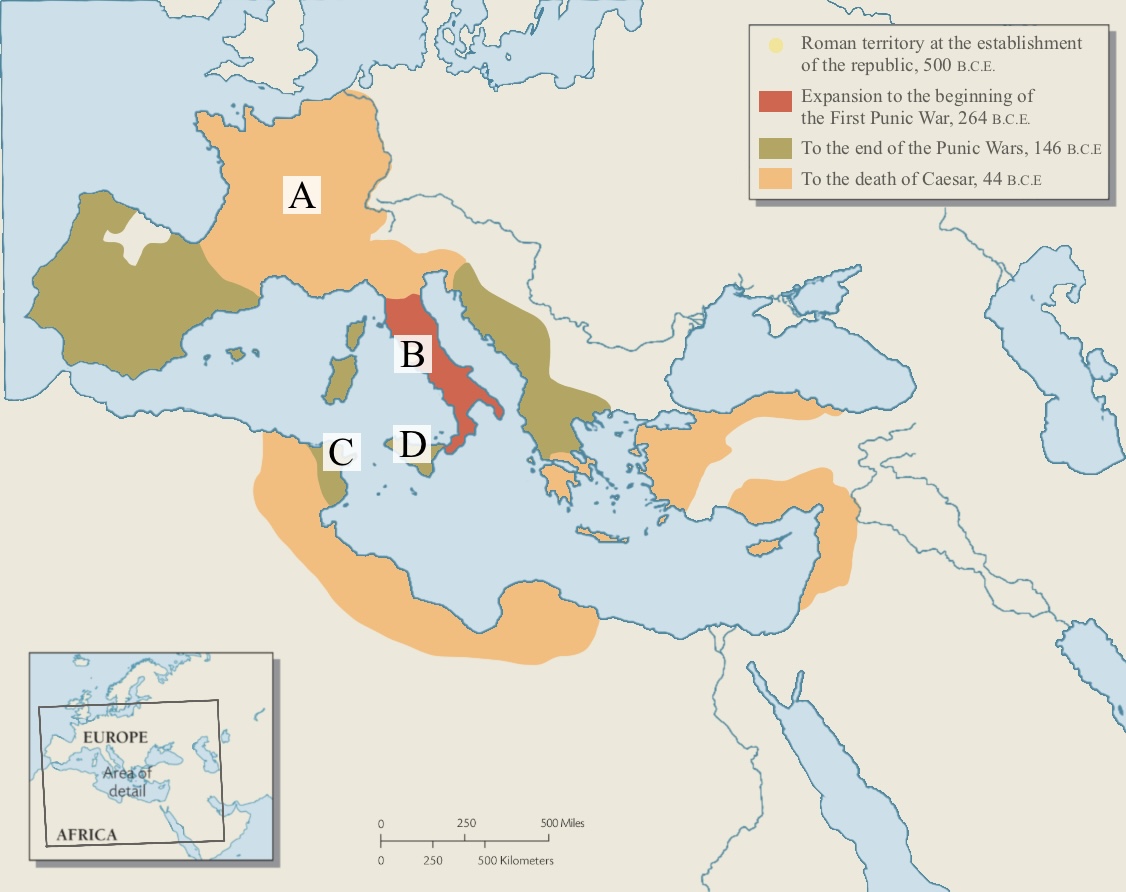
Which of the following places on the map is Carthage?
C

Which of the following places on the map is Sicily
D
Who is Hannibal?
the Carthaginian General who led the attacks during the Second Punic War. He attacks Saguntum in 218 BCE, then invades the Italian peninsula with war elephants to attack Rome. In 216 BCE, he led the Battle of Cannae, one of the worst Roman defeats in history. Rome eventually seizes control of Spain and the Roman General, Scipio Africanus, brings the war to Carthage and forces him to withdraw from Italy. He leads the Battle of Zama in 202 BCE in North Africa and loses. Under his control, Carthage lost the second war.
What was the Battle of Zama?
the last battle of the Second Punic War. It occurred in 202 BCE in North Africa. The battle was Rome, led by Scipio Africanus, versus Carthage, led by Hannibal. The Romans won, and subsequently won the Second Punic War.
Who was Spartacus?
a Roman slave born in Thrace (near Greece) in c. 109 BCE. He was forced to fight as a gladiator as a slave and plotted with other enslaved gladiators to escape. Upon escaping, he led massive slave revolts against Rome from 73 to 71 BCE. The revolts were very successful at first due to the large number of oppressed people in the cause, his clear military tactics, and the lack of a Roman army presence as they were fighting enemies elsewhere. Soon Rome summons the army to fight the insurrection and in 71 BCE, he is forced into a last stand near Senerchia and is overwhelmingly defeated.
Who was Lucius Cornelius Sulla?
Gaius Marius’ rival who represents the optimates. He was elected consul in 88 BCE which snowballed into a civil war. In 82 BCE, he became dictator and granted more power to the Senate.
What are the dates of the two civil wars in Rome that create further instability prior to Caesar’s presence in the Roman government?
The Social War (90-88 BCE) & Sulla’s Civil Wars (88-87 BCE & 83-81 BCE)
True or False? During the time of Roman slave revolts and after the failed reforms of the Gracchi brothers, civil wars began to create further instability in Rome.
True
In 58 BCE, where did Julius Caesar campaign for Rome to conquer?
Gaul
In the First Triumvirate, which political groups did Julius Caesar and Pompey represent?
Pompey = optimates, Caesar = populares
What began the fall of the Roman Republic?
the Great Roman Civil War (49-45 BCE)
When was the Great Roman Civil War?
49-45 BCE
What does Pax Romana mean?
“Roman Peace,” and it lasted for around 200 years, until the death of Marcus Aurelius
What was the Second Triumvirate?
a three-person military-political alliance dividing Roman territory consisting of Marc Antony (a general; bestowed Egypt, Greece, and the east), Octavian (Caesar’s adopted son; bestowed the western Roman land, incl. Italy), and Marcus Lepidus (a general; bestowed North Africa). The members avenged Caesar and defeated conspirators until they were torn apart by power struggles. In 36 BCE, Lepidus is expelled from the alliance and it devolves into the civil war between Antony and Octavian.
Who was Cleopatra VII?
the pharaoh of Egypt from r. 51-30 BCE. She assumed reign with her brother Ptolemy XIII but used wars to assert her sole power. In 48 BCE she meets Julius Caesar who assists her in securing the Egyptian throne and they later become romantically involved. After Caesar, Marc Antony becomes stationed in Egypt and she becomes romantically involved with him, causing a rift within the Second Triumvirate where Antony already agreed to a political marriage to Octavian’s sister. This rift grows into a civil war where she becomes involved and targeted. After a defeat by Octavian with him still in pursuit, Antony and her commit suicide.
When was the Battle of Actium?
2 Sept 31 BCE
What is princeps?
a state of recognition Octavian was given by the Senate meaning “first citizen.” With this recognition, he maintains the façade of republicanism despite having enormous power.
“First Among Equals”
primus inter pares, a phrase used by Octavian meant to indicate that he is unofficially given more respect even though he is equal to other Romans due to his position in government. This is used as a part of the façade Octavian keeps up with republicanism and is not respective of his true power over Rome.