Final Pharm Chem II Lab Short Test
 Call Kai
 Learn
Learn Practice Test
 Spaced Repetition
 Match
Match Flashcards
 Knowt Play
1/6

There's no tags or description
Looks like no tags are added yet.
Name | Mastery | Learn | Test | Matching | Spaced | Call with Kai | Chat |
|---|
No analytics yet
Send a link to your students to track their progress
7 Terms
What are the structure and full name of EDTA?
EthyleneDiamineTetraacetic Acid

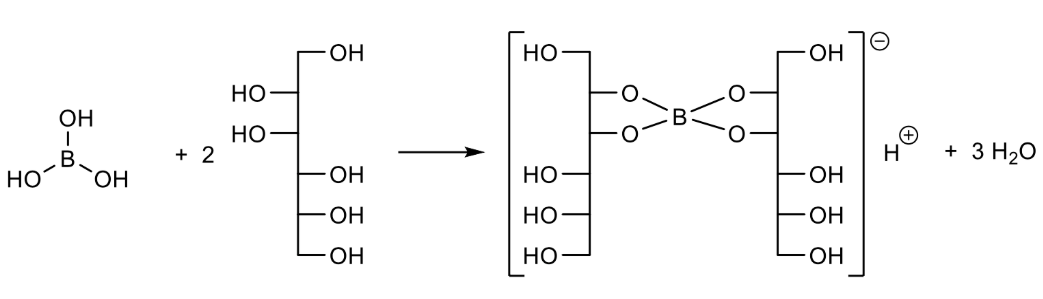
Why is it necessary to use mannitol at the titration of the ointment? Write down the explanation and the reaction equation. What is the final colour of the titration?
Alternatively: Write down the reaction equation of the boric acid with mannitol.
Mannitol increases boric acid’s acidity for titration with NaOH.
Final colour is pink
What are the components of “Pulvis Chinacisulis Cum Vitamino C”?
(names and structures)

Write down the names and the formulas of the active compounds of the “Boron-Zinc” ointment and the Pulvis Chinacisalis Cum Vitamino C
Boron-Zinc ointment:
Boric Acid H₃BO₃
Zinc Oxide ZnO
Pulvis Chinacisalis Cum Vitamino C:
See picture

Write down the structure of the produced complex and the procedure of the identification of Vitamin C from Pulvis Chinacisalis Cum Vitamino C. (How should you prepare this test?)
Mix sample + water. Filter it. Add water to the filtrate, and after adding NaHCO₃ and FeSO₄ → violet colour develops.

You are investigating the powder preparation Pulvis Chinacisalis Cum Vitamino C with test tube experiments. Based on your observations you are not sure whether the sample contains ascorbic acid or not. What other method could you use to verify the ascorbic acid content of your sample? Why would it be a clearer evidence? What are the ingredients of the powder mixture beside the ascorbic acid? (Give their name and the structure of all compounds!)
Other method: TLC
Why clear evidence: get the Rf of ascorbic acid reference solution. Check if there is a spot in test solution that has the same Rf. then u know if u have ascorbic acid or not

You should determine the unknown zinc oxide content of an unknown boron-zinc ointment.
For the titration 10.7 ml of the volumetric solution with a concentration of 0.02 M was used.
Write down the steps which are required for the sample preparation! What kind of volumetric solution was used for the titration! Write down the reaction equation of the titration! Calculate the amount (mg) of the ointment! (6 points)
c(VS) = 0.02 mol/dm³; V(VS) = 10.7 ml, f(VS) = 1.2626, (m/m)% (zinc oxide) = 6.16%.
In flask put sample + water + sulfuric acid + boiling stones
Boil, then let it cool
Add chloroform
Shake till vaseline dissolves
Dilute with water
Add xylenol orange indicator + methenamine = cycalmen red color
Titrate with EDTA till it turns yellow
I know the calculation part; The answer is 357mg.