Ice Ages and GHGs
 Call Kai
 Learn
 Practice Test
 Spaced Repetition
 Match
 Flashcards
 Knowt Play
1/13

There's no tags or description
Looks like no tags are added yet.
14 Terms
2 Questions to Answer
Why do glaciations have a saw-tooth pattern?
Why does the onset of glacials happen slowly, while the onset of
interglacials occurs rapidly? (ice melts more rapidly than it accumulates)
What drives these cycles other than Milankovitch cycles?
Why do glaciations in both hemispheres vary in response to NORTHERN hemisphere insolation?
what synchronizes the hemispheres
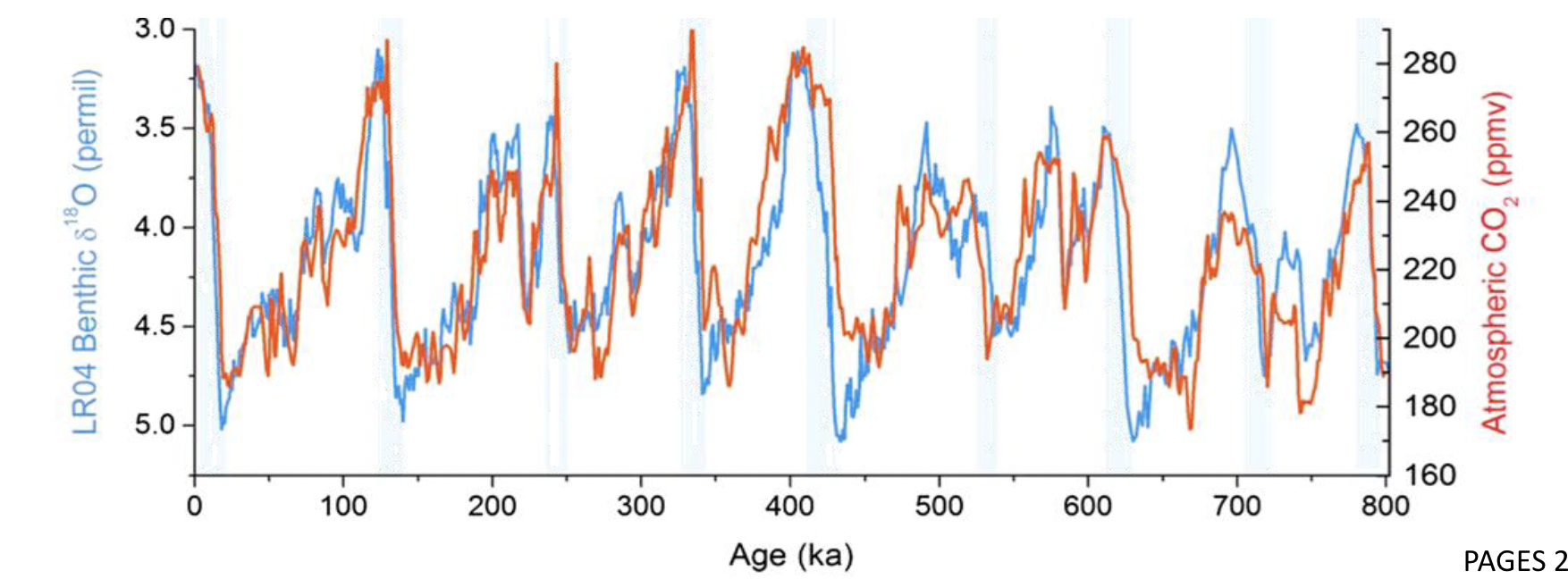
Measuring Ancient Greenhouse Gases
CO2 + CH4 from bubbles in ice cores closely resemble each other and can explain temperature anomalies
Same sawtooth pattern

Relationship between CO2 in atmosphere and size of Earth’s ice sheets
Large Ice Sheets (Glacial/Ice Age): Low atmospheric CO2
Small/Absent Ice Sheets (Interglacial/Warm Era): High atmospheric CO2
Why is there low CO2 during glacial periods? Where did the carbon go?
Ocean? Biosphere?
Where’s the missing carbon? Biomass/Glaciers
When ice sheets are large there’s less vegetation land, which means less biomass. Therefore, the carbon couldn’t all have gone to the biosphere, it must’ve gone to the deep ocean!
How do we know? - Carbon Isotopes!
12C 13C Isotopes, Biosphere/Ocean Effects
Photosynthesis/Plants have an easier time taking up lighter 12C isotopes
Interglacial → more 12C taken on land → high δ13C in deep ocean
Glacial → less 12C taken up on land bc of less biomass → low δ13C
Glacial - high δ18O (lots of light isotopes are evaporated as snow gets locked into glaciers instead of returning to the sea)
Interglacial - low δ18C
Oxygen shows how much ice was on land carbon shows where it was stored
How does carbon get to the deep ocean?
Biological pump
Biological pump
transfers CO2 and nutrients from the surface water to the deep ocean
photosynthesis takes up CO2 in shallow water and the decomposition of that organic matter travels to the deep water
The pump is very strong during glacial intervals because of increased nutrient input
Iron fertilization hypothesis
Because glacial periods have dry/arid land, there’s a higher amount of dust emissions and plumes that add nutrients (iron) into the ocean which makes the ocean more productive
Carbon also gets into the deep ocean by __
Solubility of CO2
Cold periods = more CO2 in ocean, and less CO2 in atmosphere
Methane release during interglacials
More waterlogged soils = more methane released to atmosphere
In monsoon regions (linked to precession)
In circumpolar Arctic, bogs are left when glaciers retreat (orbital cycles)
Precession dictates intensity of monsoons
during interglacials, when NH summer is in perihelion, the northern monsoon is very strong
creates maximum summer insolation and therefore a stronger monsoon
Strong monsoon = lots of rainfall = more waterlogged soils = more methane released into the atmosphere
Precession matters more than obliquity when it comes to the tropics
Because both northern monsoons and Arctic glacial retreats are dictated by Earth's orbital variations, atmospheric methane concentrations are fundamentally linked to orbital cycles and glaciations.
More GHGs in atmosphere during _____, transferred to deep ocean during _____
interglacial, glacial
What synchronizes the northern and southern hemisphere glacial/interglacial cycles? Why the saw-toothed pattern of ice ages
The influence of orbitally-driven GHGs in the atmosphere and ice-albedo feedbacks
It is quicker to get out of a glacial than to get into one
combo of ice-albedo feedbacks and GHGs
North America has more land for glaciers?
Summary

Take homes
