Chapter 3 SPI Physics: Describing Sound Waves
 Call Kai
 Learn
Learn Practice Test
 Spaced Repetition
 Match
Match Flashcards
 Knowt Play
1/33

There's no tags or description
Looks like no tags are added yet.
Name | Mastery | Learn | Test | Matching | Spaced | Call with Kai | Chat |
|---|
No analytics yet
Send a link to your students to track their progress
34 Terms
Acoustic Parameters
describe the wave’s features
Frequency
Period
Amplitude
Power
Intensity
Wavelength
Propagation Speed
acoustic = ___ parameter = ____
sound, characteristic
Period (def, units, values, determined, adjustable)
time required to complete a single cycle or time form start of one cycle to start of the next
UNITS: time - seconds, milliseconds, hours, days
VALUES: 0.06-0.5 microseconds
DETERMINED: by sound source ONLY
ADJUSTABLE?: No, once transducer is selected

Frequency (f) (def, units, values, determined, adjustable)
number of particular events in a specific duration of time (CYCLES PER SECOND IN ULTRASOUND)
how often an event occurs per time
once per day
once per century
3 times per minute
UNITS: per second (known as hertz or Hz)
one cycle/second = 1 Hz
VALUES: 2MHz - 15MHz per second
DETERMINED: by sound source ONLY
ADJUSTABLE?: No, once transducer is selected
increased frequency = less penetration through the body
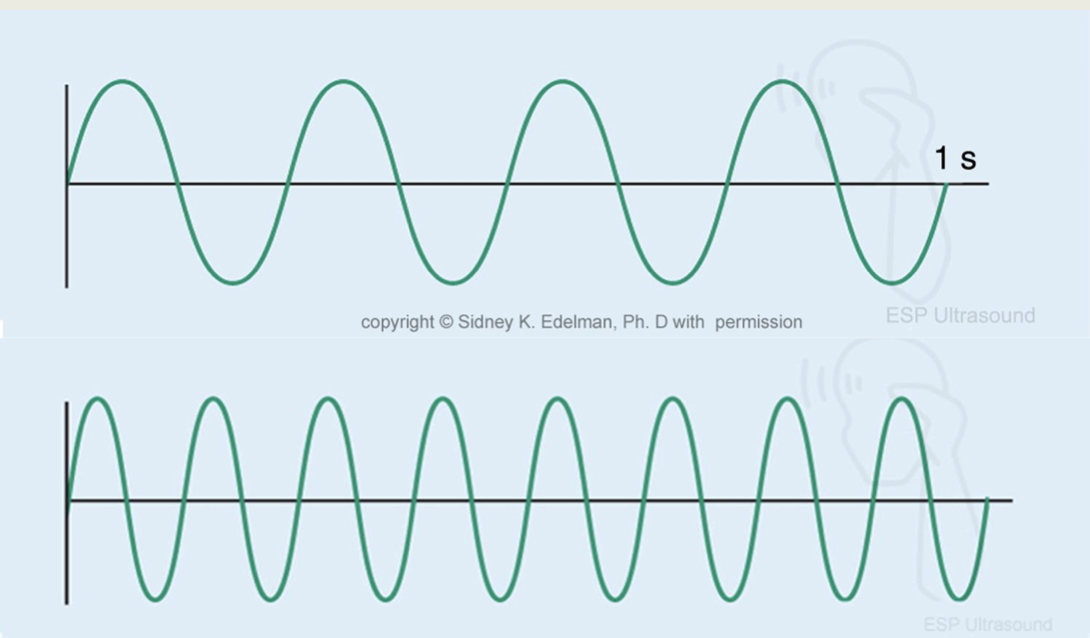
Frequency of a sound wave refers to
how many compressions or rarefaction cycles that occur per time (usually per second)
one compression per cycle = 1 Hz
For each compression, there is a rarefaction.
How do we Determine the Frequency?
determined by the sound source
count the number of compression per second
MORE compressions per second = HIGHER frequency
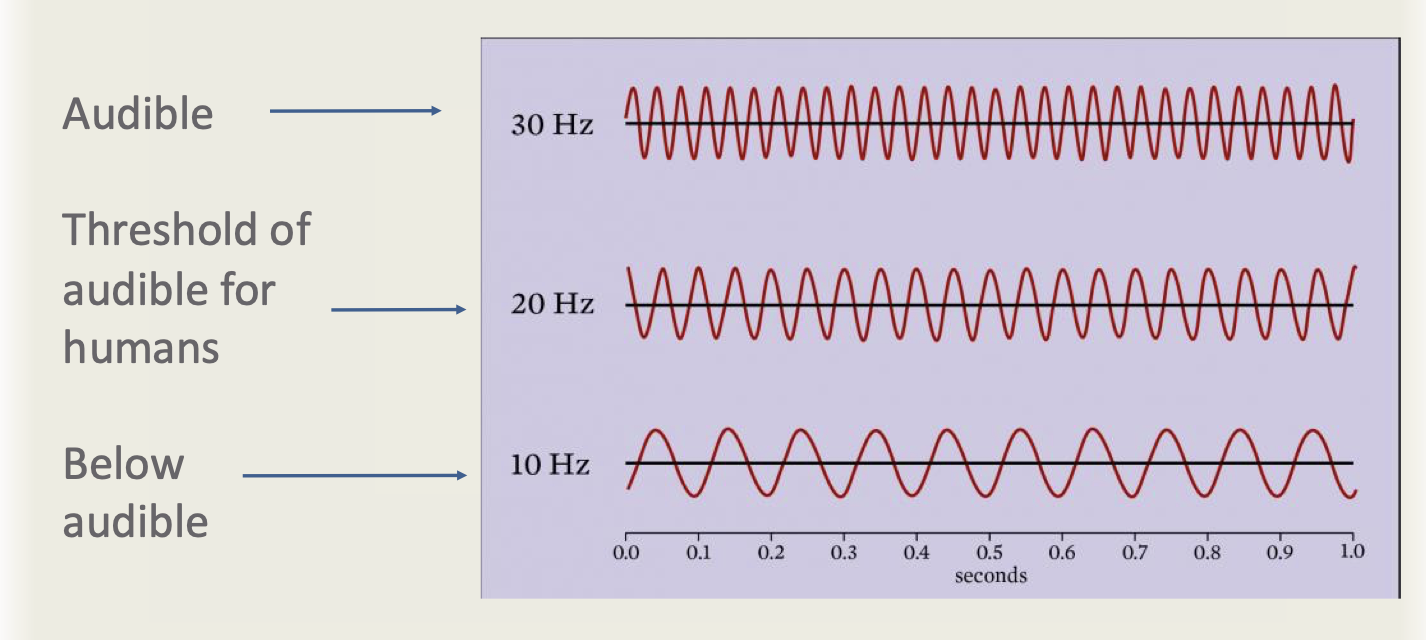
Infrasonic
below threshold of human hearing
less than 20 Hz

Audible
in range of human hearing
between 20 Hz and 20 kHz

Ultrasound
above threshold of human hearing
greater than 20 kHz
Relationship Between Frequency and Period
inversely related
when one goes up, the other goes down
Hertz (per second) is the inverse of time
As frequency increases, period decreases
As frequency decreases, period increases
If one remains constant, the other does not change
Period * frequency = 1 (reciprocals)

“Bigness” Parameters
Amplitude
Power
Intensity
describe a sound beams strength
directly related to each other
as one increases, the others increase
as one decreases, the others decrease
Amplitude (def, units, values, determined, adjustable)
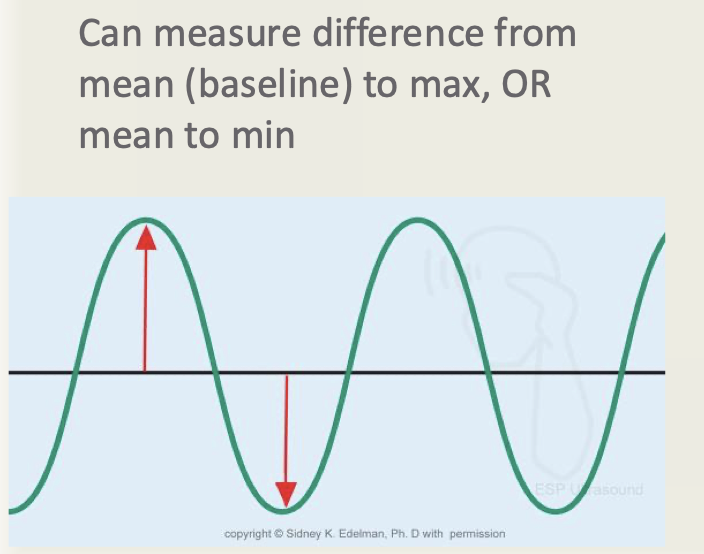
“bigness” of a wave, measured from baseline to max value (or min value)
maximum variation of an acoustic variable
technically defined as strength, volume, or size of a physical quantity
UNITS: any acoustic variable
pressure (pascals)
density (g/cm³)
distance (cm, ft, etc)
temperature (degrees, celsius)
VALUES: 1 million pascals to 3 million pascals (1MPa-3MPa) in clinical imaging
DETERMINED: by sound source initially, then the medium
ADJUSTABLE?: Yes, initial amplitude is adjustable
Info about Amplitude
determined by the sound source as it depends on the voltage applied to the transducer
higher voltage = high amplitude
if you turn the volume up on the radio, you make it louder meaning you increase the amplitude, or make the amplitude higher
amplitude decreases as sound propagates through the body (attenuates)
unit of measure depends on the acoustic variable being measured
adjusted by output power
if you increase the amplitude of an ultrasound echo, the image will get brighter
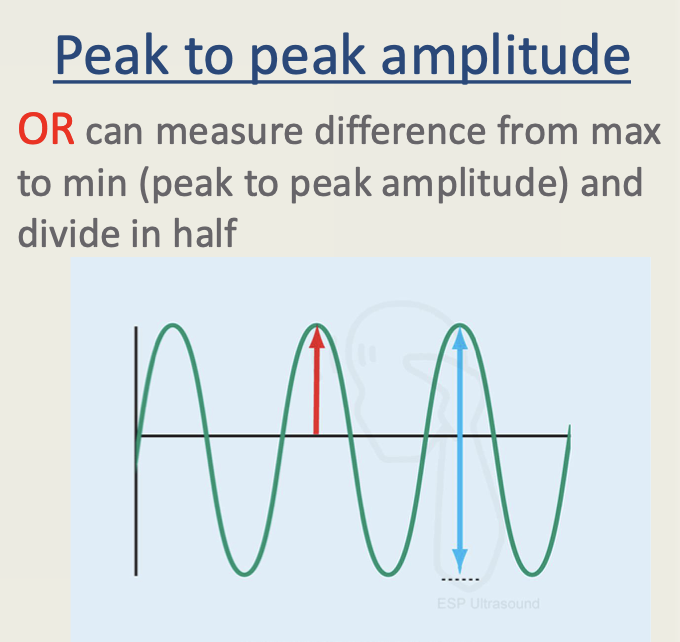
Peak to Peak Amplitude
can measure difference from max to min and divide in half

How to calculate Amplitude
MAX - MEAN
MEAN - MIN
(MAX - MIN)/2
Power (def, units, values, determined, adjustable)
rate of energy transfer, or rate that work is performed. Also describes “bigness”
rate of energy transfer in the cross section of the ultrasound beam
UNITS: Watts (W) or milliwatts (mW) (think lightbulb)
VALUES: 0.004 to 0.090 watts, or 4 to 90 milliwatts
DETERMINED: by sound source initially, then the medium as sound propagates through the body power decreases— the extent is dependent on sound wave AND medium
ADJUSTABLE: Yes, initial power is adjustable
Amplitude and Power Relationship
directly proportional
Power ⍺ amplitude²
power controls the amplitude of the wave
if amplitude is increased by a factor of 3, power has increased by 9
if sonographer cuts the amplitude in half —> (1/2)²=1/4
higher power = stronger ultrasound beam = better penetration BUT at the cost in creased risk of bioeffects
Intensity (def, units, values, determined, adjustable)
concentration of energy in a sound beam, also describe “bigness”
beam power/ beam’s cross-sectional area = intensity
UNITS: watts/cm² (watts from power, cm² from beam area)
VALUES: 0.01 to 300 W/cm²
DETERMINED: by sound source INITIALLY, then the medium as sound propagates through the body intensity changes — this depends on the medium and SHAPE of sound beam
HIGH POWER over a small area = GREAT INTENSITY BUTTT increases the risk of bioeffects
Power, Intensity, & Amplitude Relationships
intensity ⍺ power
power ⍺ amplitude²
SO
intensity ⍺ amplitude²
increasing intensity by decreasing the area (narrowing sound beam) and focusing it on a certain point
Wavelength (λ) (def, units, values, determined, adjustable)
distance or length of one complete cycle
measure from one point on the wave to the NEXT IDENTICAL point
UNITS: meters, millimeters, unit of length
VALUES: specifically in soft tissue: 0.1 to 0.8 mm
DETERMINED: by BOTH the SOURCE and the MEDIUM
ADJUSTABLE: No, once transducer has been selected
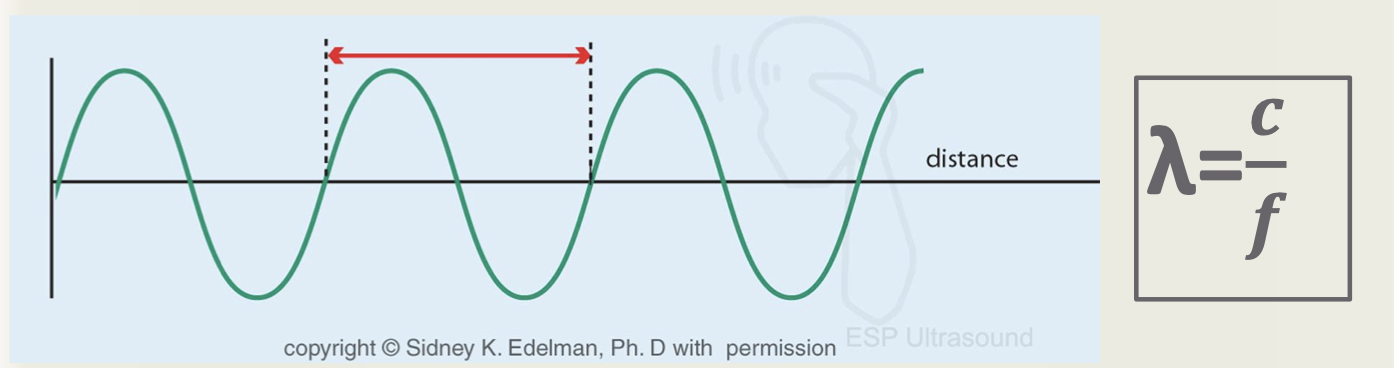
Wavelength and Frequency Relationship
inversely related
frequency increases, wavelength decreases
RULE: 1.54/Frequency = Wavelength
shorter wavelengths produce better image quality (THINK HIGHER FREQUENCY)
Wavelength Equation
Wavelength (λ) = propagation speed (c)/ frequency (𝑓)
OR
Wavelength (λ) × frequency (𝑓 )= propagation speed (c)
Propagation Speed (or propagation velocity) (def, units, values, determined, adjustable)
distance a sound wave travels through a medium in 1 second
answers how long it will take to get from one location to another
UNITS: meters/second, mm/millisecond, or any distance divided by time
VALUES: 500 m/s - 4000 m/s depending on tissue
DETERMINED: by MEDIUM ONLY
speed is determined by the density and stiffness of the medium
Every frequency travels the same speed in a particular medium
ADJUSTABLE?: No, only a change in medium changes the speed
Speed
apply to ultrasound, the average speed in soft tissue is:
1.54 mm/μs
1540 m/s (one mile per second)
WHY IS THIS IMPORTANT?:
By knowing the speed in soft tissue, the ultrasound machine can calculate the go return time and then calculate the distance of each structure, then knowing where to place it on the image.
• Distance= rate (speed) x time (machine knows how long the echo took to
return)
Speed in Mediums
Different mediums have different speeds
Stiffness and Density affect speed
Sound travels fastest in solids
Medium speed in liquids
Slowest in gases
EXAMPLES:
Very stiff + NOT dense = fast speed (bone)
Not stiff + very dense= Slow speed (air)
Speed Formulas
Propagation Speed = stiffness/density
Propagation Speed = frequency x wavelength

Stiffness
ability of an object to resist compression
“squishability”
directly related to speed (and has the greatest impact on speed)
Bulk Modulus Definition
describes the change in materials volume under external stress
same as stiffness
change in pressure divided by the fractional change in volume
basically, how much does the volume of an object shrink down under pressure change

Bulk Modulus Continued
stiffer material = larger bulk modulus
more elastic materials = smaller bulk modulus
c = Bulk modulus/density
Propagation velocity is impacted more by BM stiffness compared to density
Therefore, stiffness plays a greater role
Examples:
Bone is very dense but also very stiff, therefore it has increased
propagation velocity due to stiffness, rather than decreased due to its
density
The marshmallow that is very compressible will have a smaller/lower bulk modulus than the rock that cannot compress easily

Density
mass per volume: density (𝜌) = m/v
larger mass within the same volume increases density
two objects of similar volume can have very different densities
density and speed are inversely related
Rule of Thumbs
bone is NOT compressible and has tight molecular bonds so speed is fastest
bone is stiff but not dense
gas is very compressible and contains freely moving wide spaced molecules, so speed of sound is slowest in gas or air
gas is dense and not stiff

Frequency in terms of speed
Acoustic waves with different frequencies travel at the same speed through the same medium

What is the Speed of Sound in:
Lung
Fat
Soft Tissue (average)
Liver
Blood
Muscle
Tendon
Bone


memorize
