Metabolic Tests LM
 Call Kai
 Learn
 Practice Test
 Spaced Repetition
 Match
 Flashcards
 Knowt Play
1/73

There's no tags or description
Looks like no tags are added yet.
74 Terms
What is the primary diagnostic purpose of the Phenol Red (PR) sugar fermentation broth test?
To determine a microorganisms’ ability to ferment specific carbohydrates (sugars) and produce acid, gas, or both
What four primary ingredients make up a standard Phenol Red (PR) sugar broth?
A specific carbohydrate (e.g., glucose, lactose, or sucrose)
Peptone (protein source)
Phenol Red (pH indicator)
An inverted Durham tube
What visual color change indicates a positive result for acid production in a Phenol Red (PR) sugar test
Yellow (indicating an acidic pH drop from carbohydrate fermentation)
What visual color indicates a negative result for acid production in a Phenol Red (PR) sugar test?
Red (indicating neutral or alkaline pH, meaning no acid was produced)
What is the function of the inverted Durham tube placed inside a PR sugar broth tube
To trap metabolic gas bubbles (CO2 and H2) produced during carbohydrate fermentation.
Why is the Phenol Red (PR) sugar fermentation test considered strictly time-sensitive?
Incubation beyond 24 hours can lead to false-negative results after microbes exhaust the sugar and start fermenting peptone
How does over-incubation (>24 hours) of a PR sugar broth cause a false-negative result?
Microbes consume all available sugar, then ferment peptone to release alkaline ammonia (NH+4), raising the pH and turning yellow broth back to red (false neg.)
What specific enzyme must a bacterium possess to ferment lactose into glucose and galactose?
lactase
Which specific bacterium possess to ferment sucrose into glucose and fructose?
Sucrase
How would you record and interpret PR test results for a tube that turns yellow with a gas bubble inside the Durham tube?

What are the PR Glucose, PR lactose, and Sucrose test results for Escherichia coli?
E. Coli is positive for acid and gas fermentation across all three sugars (PR Glu: +/+, PR Lac: +/+, PR Suc: +/+)
What are the PR sugar fermentation results for Pseudomonas fluorescens?
P. fluorescens is negative for acid and gas fermentation across all three sugars (PR Glu: -/-, PR Lac: -/-, PR Suc: -/-)
How do Phenol Red and Methyl Red pH indicators differ in their color response to acidic pH?
Phenol Red turns yellow under acidic conditions (pH < 6/8), whereas Methyl Red turns red under strongly acidic conditions (pH < 4.2)
How do Phenol Red and Methyl Red pH indicators differ in their color response to neutral or alkaline pH?
Phenol Red turns red at neutral/alkaline pH, whereas Methyl Red turns yellow at neutral/alkaline pH (pH > 6.5)
Why is Methyl Red indicator reagent added only after culture incubation rather than before?
Methyl Red is toxic to bacterial cells and would inhibit bacterial growth if included in the culture medium prior to incubation.
What is the primary function of sodium thioglycollate in Thioglycollate (TG) broth medium?
It acts as a reducing agent that removes free oxygen (O2), creating an oxygen gradient and an anaerobic environment deeper in the tube
What creates the distinct oxic and anoxic zones within a Thioglycollate (TG) broth tube?
Atmospheric O2 diffuses into the top layer (oxic zone), while sodium thioglycollate consumes free O2 in the lower portion (anoxic zone)
Where would an obligate aerobe grow in a Thioglycollate (TG) broth, and why?
At the top of the tube only (oxic zone), because it strictly requires O2 as a terminal electron acceptor for respiration.
What is the surface biofilm formed by an obligate aerobe at the top of a TG broth tube termed?
A pellicle (acting as a biofilm “life raft” to access atmospheric oxygen)
Where would an obligate anaerobe grow in a Thioglycollate (TG) broth tube?
At the bottom of the tube only (anoxic zone), because oxygen is toxic to it.
How does the growth distribution of a facultative anaerobe differ from that of an aerotolerant anaerobe in TG broth?
Facultative anaerobes grow throughout but show heavier growth at the top (due to higher ATP yield from O2 respiration)
Aerotolerant anaerobes grow evenly throughout.
Why do aerotolerant anaerobes show uniform growth throughout TG broth without heavier growth at the top?
Because they rely entirely on fermentation or anaerobic metabolic pathways and cannot utilize oxygen even when present
Where do microaerophiles grow within a Thioglycollate (TG) broth tube?
In a thin layer near the top of the medium, just below the oxic surface where oxygen levels are low.

Identify the aerobicity classification represented by tube (a) and (b) in this TG diagram.
A: obligate aerobe (growth at top oxic layer)
Tube (b): Obligate anaerobe (growth at bottom anoxic layer
What aerobicity classifications are observed for E. coli and P. fluorescens in TG broth?
E coli = Facultative anaerobe (growth all over)
P. fluorescens: Obligate aerobe (growth top only)
What four diagnostic tests comprise the IMViC test series?
Indole, Methyl Red (MR), Voges-Proskauer, Citrate
What is the primary diagnostic objective of running the IMViC test series?
to differentiate fecal coliforms (e.g., E.coli) from non-fecal coliforms (e.g., Enterobacter aerogenes) within the Enterobacteriaceae family.
Which specific enzyme is detected by the Indole test, and what amino acid substrate does it catabolize?
Enzyme: Tryptophanase Substrate: Tryptophan (degraded into indole, pyruvate, and ammonia)
What reagent is used in the Indole dry slide assay, and what color signifies a positive result?
Indole dry slide showing pink positive smear (top left) and yellow negative smear (bottom right)

What metabolic pathway does the Methyl Red (MR) test detect?
Mixed Acid Fermentation (production of multiple stable organic acids from glucose, lowering pH to < 4.2)
What organic acid end-products are typically generated during mixed acid fermentation?

What appearance indicated a positive versus negative Methyl Red (MR) test result?
Yellow = negative, Red = positive

What metabolic pathway is evaluated by the Voges-Proskauer (VP) test?
2,3-Butanediol Fermentation
What key intermediate compound is directly detected in the Voges-Proskauer (VP) test?
2,3 butanediol fermentation
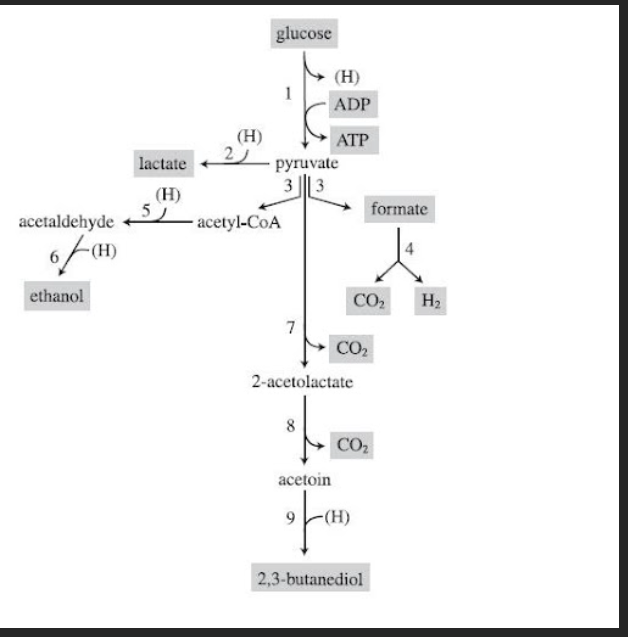
Which two reagents are added post-incubation to perform the Voges-Proskauer (VP) test?
α-naphthol (VP-A)
40% KOH (VP-B)

What visual result signifies a positive Voges-Proskauer (VP) test?
A = Positive
B = Negative
What capability is evaluated by the Citrate utilization test?
An organism’s ability to utilize sodium citrate as its sole carbon source using the enzyme citrase (citrate permease)
What pH indicator is included in Simmon’s citrate medium, and what color change indicates a positive result?
pH indicator: Bromthymol blue
Positive result: Blue color (alkaline pH shift)
Negative result: Green color (unchanged)
What are the classic IMViC test results for Escherichia coli versus Enterobacter aerogenes?
E. Coli: ++-- (Indole +, MR+, VP-, Citrate -)
E. aerogenes: -- ++ (Indole -, MR-, VP+, Citrate +)
Why is Escherichia coli routinely used in microbiology as an indicator of fecal contamination?
E. coli resides naturally in the intestinal tract of warm-blooded animals; its presence in water signals sewage contamination and dangerous waterborne enteric pathogens.
Why is fecal contamination of public water supplies of major public health important?
It can spread severe infectious enteric pathogens (such as Salmonella, Shigella, and pathogenic Vibrio species) leading to widespread disease outbreaks.
What does the acronym TSI stand for in Triple Sugar Iron medium?
Triple Sugar Iron
Which three carbohydrates are contained in a TSI agar slant, and in what relative concentration?
Glucose (0.1% low concentration)
Lactose (1.0% high concentration)
Sucrose (1.0% high concentration)
What pH indicator is incorporated into Triple Sugar Iron (TSI) slants?
Phenol Red
What are the two metabolic mechanisms by which bacteria produce hydrogen sulfide (H2S) in TSI medium?
1. Catabolism of sulfur-containing amino acids (cysteine or methionine)
2. Anaerobic respiration utilizing thiosulfate as an inorganic terminal electron acceptor.
Why is ferrous sulfate (FeSO4) added to TSI slant medium?
To act as an indicator for H2S gas by reacting with produced H2S to form an insoluble black precipitate.
What specific technique must be used to inoculate a TSI agar slant?
The “stab-and-streak” method (stabbing an inoculating needle into the deep butt, then streaking the surface slant as the needle is withdrawn).
How does a TSI slant appear when an organism ferments only glucose (no lactose/sucrose, no gas, no H2S)
Red slant and yellow butt (K/A reaction).
How does a TSI slant appear when an organism ferments glucose and lactose/sucrose with gas production (no H2S)?
Yellow slant and yellow butt (A/A reaction) with cracks, bubbles, or agar displacement caused by gas.
How does a TSI slant appear when an organism ferments glucose and produces H2S?
A black precipitate obscures the lower portion (black butt)
What TSI slant reaction is observed for Citrobacter species?
Black Butt (indicating active H2S production).
What TSI slant reaction is observed for Escherichia coli?
Yellow slant and yellow butt with fragmented agar (gas positive, H2S negative).
What key enzyme does the cytochrome oxidase dry slide assay detect?
Cytochrome C oxidase (a terminal oxidase enzyme in aerobic respiratory electron transport chains)
What visual color change indicates a positive cytochrome oxidase test result?

Which major bacterial genera are typically oxidase-positive versus oxidase-negative?
Oxidase-positive: Pseudomonas and Neisseria
Oxidase-negative: Enterics (e.g., Escherichia coli)
What chemical reaction is catalyzed by the bacterial urease enzyme?
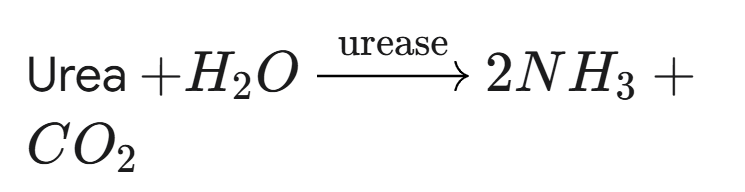
What indicator is used in urease broth, and what color represents a positive test result?
Indicator: Phenol Red Positive
Result: Bright pink color (due to alkaline ammonia release)
Negative result: Yellow/orange color
Which lactose non-fermenting enteric bacterium is clinically distinguished by a positive (pink) urease test?
Proteus mirabilis (distinguishing it from urease-negative Salmonella and Shigella)
What enzymatic chemical equation describes the detoxification of hydrogen peroxide by catalase?
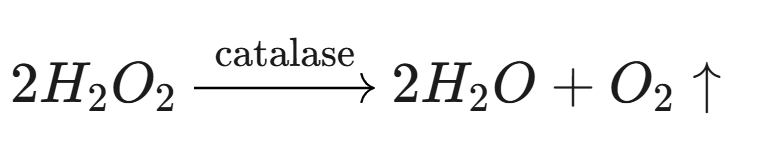
How do you interpret the presence of immediate bubbling when 3% H2O2 is dropped onto a bacterial colony?
Positive catalase test (oxygen gas bubbles generated by catalase degradation of H2O2)
Which Gram-positive cocci genera are clinically differentiated using the catalase test?
Staphylococcus (catalase-positive) is differentiated from Streptococcus and Lactococcus (catalase-negative)
What reagent solution is utilized in the rapid 3% KOH test?
3% Potassium Hydroxide (KOH) aqueous solution
What chemical process occurs when 3% KOH is mixed with Gram-negative bacteria on a glass slide?
KOH lyses the thin peptidoglycan cell wall and outer membrane, releasing viscous genomic DNA that forms a slimy string.
How do you interpret a 3% KOH test result that forms a viscous, snotty DNA string when lifted with a loop?
Positive KOH reaction = gram-negative bacterium
How do you interpret a 3% KOH test result that remains a water fluid suspension without stringing?
Negative KOH reactio = gram-positive bacterium (thick peptidoglycan wall resists KOH lysis)
What procedural error causes a false Gram-negative stain result?
Over-decolorizing with alcohol/acetone, which washes crystal violet out of Gram-positive cells
What procedural or culture error causes a false Gram-positive stain result?
Under-decolorizing during staining, or using thick smears/old cultures where dead cell debris retains crystal violet.
How can performing a 3% KOH test assist in evaluating an ambiguous Gram stain outcome?
It provides a non-staining chemical test of cell wall integrity: stringing confirms a Gram-negative cell wall regardless of staining technique.
What does the term “Gram-variable” mean when describing a bacterial culture?
A pure culture displaying both pink (gram-negative) and purple (gram-positive) cells, often seen in aging cultures as cell walls break down
What is the defining biochemical distinction between aerobic respiration and anaerobic respiration?
Aerobic respiration uses molecular oxygen (O2) as the terminal electron acceptor, whereas anaerobic respiration uses an inorganic compound other than O2 (e.g., NO3-, SO4²-).
How does fermentation fundamentally differ from cellular respiration?
Fermentation does not use an electron transport chain or Krebs cycle; it re-oxidizes NADH to NAD+ by transferring electrons directly to pyruvate or an organic derivative.
Can an obligate aerobe use fermentation to sustain life in the absence of oxygen? why or why not?
No, because obligate aerobes lack the functional metabolic pathways and enzymes required for sustained fermentation and strictly depend on O2 respiration for ATP
What are the major categories of end-products produced by microbial fermentation pathways?
Organic acids (lactic, acetic, formic, succinic)
Neutral alcohols (ethanol, 2,3-butanediol)
Gases (CO2, H2)
General mechanism: How do pH indicators detect microbial acid or base production in culture media?
They are weak acids/bases that undergo reversible structural and color shifts in response to changes in hydrogen ion concentration (H+)